
July 26, 2026
Problem Solving Methods That Actually Work in 2026
Discover problem solving methods that work in real life. From 5 Whys to design thinking, learn when to use each and how to apply them to deadlines and habits.
You’re staring at a problem that keeps coming back. A deadline slips again, a team keeps arguing in circles, or a habit you meant to fix has gradually gone stale. The annoying part is not that the issue exists. It’s that you can’t tell whether you need better facts, a better question, or a better way to test the fix.
That’s where problem solving methods earn their keep. The useful ones do not just name a technique, they help you move from a vague worry to a question you can definitively answer, then from an answer to a change you can verify. If you want a simple way to keep that change visible while you work, how to build accountability is a practical companion to this process, especially when the fix depends on daily follow-through. People changing careers, including readers exploring switching careers from nursing, run into the same challenge, a problem looks emotional until a method makes it measurable.
Table of Contents
- The Moment You Know Something Has to Change
- How to Read a Problem Before You Pick a Method
- Root Cause Methods That Turn Complaints into Evidence
- Iterative Cycles That Keep You Honest
- Creative and Human-Centered Methods
- A Worked Example Catching a Missed Project Deadline
- How to Choose, Combine, and Adapt When Things Break
The Moment You Know Something Has to Change
A student opens a laptop at 11:47 p.m. and sees a third missed assignment deadline in a row. A founder watches a launch slip again because nobody can say what blocked the handoff. A freelancer hears, “Can you just send the revised version tomorrow?” and knows the client has already started doubting the process. In each case, the pain is obvious, but the fix is still foggy.
That fog is the gap between intuition and method. Intuition tells you something feels wrong. A method helps you answer what is wrong, where it starts, who needs to act, and how you’ll know it improved. In quality and operations work, that shift is the difference between reacting to a complaint and using a repeatable process, including the seven core tools for variation and cause analysis, plus structured cycles like PDCA, DMAIC, and 8D that turn correction into a routine you can follow quality management and problem solving guidance.
Why the right method matters more than the clever one
People often reach for the first familiar technique because they want relief, not diagnosis. That makes sense in the moment, but it also sends teams after a side issue instead of the core problem. Process-improvement and engineering practice keep returning to the same discipline, verify the problem with data, make only the minimum assumptions needed, and test the answer before trusting it engineering problem-solving workflow.
The practical version is straightforward. First, put the complaint into words. Then turn it into evidence. Then choose the lightest method that can still carry the load. A school project, a startup launch, and a factory defect do not need the same tool, but they all need the same discipline.
Practical rule: if you can’t restate the problem in plain, measurable terms, you’re still in the complaint stage, not the solution stage.
That same rule helps when the problem is personal. If a job change is on your mind, or you are comparing paths the way someone might while reading about switching careers from nursing, the first task is still to sort signal from noise. Once the problem is clear enough to describe, accountability becomes easier to build, and clear accountability practices can turn vague intention into a work pattern people can follow.
How to Read a Problem Before You Pick a Method
A team sees a drop in output, a manager sees missed handoffs, or a founder hears that customers are churning. The pressure is to do something fast, so people reach for a familiar method before they know whether they are holding the right problem. Research calls that plunging-in bias, and it helps explain why smart people can solve the wrong problem with impressive effort problem reframing and plunging-in bias. The better move is a short read on the situation before choosing a tool.
First, sort out what kind of problem you are facing. Is the framing unclear, the cause unclear, the fix unclear, or the adoption problem sitting with the people who have to carry it out? That order matters because a method that works well for one of those jobs can fail badly at another. A simple analogy helps: you would not use a thermometer to repair a broken pipe. The same logic applies here.
Four questions that change the choice
Use these questions before you begin:
- How clear is the problem? If the issue is fuzzy, start by reframing it. If the issue is already specific, a root cause method usually fits better.
- How much data do you have? Reliable counts, timestamps, and process records support methods that test patterns. If you only have stories, start by turning them into facts.
- Who owns the fix? A personal habit, a team workflow, and a cross-functional failure each need a different level of coordination.
- How much time do you have? Urgent problems call for lighter, faster methods. Problems that will keep returning can justify deeper analysis and a pilot.
The point is to match the method to the job, not to rank methods as if one is always better than another. Some tools help you frame the question. Others help you diagnose a cause. Others help you test a change before you trust it. The strongest approach is often a sequence. Reframe a vague complaint, narrow it with a root cause method, then test the fix in a small cycle.
When the framing is the bottleneck
If the problem statement is still muddy, asking “Which method should I use?” is too early. Ask what is blocking you right now. If the wording is vague, start with reframing. If the cause is unclear, use diagnosis. If the fix is obvious but people are not following through, use a method that accounts for behavior and process, not just logic.
That same sequence shows up in customer-facing work. A team trying to reduce churn has to separate a complaint from a measurable failure mode before it can make a useful choice. A customer retention playbook can help with that kind of read, especially when the issue is less about one bad event and more about a pattern in how customers experience the product.
Root Cause Methods That Turn Complaints into Evidence
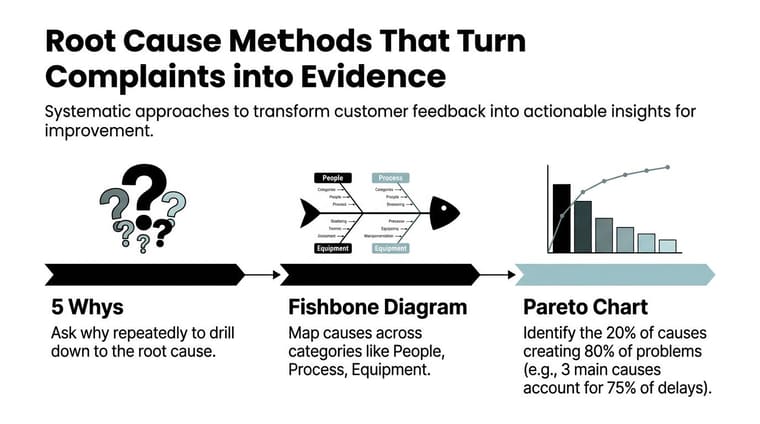
A complaint is usually the visible edge of a larger pattern. The useful work starts when you ask what sits underneath it, and which method can reveal that pattern without guesswork. 5 Whys, fishbone diagrams, and Pareto charts all do that job, but each one fits a different kind of problem.
5 Whys, fishbone, and Pareto on the same problem
Take a simple example. You keep skipping morning workouts. With 5 Whys, you ask why you missed today, then ask why that reason happened, and keep going until the answers stop sounding like excuses and start pointing to structure. The method fits best when the chain is fairly linear and the team needs a quick path from symptom to cause.
A fishbone diagram, also called a cause-and-effect diagram, helps when one complaint may have several branches. For workouts, the branches might be People, Process, Equipment, Environment, Materials, and Management. Its value is simple, it keeps you from blaming willpower for a problem that may really be sleep, planning, or setup.
A Pareto chart helps when a few causes seem to create most of the trouble. In practice, it pushes you to turn a vague complaint into something countable by asking which units are affected, how the defect shows up, where it appears, and when it occurs. That makes the problem concrete enough to rank. In the workout example, that might mean seeing that one cause, not enough time in the morning, keeps showing up more often than the others.
Use Pareto when the list is long and the pressure is high. It helps you focus on the causes that deserve attention first, instead of polishing every possible explanation.
The differences matter because each tool answers a different question. 5 Whys asks what chain led here. Fishbone asks what branches could be involved. Pareto asks which causes deserve attention first. If you pick the wrong one, you do not get a wrong answer so much as a blurry one.
A simple template you can reuse
Start with the complaint in plain facts. What happened, how often, where, and when. That keeps the discussion from drifting into impressions before the team has even agreed on the shape of the problem.
Then ask why repeatedly. Stop when the answer points to a process, a constraint, or a decision, not just a mood. If the cause chain forks, map the branches with a fishbone so people can see the alternatives instead of arguing in circles. If several causes are in play, use a Pareto view to sort the ones that matter most from the ones that are only loud.
A short test comes next. Root cause analysis is a hypothesis, not a verdict, so the fix should be checked in the actual setting before anyone calls it solved. A brief monthly progress report can help keep that check visible while the team watches what changes after the fix, and the same habit supports designing tests to detect changes before anyone treats the result as settled.
Iterative Cycles That Keep You Honest
Some methods do not tell you what caused the problem, they tell you how to keep learning without fooling yourself. PDCA, DMAIC, and 8D all share the same shape, try, measure, adjust, repeat. The difference is mostly weight and context.
Three cycles, three levels of gravity
PDCA is the lightest. Plan the change, do it on a small scale, check what happened, act on the result. That makes it a good fit for personal habits, small experiments, and low-risk workflow changes. If you want to see your daily writing streak or deadline progress at a glance, a visible countdown or progress widget from Pretty Progress can serve as the reminder layer while the cycle handles the learning.
DMAIC is heavier and more disciplined. The five stages, Define, Measure, Analyze, Improve, Control, fit work where you need proof that the change works and keeps working problem-solving and DMAIC structure. It is the better choice when data quality matters and when a fix has consequences beyond one person’s calendar.
8D is the team-response framework. It’s what you reach for when something has already gone wrong and you need a documented, cross-functional response. The method matters because it makes ownership explicit, which is often the missing piece in messy incidents.
| Cycle | Best use | What makes it fit |
|---|---|---|
| PDCA | Small tests, habits, quick improvements | Light, flexible, easy to repeat |
| DMAIC | Operational problems with measurable outcomes | Data-heavy and control-oriented |
| 8D | Team incidents and documented corrective action | Structured response with clear ownership |
A helpful way to see the difference is through a daily writing habit. If you’re trying to write every morning, PDCA might mean planning a 20-minute block, doing it for a week, checking which mornings failed, and adjusting the start time. If the issue is a team process with real business impact, you’d move toward DMAIC instead. If a delivery failure already hit a client, 8D is the more responsible shape.
For people who like keeping progress visible, the monthly progress report is a natural companion to this way of working because it keeps the review step concrete. And if you’re designing experiments, the idea behind designing tests to detect changes matters here too, because you need a test that can show whether the change moved anything.
The rule that keeps cycles real
If you can’t measure the result, you’re not in a cycle yet. You’re in a guess.
That’s the line between effort and learning. A cycle without measurement becomes a story you tell yourself. A cycle with measurement becomes a way to improve without drifting.
Creative and Human-Centered Methods
Not every problem is hiding a clean cause. Some problems are fuzzy because the people involved experience them differently. Others involve requirements that seem to fight each other. In those cases, a rigid cycle can be too narrow.
When empathy beats a tidy answer
Design thinking starts with empathy. It asks you to understand the user, the customer, or the teammate who lives with the problem before you try to fix it. That makes it especially useful when the issue is human, unclear, or emotionally loaded. The method’s value is not in being “creative” for its own sake, it’s in re-framing the problem from the inside of the process to the outside experience design thinking and user-centered problem solving.
TRIZ is different. It came out of engineering thinking and is useful when two things seem to contradict each other, for example, a process needs to be faster and more accurate at the same time. Instead of accepting that tradeoff too quickly, TRIZ pushes you to search for a better design.
Heuristics are the opposite of elaborate frameworks. They’re simple rules of thumb that experts use when speed matters more than perfect analysis. If your focus block keeps getting hijacked, a heuristic like “do the hardest thing first” can outperform a beautiful planning system because it is easier to follow under pressure.
A quick comparison that keeps each in its lane
- Design thinking helps when the underlying issue is that you don’t yet understand the person on the other end.
- TRIZ helps when the problem seems blocked by a contradiction.
- Heuristics help when you need action now and can’t afford a long setup.
A method can be elegant and still be wrong for the moment you’re in.
That’s why creative methods are not a luxury layer. They’re the right tool when the problem is social, ambiguous, or constrained by behavior. Brainstorming can sit next to them as a way to widen options, but the point is still the same, broaden first, then narrow.
A Worked Example Catching a Missed Project Deadline
A freelance designer keeps missing final-delivery deadlines on client work. Not every project fails, but enough do that the pattern is starting to hurt trust. The obvious story is “bad time management.” That story is too simple, so it’s the wrong place to stop.
First, find the real cause
A short 5 Whys session changes the picture. Why was the final delivery late? Because revisions took longer than planned. Why did revisions take longer? Because the client kept changing direction. Why did that happen? Because the kickoff brief didn’t lock scope tightly enough. Why didn’t it? Because the designer rushed the intake call and didn’t ask enough clarifying questions. The cause is not laziness. It’s an unclear start.
That’s where a second method helps. A PDCA loop can now turn the insight into behavior. The designer plans a stricter kickoff script, does it on the next project, checks whether revision churn drops, and acts on the result by keeping or adjusting the script.
A visible deadline tracker helps because the fix has to stay in sight. A countdown widget or progress bar, like the one available in Pretty Progress, can make the delivery date and the current phase hard to ignore. That matters because many fixes fail not from bad intent, but from invisible drift.
What the weekly review looks like
- Plan: use a kickoff checklist before any new client work starts.
- Do: run the checklist on one project, not every project at once.
- Check: ask one question on Friday, did scope changes shrink or stay the same?
- Act: keep the checklist if it worked, revise it if it didn’t.
If the fix still doesn’t hold, the response is not to panic and start over. Add one more review trigger, then inspect whether the problem is now scope, communication, or workload. That is how methods support each other instead of competing.
For people managing delivery milestones in a more formal way, the project deadline tracker is useful because it keeps the deadline visible while the process change settles in. The point is not decoration. The point is to keep the problem in view long enough to know whether your new method is working.
How to Choose, Combine, and Adapt When Things Break
The best method is the one that matches the problem you have. If the problem is fuzzy, start with reframing. If the cause is unclear, use root cause tools. If the fix needs proof, use a cycle. If the issue is human or contradictory, use design thinking or a heuristic. Most real work needs more than one.
| Problem Type | Best Method to Start With | Why |
|---|---|---|
| Fuzzy or poorly framed | Design thinking | It helps clarify the real issue before narrowing |
| Recurring operational issue | 5 Whys or fishbone | It exposes the likely cause path |
| Many possible causes | Pareto chart | It helps focus on the vital few |
| Need to test a fix | PDCA | It supports small, measurable experiments |
| Incident with ownership gaps | 8D | It creates a documented team response |
| Contradictory requirements | TRIZ | It looks for a better design, not a forced tradeoff |
The hard part is not picking a method once. It’s adapting when reality pushes back. Set KPIs before you act, pilot before rollout, schedule a post-mortem, and watch for the moment you stop testing the answer and start defending it. That is usually the sign that the method has become a story instead of a tool.
The biggest shift is simple. Stop asking which method sounds smartest. Ask which step you’re stuck on, what kind of evidence you have, and how much risk you can tolerate before you change course.
If you want a cleaner way to keep deadlines, habits, and project milestones in sight while you work through problems, visit Pretty Progress. It gives you customizable countdown and progress widgets that make the next checkpoint visible, which is exactly what a good problem-solving loop needs when the fix depends on follow-through.