
September 29, 2026
Travel Planning Timeline: When to Book Everything
Build a travel planning timeline that works for your trip. Week-by-week checklists for bookings, documents, health, and packing, plus what
“Book everything six months ahead” is tidy advice, and it’s often wrong. A good travel planning timeline doesn’t treat flights, visas, hotel rooms, and restaurant reservations as if they follow the same clock. Some decisions need to happen early because they’re hard to change. Others are better left open until prices, weather, and your plans become clearer.
Travelers now split between two habits. Some search and plan far ahead, while others wait until the final weeks to book. Your trip type, route, season, group size, and flexibility should decide your schedule, not a slogan repeated in every generic checklist.
Table of Contents
- Why One Perfect Booking Window Does Not Exist
- How Far Out Travelers Actually Plan and Book
- Six Months to Three Months Before You Fly
- Three Months to One Month Out and Booking Flights
- Your Final Month and Week Checklist
- Adjusting the Timeline for Different Trips
- Tracking Your Milestones With Pretty Progress Widgets
Why One Perfect Booking Window Does Not Exist
The biggest mistake in travel planning is assuming there’s one magic date when every purchase becomes cheaper or safer. Airfare doesn’t behave like accommodation, accommodation doesn’t behave like visas, and a sold-out concert or cruise excursion follows its own rules.
Recent booking behavior makes the old “book early” rule even less reliable. Expedia Group reported a nearly 50% quarter-over-quarter increase in searches made 91 to 180 days before travel in Q2 2025, followed by a 20% quarter-over-quarter increase in searches within 0 to 13 days of departure in Q3 2025. The same source reported a 25% year-over-year increase in the 7 to 13-day search window in Q2 2026. These figures point in opposite directions, which is precisely the point: travelers are both dreaming earlier and converting later. Expedia Group’s travel trends insights show why a single booking rule can’t describe the market.
Hopper also found that domestic travelers began planning in 2023 nearly 1.5 weeks closer to departure, about a 30% reduction compared with pre-pandemic behavior. First searches shifted to about 5 weeks before departure, compared with nearly 7 weeks before the pandemic, while Europe trips were being planned a full two weeks closer to departure than in 2019. Hopper’s 2023 travel trends report supports a practical conclusion: planning horizons have compressed, but not uniformly.
Separate fixed tasks from flexible purchases
Start early with tasks that can block the trip:
- Documents: Passport validity, visas, entry permits, and health requirements may involve processing time.
- Dates: Work leave, school schedules, weddings, festivals, and group availability can’t always move.
- Scarce inventory: Popular cruises, limited-capacity tours, and special events may sell out.
- Money-sensitive bookings: Flights deserve active price tracking rather than an automatic early purchase.
Leave room for decisions that benefit from flexibility. You don’t need to reserve every dinner, transfer, and day trip before you know how tired you’ll be after arrival.
Practical rule: Lock what can stop the trip. Track what can change the price. Leave open what makes the trip enjoyable.
Cruises illustrate the distinction well. Cabin choice, sailing date, and excursion availability can matter more than a generic flight-booking rule, so use a focused guide to strategies for cheaper cruise fares when a cruise is the anchor of your itinerary.
How Far Out Travelers Actually Plan and Book
Many travelers think they’re late because they compare themselves with someone who has already built a detailed itinerary. That comparison is useless unless the trip type is the same. A two-week international journey with visa requirements demands a different runway from a nearby weekend with flexible dates.
APH reported that the average traveler spent 71 days from first considering a trip to booking it. That period included 33 days of inspiration and 38 days of research and planning, followed by 73 additional days between booking and travel. TripAdvisor found that 59% of global travelers begin researching one to three months before travel, and nearly half make their final booking decisions within a week. These benchmarks appear in APH’s travel booking statistics overview.
| Planning Phase | Average Duration |
|---|---|
| Inspiration | 33 days |
| Research and planning | 38 days |
| From first consideration to booking | 71 days |
| From booking to travel | 73 days |
The table describes an average journey, not a rule you’ve failed by missing. Inspiration can last longer when you’re comparing several destinations. Research can shrink when you’re returning to a familiar place. A group trip often stretches because every person has to agree, while a solo traveler can decide quickly.
Use behavior as a planning signal
The useful question isn’t “Am I booking at the perfect moment?” Ask instead:
- How fixed are my dates? Fixed dates reduce your ability to wait for a better fare.
- How costly is failure? A missed visa deadline is more serious than paying slightly more for a flexible hotel.
- How much inventory exists? A large city may offer alternatives, while a remote lodge or small ship may not.
- How much flexibility do I have? Flexible airports, weekdays, and neighborhoods create more room to compare.
The airfare question deserves separate treatment because the answer changes by route and trip category. For a practical discussion of when to book airline tickets, compare the advice with your own flexibility instead of treating any window as guaranteed.
Your planning horizon should be long enough to protect the essentials and short enough to avoid unnecessary commitment. That balance is the foundation of the timeline below.
Six Months to Three Months Before You Fly
At this stage, don’t build a minute-by-minute itinerary. Make the decisions that become painful or expensive to change later.
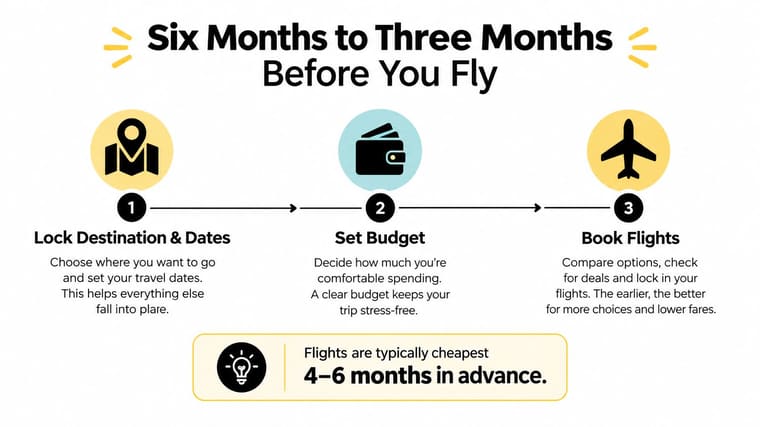
Choose the destination, dates, and rough trip shape first. Decide whether you’re flying into one city and leaving from another, whether you’ll move between regions, and whether the trip needs a rest day after arrival. Then write a budget that includes transport, lodging, food, activities, insurance, and a buffer for surprises. A budget isn’t a restriction. It tells you whether your preferred dates and destination can coexist.
Check the tasks that can block departure
Passport, visa, and vaccination checks belong near the beginning, not in the final week. Verify the entry rules for your nationality and itinerary, inspect your passport’s expiry date, and check whether a vaccination or medical appointment needs lead time. If a visa requires an appointment, supporting documents, or a passport submission, start before you feel urgency.
Do this even if the destination seems straightforward. Travelers often focus on finding flights and only later discover that a transit country has a separate requirement or that an appointment calendar is full.
- Destination and dates: Write down your preferred option and one backup.
- Budget: Set a ceiling before you browse premium rooms and add-on experiences.
- Documents: Check passport validity and entry requirements for every country and transit point.
- Health preparation: Review vaccination and medication requirements with an appropriate official or medical source.
- Research file: Keep confirmations, notes, and decisions in one folder so details don’t scatter across inboxes.
If your departure is roughly four months away, a date calculator for 120 days from today can help translate the broad timeline into a specific planning checkpoint.
Your three-month checkpoint
By the time you reach three months before departure, you should know where you’re going, when you’re going, what you can spend, and whether you can legally and practically enter. You don’t need every hotel or activity selected. You do need to know which decisions are genuinely time-sensitive.
Flights may belong in this phase, but don’t assume that early automatically means cheap. Track the route, compare nearby airports when practical, and check the fare’s change and cancellation terms before you chase a small price difference.
Three Months to One Month Out and Booking Flights
This is the spending phase, so separate urgency from habit. Book the pieces that could sell out or disrupt the rest of the trip, then keep the rest flexible.
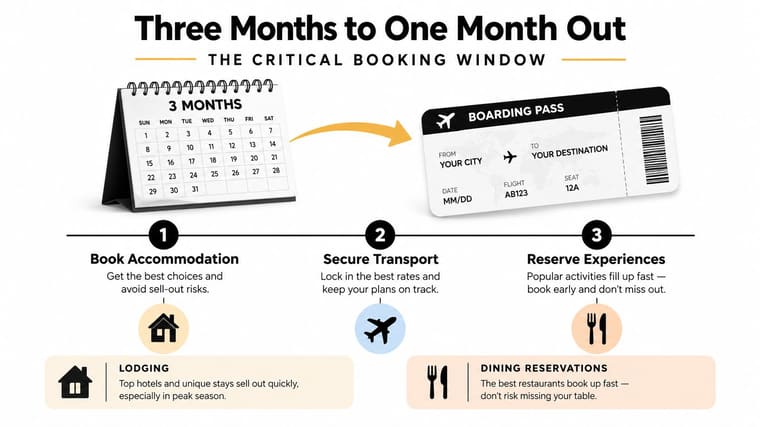
For most international itineraries, reserve the flight, the first night’s lodging, and experiences with limited capacity. The first night matters because arrival fatigue makes improvisation unpleasant, especially after a long flight or a late landing. You can leave later accommodation open if your route allows it, but don’t gamble with a remote destination, peak-season room, or property that anchors a complicated transfer.
Fare data doesn’t support one universal airline rule. The methodology in this step-by-step trip-planning guide indicates that domestic economy fares often bottom out around 15 to 30 days before departure, while international fares are often cheapest in a 31 to 45-day window. Its analysis also cites about $190 in average savings compared with booking six months early for one international comparison. That result is route-specific, so use it as evidence against automatic early booking, not as a promise for your itinerary.
Match the booking decision to your risk
Booking too early can tie up money and reduce flexibility. Booking too late can leave you with poor schedules, expensive fares, or no practical room near the airport or train station. The right choice depends on how much damage a bad outcome would cause.
- Fixed dates: Buy earlier when missing the trip would create a serious problem.
- Flexible dates: Track several departures and compare the whole itinerary, not just the headline fare.
- Peak demand: Secure scarce rooms and experiences before they disappear.
- Simple route: Avoid paying a premium months early merely because a checklist tells you to.
- Uncertain plans: Choose refundable or changeable options where the price difference is reasonable.
Domestic and international fare patterns can even contradict each other. One Expedia Air Hacks report said domestic flights were cheapest 170 to 180 days out, while international flights were cheapest 13 to 21 days before travel. That contrast is a reminder to investigate your route rather than copy a rule from another market.
Book the non-flexible parts when availability matters. For flights, compare route-specific fare data, date flexibility, and change conditions before committing.
Reserve only the experiences you’d genuinely regret missing. A famous restaurant, a small-group expedition, or a timed museum entry may deserve a place on the calendar. The ordinary lunch and the open afternoon don’t.
Your Final Month and Week Checklist
The last month isn’t for major discovery. It’s for removing small sources of failure before they become airport problems.
One month out
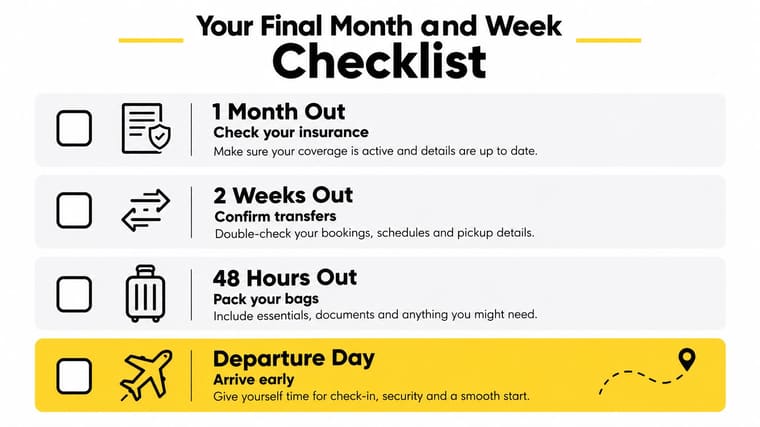
- Documents: Save passport, visa, insurance, ticket, and booking details in a secure digital folder.
- Backups: Keep copies available offline. Don’t depend on a confirmation email loading without Wi-Fi.
- Maps: Download offline maps for arrival points, accommodation areas, and any self-drive route.
- Medication: Refill prescriptions and keep essential medication in your hand luggage.
- Reservations: Check names, dates, cancellation terms, and arrival instructions.
- Transfers: Decide how you’ll reach the first accommodation, especially after a late arrival.
Two weeks out
- Weather: Check the forecast and adjust clothing without rebuilding your entire bag.
- Packing list: Separate essentials from “maybe” items. If you can’t explain when you’ll use something, leave it home.
- Money: Arrange payment methods and notify relevant financial institutions if needed.
- Home: Plan pet care, plant care, mail, rubbish, and any bills due while you’re away.
- Technology: Download tickets, translation tools, transport apps, and entertainment before departure.
Don’t wait until packing day to discover that your bag is too full or that a required document is buried in an old email thread. Put the essentials together early, then refine.
Here’s the final sprint:
- 48 hours out: Pack the main bag, charge devices, check departure status, and confirm the transfer.
- The night before: Put passports, medication, wallet, keys, and chargers in one accessible place.
- Departure day: Recheck the route, allow time for queues, and keep critical documents with you rather than in checked luggage.
The purpose of this stage is calm, not perfection. A short list you complete beats a beautiful itinerary you can’t find.
Adjusting the Timeline for Different Trips
A road trip, a long-haul journey, a city break, and a group holiday don’t need the same runway. Keep the sequence of decisions, but stretch or compress the time assigned to each one.
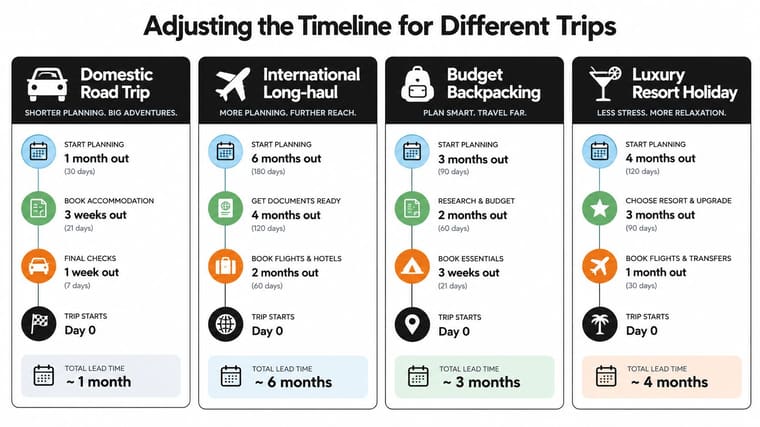
| Trip type | Move earlier | Keep flexible |
|---|---|---|
| Domestic road trip | Vehicle, major lodging stops, route constraints | Daily stops, restaurants, scenic detours |
| International long-haul | Passport, visa, health checks, flights, first night | Some local transport and unmissable activities |
| Short-notice city break | Documents, transport, central lodging | Most sightseeing and meals |
| Group trip | Dates, deposits, room configuration, shared priorities | Optional activities and personal time |
Domestic road trips
A road trip usually compresses the early phase. Choose the route, inspect driving constraints, reserve any limited lodging, and check the vehicle before departure. Don’t overbuild the schedule. A loose route with realistic stops gives you room for weather, fatigue, and the roadside place you didn’t know existed.
International long-haul trips
Long-haul travel deserves the fullest version of the timeline. Confirm entry rules before buying non-refundable arrangements, then secure the flight and first night once the route is sound. Check connections carefully. A cheaper ticket with an exhausting or risky transfer can damage the entire first day.
Traveling with a pet adds another administrative track. Start the vet prep for overseas pet trips early because health certificates, carrier requirements, and airline rules may not fit into a rushed schedule.
Short-notice breaks
You can compress the schedule, but don’t delete the safety checks. Confirm your documents, entry permissions, medication, transport, and first-night address first. Then book the simplest workable route and avoid building a tightly connected itinerary around a late purchase.
Group travel
Group trips run on the slowest decision-maker. Set dates, budget expectations, room preferences, and payment deadlines before anyone books separate arrangements. A shared document should show what’s fixed, what’s optional, and who owns each task.
For a large event or celebration, the same backward-planning logic applies. A wedding planning timeline offers a useful comparison because it also separates immovable milestones from tasks that can move.
The critical compression rule is simple: shorten inspiration and browsing first. Don’t shorten document checks, health preparation, or the time needed to reach an airport after a complicated connection.
Tracking Your Milestones With Pretty Progress Widgets
A travel planning timeline only helps if you see it before the deadline arrives. A note in a crowded app is easy to ignore, especially when the trip is months away and the urgent tasks are still invisible.
Use separate milestones instead of one vague countdown. Create one for the visa deadline, one for the fare-review date, one for the packing weekend, and one for departure day. Each should answer a clear question: what needs attention before this date?
Build a visible system
Start with the event date, then work backward:
- Set the endpoint: Enter the departure date and time.
- Mark fixed milestones: Add visa submissions, booking deadlines, check-in openings, and transfer confirmations.
- Assign review points: Decide when you’ll compare fares, inspect the weather, and check reservations.
- Label the action: Use plain names such as “Check passport,” “Review flight fare,” or “Download maps.”
- Choose the display: Use a countdown for a deadline or a progress bar for a long preparation period.
- Place it where you look: Add the widget to a Home Screen or Lock Screen, and use an Apple Watch or Mac view when that fits your routine.
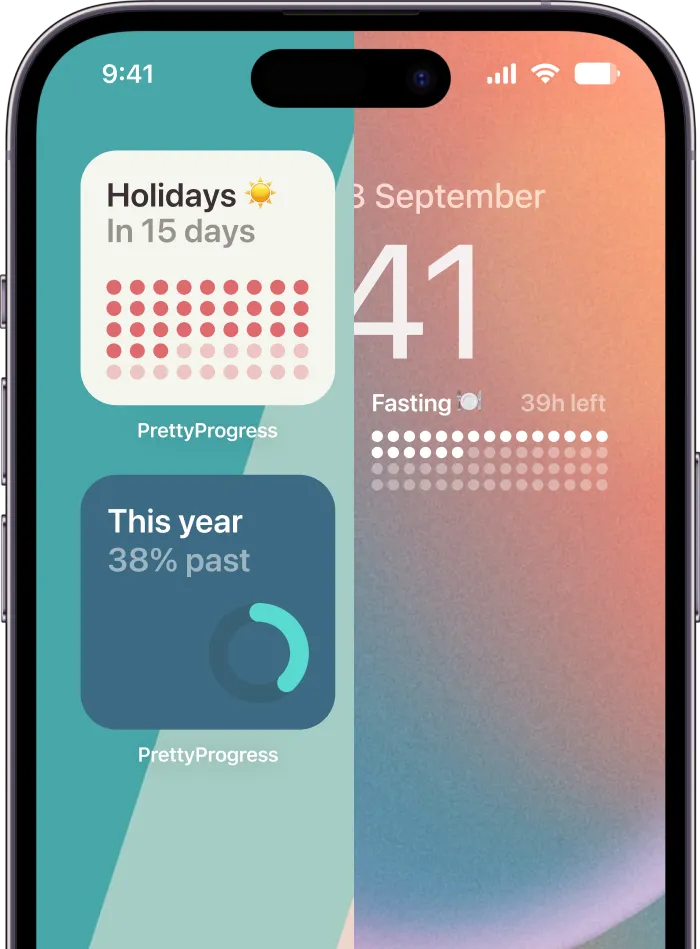
Pretty Progress supports countdown and progress-bar widgets across iPhone, iPad, Apple Watch, Mac, and Android. You can set start and end dates, choose a theme, and adjust visual details such as colors, gradients, bar shape, layout, and icons. That makes it suitable for a single departure countdown or several separate travel checkpoints.
For busy planners, including people with ADHD, the advantage is visibility. A glanceable reminder can prompt a small action before the task becomes a crisis. It won’t choose your destination or interpret entry rules, but it can keep “check visa” from disappearing under ordinary daily noise.
For a practical setup focused on glanceable reminders, use this guide to add a home screen timer. Keep the labels short, review them regularly, and remove milestones once they’re complete so the screen reflects the trip you’re preparing.
The best travel planning timeline isn’t the one with the most entries. It’s the one that protects the important decisions, preserves flexibility where it helps, and stays visible long enough for you to act.
Pretty Progress lets you turn your travel dates into customizable countdown and progress widgets for your Home and Lock Screens, so visa deadlines, booking reviews, packing days, and departure stay visible. Set up your key milestones now, then visit Pretty Progress to build a travel timeline you’ll follow.