
May 30, 2026
Create Your Project Deadline Tracker with Pretty Progress
Learn how to create a visual project deadline tracker on your phone with Pretty Progress. This step-by-step guide covers setup, widgets, and advanced tips.
You probably already have the project in your head right now.
A final exam date. A client handoff. A launch you keep meaning to “properly plan” once you have time. The hard part usually isn’t knowing the deadline exists. It’s carrying that deadline around mentally, along with all the smaller steps, and trying not to lose track of what matters today.
That’s why a good project deadline tracker feels less like admin and more like relief. When the timeline is visible, you stop rehearsing it in your head. You can glance at your screen, see where you stand, and get back to the work.
Table of Contents
- Why a Visual Project Deadline Tracker Works
- Setting Up Your First Deadline in Pretty Progress
- Customizing Widgets for At-a-Glance Progress
- Advanced Tracking Workflows and Integrations
- Unlocking Deeper Customization with PRO Features
- Common Questions and Quick Fixes
Why a Visual Project Deadline Tracker Works
Most missed deadlines don’t start with laziness. They start with invisibility.
A project lives in scattered places: one date in your calendar, a few tasks in Notes, a message from a client, a half-finished checklist, and the rest floating in your head. Students feel this before exams. Freelancers feel it with overlapping deliverables. People with ADHD often feel it most intensely, because friction-heavy tools can make planning itself feel like another task to avoid.

Visual tracking reduces mental load
A visual project deadline tracker does something a spreadsheet rarely does. It turns time into something you can see.
Instead of reading rows of dates, you get a quick sense of distance, urgency, and momentum. That matters when your real problem isn’t project governance. It’s remembering what needs attention without reopening five apps.
Productivity advice often leans toward team software, but many people don’t need resource planning or complex collaboration layers. They need visibility and follow-through, especially students and freelancers who are mostly managing themselves, not a department. That gap is described well in Rocketlane’s discussion of project trackers for visibility and behavioral follow-through.
Practical rule: If opening your tracker feels like starting work, you won’t check it often enough.
Why simple beats elaborate for personal deadlines
Independent project-management sources report that only about 35% of projects finish on time and within budget, which implies roughly 65% miss at least one core target because of issues like scope creep and poor planning, according to Taskfino’s project management statistics overview. For solo users, the lesson isn’t “buy enterprise software.” It’s “make deadline status impossible to ignore.”
I’ve seen people stick with a system longer when it’s glanceable. A countdown on the Home Screen gets checked. A polished dashboard buried behind logins usually doesn’t.
If you’re interested in the broader connection between visual consistency and behavior design, RapidNative habit tracker development is a useful read. The same principle applies here. The easier a tracker is to notice, the easier it is to act before the deadline turns into a panic.
For a deeper look at how visual timelines change decision-making, the guide to project timeline visualization is worth bookmarking.
Setting Up Your First Deadline in Pretty Progress
The first deadline should take about as much effort as writing a calendar entry. If setup feels fussy, people quit before the tracker becomes useful.
Start with one concrete project. Don’t begin with “organize my whole semester” or “manage all client work.” Pick one thing with a real finish line, like “Biology final exam” or “Website draft for client.”

Create a simple countdown first
Use this sequence:
-
Open the app and create a new tracker.
Choose a fresh countdown or progress bar rather than importing a big system all at once. -
Set the start date.
This matters more than people think. A start date gives context, not just urgency. It turns the deadline into a measurable span instead of a random due date. -
Set the end date. Use the actual deadline if you have one. If the exact deadline is fuzzy, choose the date you want your first complete version done.
-
Name it clearly.
“Client project” is too vague. “Homepage copy draft” is better. “Accounting exam revision” is better than “Study.” -
Save it and look at it once.
That moment matters. Your project stops being abstract and becomes visible.
Many productivity guides overbuild from the start. That’s one reason they don’t fit students and freelancers very well. A lot of people need a project deadline tracker that supports visibility and behavior, not a team stack built around resource allocation and handoffs.
Use a real example instead of a generic one
Say you’re a freelancer with a client deliverable due in a month. Create one tracker for the final due date. Name it after the actual output, such as “Client site handoff.” If you’re a student, use the exam title, not the course name. Specific labels lower friction later because you don’t have to remember what the tracker meant.
A short walkthrough helps if you want to see the flow before setting it up yourself:
The best first setup is boring on purpose. One deadline, one name, one visible timeline.
What to avoid on day one
A quick comparison makes this easier:
| Approach | What happens |
|---|---|
| One clear deadline | You check it often and understand it instantly |
| Ten deadlines at once | You spend more time organizing than acting |
| Vague project names | You ignore the tracker because it doesn’t feel connected to real work |
| A visible end date | You feel urgency without having to mentally recalculate it |
If you want your tracker to stay useful, keep the first version almost too simple. You can always layer more structure on later.
Customizing Widgets for At-a-Glance Progress
Once the deadline exists, the next job is placement. A tracker hidden inside an app helps less than a tracker you see without thinking.
Widgets are where deadline tracking becomes behavioral. You aren’t asking yourself to remember the project. Your phone, tablet, or desktop keeps putting it back in view.
Put the tracker where your eyes already go
Home Screen widgets work well for active deadlines. Lock Screen widgets are great for short, high-pressure windows when you want a quick pulse check. On Mac, a desktop widget can sit beside your working apps and keep the timeline present without interrupting you.
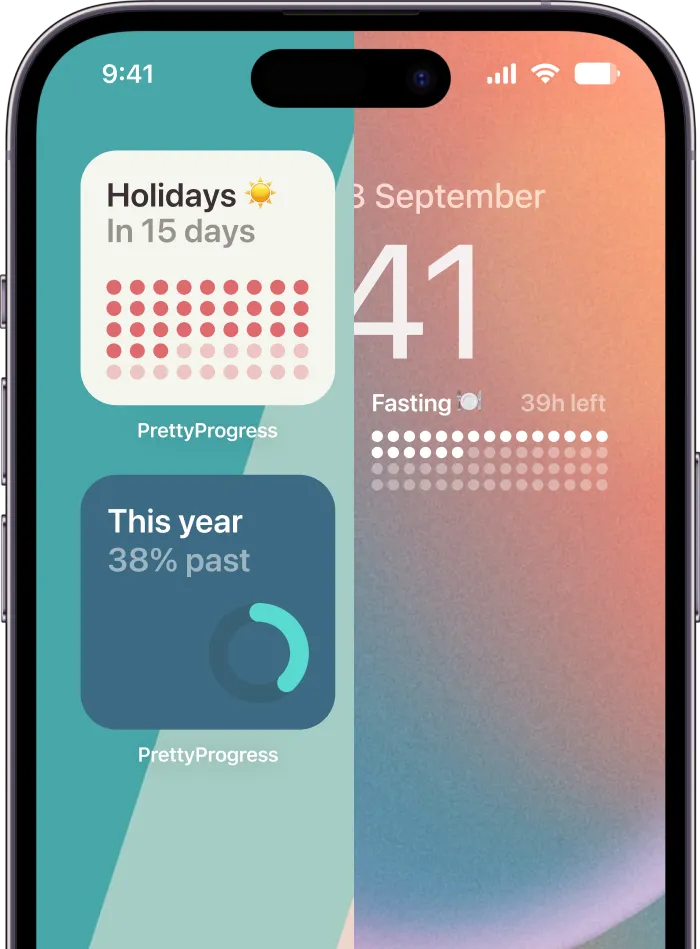
That’s the practical advantage of using Pretty Progress for this style of project deadline tracker. It lets you set up countdown and progress widgets on iPhone, iPad, Apple Watch, Mac, and Android, then customize how the timeline appears so the tracker feels easy to notice instead of easy to dismiss.

Match the design to the kind of work
The styling isn’t just cosmetic. Different looks change how a project feels.
- Swiss Style: Clean and restrained. Good for work deadlines, client projects, and anything you want to present as calm and professional.
- Retro OS: More playful. Good when motivation is the issue and you want the tracker to feel fun enough to keep checking.
- Minimal layouts: Useful if you get distracted easily and want the fewest possible visual decisions.
- Gradients and color tweaks: Helpful for signaling importance. A softer palette can reduce stress. A high-contrast setup can make an urgent project harder to ignore.
A widget works best when it fits your attention style, not just your aesthetic taste.
Small design choices that change behavior
Here are the adjustments worth making:
- Pick one dominant project color. It helps you recognize the deadline instantly.
- Choose a readable layout. If the date or progress bar feels cramped, you’ll stop noticing it.
- Use the progress bar shape deliberately. Rounded shapes feel lighter. Sharper styles often feel more structured.
- Keep the label short. Long names reduce scan speed.
If you’re building a more motivating screen setup, the article on a goal progress tracker app has useful ideas for making widgets feel glanceable instead of cluttered.
A good widget should answer one question in under a second: how close am I, and do I need to act today?
Advanced Tracking Workflows and Integrations
A single end date works for a lot of projects. Complex work needs more than that.
The trap is using one deadline to represent a project that has several points of failure. If you’re tracking a thesis, a product launch, or a client build, the final date matters less than the chain of milestones that decide whether that final date stays realistic.
Break one deadline into milestone trackers
The most reliable setup is usually a small stack of countdowns:
- Research complete
- First draft finished
- Review round done
- Final submission or handoff
Each milestone becomes its own checkpoint. That lowers stress because you no longer stare at one huge, distant finish line. It also makes delay visible earlier.

If you’re managing several active pieces at once, this guide on how to keep track of multiple projects is a practical next step.
Build in uncertainty instead of pretending it won’t happen
Static deadline lists break the moment reality changes. A stronger project deadline tracker accounts for uncertainty from the start.
One benchmark source on timeline adherence recommends planning with a 20 to 30% buffer based on historical variance, as explained in Count’s write-up on project timeline adherence. That advice matters because most projects don’t slip in one dramatic moment. They slip through revisions, waiting time, and tasks that take longer than expected.
So if your real due date is fixed, treat your visible working deadline as earlier. The widget then becomes a buffer-aware tracker, not just a reminder of the official end.
When a project has dependencies, the deadline you show yourself should often be earlier than the deadline you promised someone else.
Use calculator and calendar tools to make plans realistic
Practical utilities provide valuable assistance. A Business Day Calculator is especially useful for client work, school schedules, and office-heavy timelines because weekends can distort how much working time you really have. A project that looks comfortable on a normal calendar can feel cramped once you count only working days.
Calendar syncing also helps when deadlines already live elsewhere. Importing events avoids duplicate entry and reduces the chance you’ll update one system but forget another.
For team-heavy environments, software development management is a helpful resource because it shows how milestone planning, dependencies, and communication work together when projects move beyond solo execution.
Unlocking Deeper Customization with PRO Features
Basic tracking gets the project on screen. Deeper customization changes how useful that screen becomes over time.
The strongest deadline systems don’t just show one date. They act like a small visual dashboard. An effective project deadline tracker should support a baseline schedule, let you watch milestone completion rate, compare planned and realized task duration, and keep an eye on schedule variance, which is the difference between work scheduled and work completed to date, as outlined in TimeNeye’s guide to project success metrics.
Where PRO-style controls matter in real life
Advanced styling controls are easy to dismiss until you use them with intent.
If you’re a freelancer, exact color control can help you match client categories or separate work streams visually. If you’re a student, custom gradients and layouts can help distinguish exams, assignments, and application deadlines at a glance. If you’re easily overwhelmed, cleaner themes with precise spacing can reduce visual noise enough that you keep the tracker visible instead of hiding it.
Personal dashboard thinking beats generic defaults
A few upgrades tend to matter most:
- Exact color input: Useful when you want a consistent visual system across devices or project types.
- More layout control: Helps prioritize the information you care about most, whether that’s days left, percentage complete, or title visibility.
- Exclusive themes: Good for people who stay engaged longer when the tracker feels customized rather than generic.
- Finer bar styling: Small shape and size changes can make the progress signal easier to scan.
The practical value isn’t “more features.” It’s better fit. When the tracker matches how you process information, you check it more often and ignore it less.
The trade-off is simple
If you only need a countdown for one short deadline, defaults are often enough.
If you want a project deadline tracker to double as a visual KPI layer for several milestones, priorities, and work modes, the deeper controls become much more useful. That’s when customization stops being decorative and starts improving clarity.
Common Questions and Quick Fixes
Most deadline tracker problems come down to visibility, sync, or setup habits. The fixes are usually straightforward once you know where to look.
Why isn’t my widget updating after I changed the date
Widgets don’t always refresh instantly.
Try these quick checks:
- Open the app once after editing. This often prompts the latest data to refresh.
- Confirm you’re editing the same tracker tied to the widget. If you duplicated a countdown, the widget may still point to the older one.
- Remove and re-add the widget if needed. It sounds basic, but it often clears stale display issues.
How do I keep deadlines aligned across devices
Use the same account and confirm sync is active on each device. If a Mac widget or iPad widget looks outdated, open the app directly on that device and verify the tracker list matches what you changed on iPhone.
A good habit is to make edits in one place, then do a quick visual check on the second device before assuming the setup is wrong.
If a deadline matters, verify the visible widget after every major date change.
Can I track recurring work
You can, but don’t treat recurring work like one endless project.
For repeating tasks such as weekly study reviews, invoice runs, or content deadlines, create a fresh tracker for each cycle or duplicate the last one and update the dates. That keeps the progress bar meaningful. A recurring task with no clear end usually turns into wallpaper.
What if the project scope changes halfway through
Adjust the tracker. Don’t leave the old timeline in place out of guilt.
A deadline tracker is useful because it reflects current reality. If scope expands, rename the project if necessary, update the target date, and if the project has become more complex, split it into milestone-specific countdowns instead of forcing everything into one bar.
I have too many deadlines and now the screen feels noisy
That means the tracker worked. It exposed the actual problem.
Use this filter:
- Keep visible now: Deadlines that need attention this week
- Keep in app only: Important but not urgent deadlines
- Archive or delete: Old trackers that no longer change behavior
Users often don’t need every project on the Home Screen. They need the right few.
Should I track the final deadline or my own earlier target
Usually your earlier target.
The official due date is what you owe the world. Your working date is what protects you from last-minute chaos. If you only track the official date, you often discover problems too late to fix them calmly.
A good deadline system should feel lighter the longer you use it. If you want a visual way to track projects, exams, client work, and milestones without burying them in a heavy project stack, Pretty Progress gives you customizable countdowns and progress widgets that stay visible on the devices you already check all day.