
August 8, 2026
Why Project Timeline Visualization Changes Everything
Project timeline visualization works best when tasks, dependencies, and milestones share one view. See which format fits launches and campaigns.
You probably have a deadline floating in your head right now.
Maybe it’s a product launch with too many moving parts. Maybe it’s an exam date, a client handoff, or a personal goal that felt far away a month ago and suddenly feels close. The stress usually isn’t just the work itself. It’s the fog. You know there are tasks, dependencies, milestones, and risks, but they’re all scattered across notes, chats, calendars, and your memory.
That’s why project timeline visualization matters. In practical terms, it means putting tasks, milestones, dependencies, and planned work on one time axis so people can see both order and duration, not just a pile of dates. That matters because a timeline is a visual display of events arranged in chronological order, and the format is flexible enough to cover everything from short work sprints to long multi-year plans in Visme’s timeline overview.
Most articles stop at enterprise tools. They explain Gantt charts, mention PERT charts, and assume your world looks like a conference room wall full of sticky notes. Real life is broader than that. The same ideas that help a team run a product launch can also help one person stay on track for an exam, a fitness goal, or a big life date. The shape changes. The principle doesn’t.
I’ve found timeline visuals help most when work has handoffs, approvals, or competing deadlines. They become overkill when the job is just one person doing one task by one date. Consider the situations in between: how to choose the right format, how to build one fast, and how to show milestones alongside planned work for campaign schedules and regulated launches.
Table of Contents
- Why Visualizing Time Changes Everything
- How We Evaluated Project Timeline Visualization Methods
- The Four Main Types of Timeline Visualization
- How to Choose the Right Visualization for Your Goal
- Design Principles for Clean Glanceable Timelines
- From Pro Projects to Personal Progress How to Implement
- Frequently Asked Questions
- The Future Is Visual and Personal
Why Visualizing Time Changes Everything
A list tells you what exists. A timeline tells you what matters now.
That difference is huge. When work lives as bullets in a doc or cards in a backlog, you can miss sequence, overlap, and pacing. A timeline lays tasks out on a time axis, so you can spot what starts first, what depends on something else, and where the pressure points sit.
Research on project management visualization notes that organizations using visual timeline tools such as Gantt charts, burndown charts, and dashboards see measurable improvements in operational efficiency and reduced project costs through better resource allocation and error avoidance in this overview of data visualization in project management. That result makes sense. People make better decisions when the schedule is visible.
A useful timeline does more than decorate a deadline. It shows the shape of work: what is already planned, what cannot begin yet, which milestone acts as a gate, and where delay in one stream will push everything else. In practice, that is why project timeline visualization is so useful for launches, campaigns, and cross-functional projects. You are not just seeing dates. You are seeing sequence, duration, and dependency on the same line, which is exactly what Flourish’s interactive timeline note highlights.
I’ve seen this most clearly in status meetings. A written update can hide the fact that legal review starts the same week creative assets are due. A simple timeline makes that collision obvious in seconds. That is where visual planning earns its keep.
By the end of this guide, you’ll have a practical way to pick a format and build timelines for team delivery, stakeholder updates, campaign planning, and financial product launches with review gates.
Why your brain responds better to a picture
Time is slippery when it stays verbal.
“Design ends in two weeks” sounds clear until three related tasks also need approval during that same window. “I have plenty of time before the exam” feels comforting until a simple visual shows how few study blocks remain. A timeline removes that illusion by giving time a shape.
Practical rule: If a project feels vague, don’t add more text first. Draw the sequence.
Visual timelines also create a shared reference point. A manager, designer, student, or client can all look at the same line, bar, or milestone and understand the current state faster than they can from a status paragraph. That’s one reason dashboards have become such a common layer in project work. They bring progress, risks, resource allocation, and key indicators into one visual surface.
Clarity changes behavior
Seeing time doesn’t just help with planning. It changes how people act.
When a task bar is slipping, teams discuss tradeoffs earlier. When a countdown is visible every day, people stop treating a deadline like a distant idea. A good timeline shifts work from reactive to proactive. You stop asking, “What happened?” and start asking, “What needs attention before this becomes a problem?”
That’s true in a product team. It’s also true in personal productivity. The visual might be simpler, but the effect is the same. You’re making time legible.
How We Evaluated Project Timeline Visualization Methods
This guide compares timeline methods using four practical criteria: how clearly they show sequence, how well they handle dependencies, how easily they communicate milestones, and how useful they are for real decisions once a project is underway.
I also weighed audience fit. A team delivery view and a stakeholder status view are not the same thing, even when they describe the same project. Some formats are better for working sessions. Others are better for updates, decks, or recurring check-ins.
The final filter was implementation friction. A perfect chart that nobody updates is worse than a simpler timeline people use. Prefer formats that help you answer concrete questions: What happens next? Who owns it? Which milestone is at risk? What work is planned before launch?
The Four Main Types of Timeline Visualization
Some timelines are built for execution. Others are built for explanation. Others are built for motivation.
It helps to think of them like different kinds of travel maps. One map shows the full driving route with every turn. Another shows how roads connect. Another only marks major destinations. Another just tells you how far you have left.
Gantt charts as the working schedule
A Gantt chart is often the first timeline visualized. Tasks appear as horizontal bars placed against dates. You can see start dates, end dates, overlap, and often progress inside each bar.
This format is great when you need to manage real work over a calendar. If design runs from Monday to Friday and development starts after design approval, a Gantt view makes that relationship obvious. It’s especially useful when several tasks happen at once and you need to track progress week by week.
According to Adobe’s guide to project timelines, Gantt charts focus on task timelines and progress tracking using single-point estimates, while PERT charts focus on task dependencies and overall project duration using optimistic, pessimistic, and most likely estimates. That’s the cleanest way to separate them.
Gantt works best in project management software, shared team planning tools, and any surface where people need to adjust dates as work changes. It is usually the strongest choice for campaign schedules because it can show content production, approvals, paid media setup, launch dates, and post-launch reporting in one calendar view.
PERT charts as the logic map
A PERT chart is less about calendar display and more about sequence and dependency.
Instead of bars stretched across dates, you get nodes and connecting lines. This makes it easier to answer questions like: Which task enables the next one? Where is the critical path? Which steps have no slack?
PERT is useful when uncertainty is high or when the logic of the work matters more than the weekly schedule. Think research projects, new product development, or any initiative where one blocked decision can affect everything downstream. If you need a stronger grasp of dependency-heavy planning, especially to manage complex service provider workflows, precedence thinking pairs naturally with this kind of view.
This format fits whiteboards, planning workshops, and early-stage project design better than executive reporting. For a financial product launch with multiple approval checkpoints, I’d use a dependency map first to validate the order of compliance, legal, operations, and launch readiness, then translate that logic into a dated schedule.
Roadmaps and milestone views as the big picture
Not every audience needs task-level detail.
A roadmap or milestone chart works when you need to communicate major phases rather than every subtask. This is the version you show stakeholders who care about direction, not daily task mechanics. It says, “Research in March, prototype in April, testing in May, launch after approval.”
These formats reduce clutter. That’s their power. They help teams talk about priorities, sequence, and outcomes without drowning in implementation details.
Roadmaps fit presentation timelines, quarterly planning docs, leadership updates, and simple dashboard summaries. They are the best answer when you need a milestone view that shows launch gates, approvals, and key dates without exposing every internal task. For executive audiences, this is often the clearest way to visualize milestones alongside planned work without losing the plot.
Progress bars and countdowns as personal timeline tools
For individual goals, a full project chart can be too much.
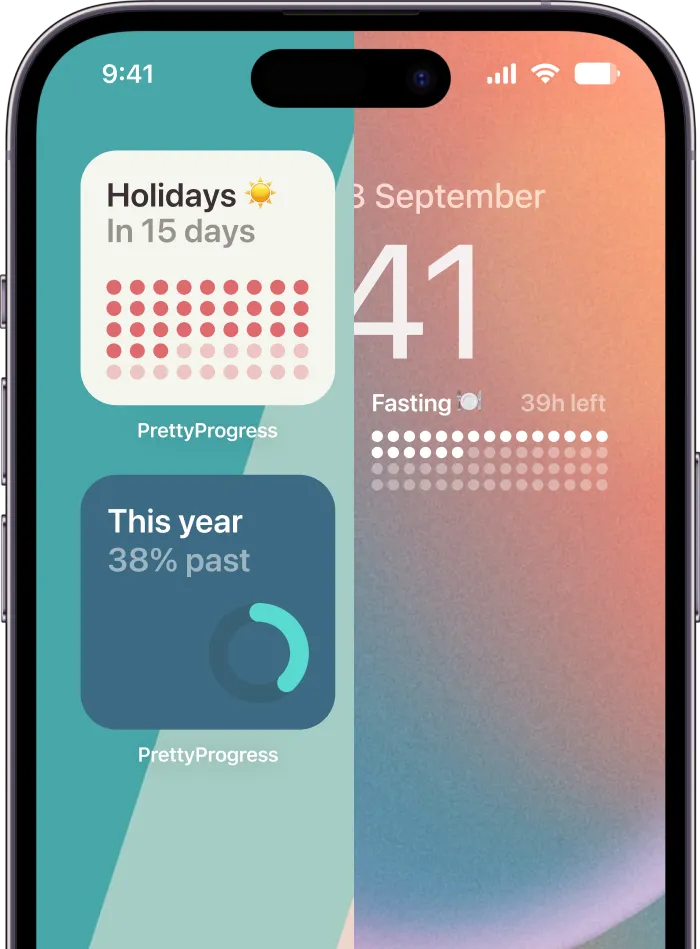
If you’re tracking exam prep, a habit streak, a trip, a fasting window, or a deadline for an application, the most useful timeline might be a progress bar or countdown. It doesn’t explain every dependency. It answers a more immediate question: “How close am I?”
That’s why these simpler visuals are so effective in personal contexts. They’re not trying to run a department. They’re trying to keep one person oriented and motivated throughout the day.
These formats work best in personal widgets, mobile apps, desktop tools, and lightweight habit systems. They are not ideal for campaign schedules or approval-heavy launches, but they are excellent for keeping one deadline visible when motivation matters more than coordination.
Here’s a simple comparison:
| Visualization Type | Best For | Key Feature | Complexity |
|---|---|---|---|
| Gantt Chart | Scheduling tasks across a calendar | Horizontal bars showing duration and progress | Medium |
| PERT Chart | Mapping dependencies and critical path | Nodes and arrows showing sequence | High |
| Roadmap or Milestone View | Communicating phases and key dates | Focus on major checkpoints | Low to medium |
| Progress Bar or Countdown | Personal deadlines and habits | Fast read on time remaining or completion | Low |
A good timeline doesn’t show everything. It shows the next useful truth.
How to Choose the Right Visualization for Your Goal
People often pick a timeline format too early. They choose the chart that looks professional instead of the chart that answers the actual question.
The better move is to start with the situation. In my experience, the right view becomes obvious when you decide who needs to act on it and what they need to notice first.
Start with the kind of question you need to answer
Use this decision framework for four common situations:
- Team delivery schedule: Best view: Gantt chart. It reveals task timing, overlap, ownership handoffs, and slippage. It hides some dependency logic unless you add linking lines or notes.
- Stakeholder status view: Best view: milestone roadmap. It reveals phase progress, major approvals, and whether the project is on track. It hides the day-to-day task detail the team still needs.
- Campaign calendar: Best view: calendar-style Gantt or marketing timeline. It reveals creative deadlines, channel launches, review points, and reporting windows. It hides deep dependency logic unless you explicitly map it.
- Regulated launch timeline: Best view: dependency map plus milestone roadmap. It reveals approval gates, sequencing risk, and no-go decision points. It hides routine task execution unless paired with a fuller schedule.
A compact matrix helps when the project sits between two formats:
| Need | Best Fit | What it’s best at | Main limitation |
|---|---|---|---|
| Many tasks, many owners, active date changes | Gantt | Shows planned work on a real schedule | Can get crowded fast |
| Heavy dependencies, unclear sequence | Dependency map / PERT | Exposes logic and critical path | Weak at status reporting |
| High-level updates, major checkpoints only | Milestone roadmap | Shows milestones clearly | Hides task-level risk |
| One person, one deadline, motivation focus | Progress bar | Fastest daily read | Doesn’t explain coordination |
If you need to show milestones alongside planned work, the choice usually comes down to this: use a full task timeline when owners need to execute the work, and use a milestone view when the audience only needs gates, dates, and progress at a glance.
When simple beats detailed
A lot of timeline advice misses the motivational side of visuals. Content here often focuses on structure and planning, but rarely explains why progress bars and countdowns work so well for individuals. One key idea, highlighted in this discussion of project timeline gaps and personal motivation, is that micromoments of visual feedback create behavioral reinforcement that traditional project tools often overlook.
That matters if you’re studying, building habits, or balancing multiple deadlines alone. A detailed chart may be accurate, but it won’t necessarily help you act. A glanceable visual often will.
A useful rule of thumb:
- Choose complexity only when the work demands it. If dependencies, resource conflicts, or multiple owners can derail delivery, use a richer project view.
- Choose visibility when consistency is the challenge. If the hard part is remembering, pacing, or staying engaged, use a simpler visual that stays in sight.
- Choose communication fit. The same project may need one timeline for the team and another for everyone else.
If you’re juggling several moving parts and want a more practical framework for organizing them, this guide on how to keep track of multiple projects is a helpful companion.
The best timeline is the one that changes what you do next.
Design Principles for Clean Glanceable Timelines
Bad timelines fail in a specific way. They make time visible, but they make meaning harder to see.
A clean timeline doesn’t need decoration. It needs hierarchy. The eye should know where to look first, what the colors mean, and which signals deserve attention. That applies whether you’re building a project dashboard or a tiny phone widget.
Use color and layout with intention
Color is one of the fastest ways to encode status. But it only works if the system stays consistent. If red means risk in one place and completion in another, users hesitate. Once they hesitate, the timeline stops being glanceable.
Empirical evaluations summarized by Office Timeline’s overview of visualizing data found that users process well-designed visual timelines with features like color-coding 20–35% faster than tabular data when identifying schedule conflicts or resource overloads. The speed comes from smart design, not from adding more elements.
Three design habits make the biggest difference:
- Limit the palette. Use a small set of purposeful colors, such as one for planned work, one for active work, and one for risk.
- Reduce label load. Put text only where it helps a decision. Repeating dates, task names, and legends everywhere creates friction.
- Strengthen contrast. If someone has to squint to decode the timeline, it won’t work at a glance.
Choose the right visual structure
Not every timeline should be a single row of tasks.
Parallel timelines help when you want to compare separate but related tracks on one shared time axis. A product team might compare marketing prep, engineering delivery, and QA readiness side by side. A student could compare revision plans for several subjects in parallel bands.
Stacked timelines are useful when multiple contributors add up to one total picture. They show both the individual parts and the cumulative effect. That works well for budget categories, workload by department, or several streams contributing to one deadline.
Overlaid timelines place multiple signals on the same axis so you can spot relationships. They’re best when correlation matters more than separation.
For cleaner visual goal tracking ideas in smaller formats, this article on visual goals shows how simple visual cues can stay readable without losing emotional pull.
Keep the signal close to the decision. If a viewer needs to decode the layout first, the design is doing too much.
A final test helps. Hide the labels for a moment and look only at shape, spacing, and color. If the timeline still tells a clear story, the structure is strong.
From Pro Projects to Personal Progress How to Implement
You don’t need a perfect timeline. You need one that works by tonight.
The fastest reliable process is to build from decisions, not from decoration. Start with scope, break the work into streams, place the milestones, map dependencies, assign owners, and then choose the view that fits the audience.
A simple professional timeline
Here is a practical build process that works for most team projects:
- Define the scope. Write a one-line outcome and a fixed deadline. If the goal is fuzzy, the timeline will be fuzzy too.
- List workstreams. Group tasks into tracks such as research, design, compliance, development, launch, or reporting. This keeps the timeline readable.
- Place milestones first. Mark the dates that change the project state: approval received, assets ready, training complete, launch live.
- Map dependencies. Draw what cannot start until something else is finished, since hidden delay risk usually appears in those handoffs.
- Assign owners. Every bar, gate, or milestone should have a name attached to it. Unowned work is where schedules drift.
- Choose the right view. Use a full task timeline for the working team, then create a milestone version for stakeholders if needed.
I usually sketch this on paper before moving it into software. It is faster to fix a bad sequence in rough form than after you have polished a chart.
Take a campaign schedule as an example. Imagine a six-week product campaign with four workstreams: messaging, creative production, channel setup, and launch reporting. Your milestones might be brief approved, assets approved, campaign live, and results review. The planned work under those milestones includes writing copy, designing ad variants, building the landing page, loading audience segments, scheduling emails, and confirming tracking. In this case, a Gantt-style timeline is the better working view because it shows tasks and milestones together and makes approval delays visible.
Now take a financial product launch. The workstreams could include market readiness, legal review, compliance approval, operations setup, customer communications, and launch support. The milestones are not just dates; they are gates: product terms approved, disclosures signed off, systems validated, staff training complete, launch decision confirmed. Planned work sits beneath each gate, and dependencies matter more than usual because a missed approval can block everything downstream. For this kind of launch, I’d build the sequence in a dependency map first, then publish two views: a milestone roadmap for executives and a full dated schedule for the launch team.
That split answers a common problem directly:
- Use a milestone view when the audience needs checkpoint dates, launch readiness, and approval status.
- Use a full task timeline when the audience needs to manage handoffs, planned work, and task overlap.
If you need visual inspiration for a polished stakeholder-facing version, Encelade has a useful roundup of timeline ideas for sales decks and presentation-style updates.
A simple personal progress setup
Now take a different example. You’re preparing for an exam, training for a race, counting down to a move, or tracking a habit streak.
A traditional project chart often feels too rigid here. Personal goals usually involve uncertainty, changing energy, and partial completion. That’s why broader planning frameworks can be a poor fit. As discussed in this piece on planning beyond Gantt charts, there’s a real gap in visualizing personal timelines where persistent visual representation shows not just the deadline, but the psychological proximity to it.
For personal goals, try this lighter process:
- Choose one anchor date. This is the exam, event, deadline, or finish line.
- Pick your unit of progress. Days remaining, percentage complete, sessions done, or streak length.
- Make the visual persistent. Put it somewhere you’ll naturally see it often.
- Keep the message emotional as well as practical. “12 study sessions left” often works better than a dense task map because it feels immediate.
If you’re planning something with both fixed dates and lots of moving pieces, this guide to an event planning timeline shows how to keep the structure manageable.
A professional timeline answers, “How do we coordinate the work?” A personal timeline often answers, “How do I stay connected to the goal?” Both are valid. They just solve different problems.
Frequently Asked Questions
What is project timeline visualization?
Project timeline visualization is the practice of showing work on a time axis so people can understand sequence, duration, and key dates quickly. A good timeline combines tasks, milestones, and sometimes dependencies so the plan is easier to read than a simple task list.
How do you show milestones alongside planned work?
The clearest method is to place milestone markers on the same calendar view as the task bars or workstreams they depend on. If the audience only needs the big picture, use a milestone roadmap; if they need to manage execution, use a fuller task timeline with milestones layered in.
Which format works best for campaign schedules?
A Gantt-style or calendar-style timeline is usually the best fit for campaign work because it shows content creation, approvals, channel launches, and reporting windows in one schedule. It is especially useful when several owners are working in parallel.
Are Gantt charts the best option for launches?
Often, but not always. Gantt charts are strong when launch work has many dated tasks and multiple owners, while dependency maps are better for sorting out complex sequencing before you commit everything to a calendar.
How should you handle financial product launch timelines?
Treat approval gates as first-class milestones, not footnotes. Legal review, compliance sign-off, operations readiness, and launch approval should appear visibly on the same timeline as the planned work they control, because those gates determine whether the schedule is real.
The Future Is Visual and Personal
Project timeline visualization is moving in two directions at once.
One direction is toward smarter professional tools. Teams increasingly expect timelines to do more than sit there. They want dashboards that surface risk, clarify resource allocation, and help them compare planned versus actual progress over time. That shift makes project management less about static reporting and more about active decision support.
The other direction is smaller, quieter, and in some ways more interesting. Time tracking is becoming ambient. Instead of opening a project tool on purpose, people now rely on visuals that live around them through the day. A lock screen countdown, a watch complication, a slim progress bar on a desktop, or a simple bar tied to a habit can keep goals mentally available without demanding a full planning session.
That matters because not every timeline problem is an enterprise problem. Many are personal attention problems. You don’t always need more features. Sometimes you need a better visual cue in the right place.
The deeper idea stays the same across both worlds. Good timeline design helps people answer three questions quickly:
- Where am I now?
- What’s coming next?
- Am I on track?
When those answers are obvious, stress drops. Decisions get faster. Progress feels real.
Project timeline visualization started as a management tool, but it’s become something broader. It’s a way to make time concrete. For a large team, that might mean dependencies, milestones, and resource planning. For one person, it might mean a single clear bar that turns a distant goal into something visible every day.
If you make time visible, you make action easier.
If you want a simple way to turn deadlines, life events, and long-term goals into glanceable progress bars and countdown widgets, Pretty Progress makes that easy across iPhone, iPad, Apple Watch, Mac, and Android. It’s a clean way to keep important timelines visible all day, without the clutter of a full project management tool.