
August 31, 2026
How to Manage Exam Stress with a Practical Plan
Learn how to manage exam stress with a practical, evidence-based plan covering study routines, sleep, relaxation, and in-exam strategies that actually work.
The week before an exam has a familiar smell to it, stale coffee, highlighters drying out, and that sharp feeling that the clock has slipped ahead of you. You sit down to study, but the syllabus looks larger than your confidence, and every unread page seems to whisper that you’re behind.
That feeling is common, and it doesn’t mean you’re weak or unprepared. Exam stress is the body’s alarm system reacting to pressure, deadlines, and the fear of consequences, and the goal is not to silence it completely. The goal is to manage it so you can still think, sleep, and perform with a clear head.
Table of Contents
- What Exam Stress Really Is and Why It Spikes
- The Three-Week Preparation Routine
- Sleep, Food, and Movement as Stress Armor
- Cognitive and Relaxation Techniques to Rehearse
- In-Exam Playbook for When Your Mind Goes Blank
- Visualize Deadlines With Pretty Progress Widgets
- Your One-Page Exam Stress Recap
What Exam Stress Really Is and Why It Spikes
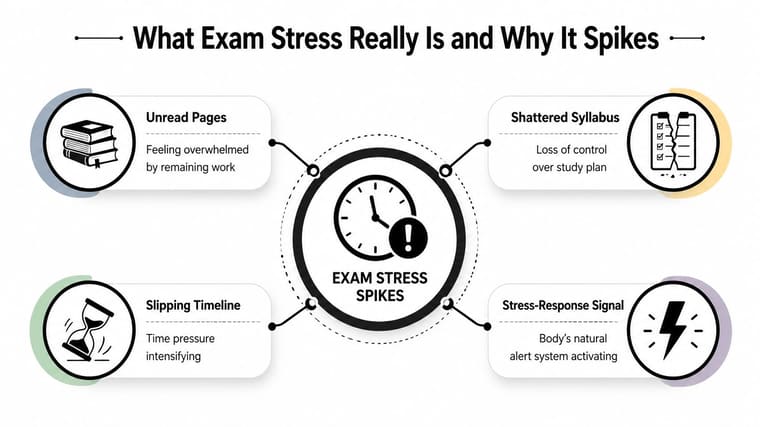
Exam stress often starts with a very ordinary moment. You open your notes, realise there are still sections you haven’t covered, and suddenly the whole timeline feels unstable. The mind starts scanning for danger, because exams carry real stakes, and the body responds as if it needs to mobilise now.
That response is not imaginary. In student reporting, 151 out of 200 students, or 75.5%, said they were stressed before the exam, and large survey-based reporting also found that 85% of students experience exam anxiety, with 71% saying they feel most stressed during exam weeks peer-reviewed study and survey summary. The same UK-based reporting noted that 68% of students experience disturbed sleep in the lead-up to exams, which matters because poor sleep makes worry louder and recall less reliable peer-reviewed study and survey summary.
What it looks like in real life
You may feel it in your body first. Tight shoulders, a racing pulse, stomach discomfort, headaches, or a strange mix of fatigue and restlessness are common physical signs. You may also notice cognitive signs, like rereading the same paragraph, blanking on facts you knew yesterday, or jumping from one topic to another without finishing anything.
The emotional side can be just as clear. Irritability, dread, guilt, and the sense that everyone else is coping better can all feed the loop. A useful way to think about how to manage exam stress is to treat it as a whole-system problem, not just a mood problem, because sleep disruption, appetite changes, and concentration loss all belong to the same pattern.
Practical rule: if stress is already affecting sleep or focus, don’t wait for motivation to appear. Start with routine, because routine is what gives motivation a place to land.
If you want a student-specific resource that speaks directly to anxiety before high-stakes testing, test anxiety relief for medical students is a useful starting point. It’s especially relevant when the pressure feels tied to performance, not just content.
The plan that works best is simple enough to repeat. Build a three-week preparation arc, protect sleep, food, hydration, and movement, rehearse a few calming techniques before exam day, use a short playbook when your mind blanks, and make the countdown visible so the dates stop living only in your head.
The Three-Week Preparation Routine
A good exam plan doesn’t begin the night before. It starts with a calendar, a clear view of what’s left, and a decision to stop pretending every topic needs equal time. If you’re learning how to manage exam stress, the first win is turning a vague mountain into a sequence of smaller hills.
Week One is triage
List every exam, confirm every date, and write the topics underneath each one. Then mark each topic by two things, how heavily it is weighted and how confident you already feel about it. That simple sorting tells you where your effort will matter.
This is also the week to stop relying on mood-based study. Put the hardest topics into your best concentration windows, and keep the sessions short enough that you can return the next day without dreading them. For time layout ideas, this student time management guide can help you turn a crowded week into something readable.
Week Two is processing
Now the work becomes active. Split topics into blocks, then revisit them through retrieval, not passive rereading. The point is to make your brain pull the answer out, because that’s much closer to what happens in the exam room.
Use two short review sessions per topic instead of one marathon revisit. Mix subjects across days so the material feels less fragile, and so one difficult unit doesn’t eat the whole afternoon. That mixing can feel less dramatic than a long session, but it usually sticks better.
Week Three is consolidation
This is when you simulate the actual exam. Do full practice papers under timed conditions, review your mistakes, and build a short error log for recurring gaps. Then taper the final two days so your sleep stays steady and your mind doesn’t arrive at the exam already exhausted.
| Week | Primary Focus | Daily Time | Key Tasks |
|---|---|---|---|
| Week One | Triage | Short planning blocks | List exams, confirm dates, sort topics by weight and confidence |
| Week Two | Processing | Two or three study blocks | Spaced retrieval, mixed subjects, two short reviews per topic |
| Week Three | Consolidation | Timed blocks plus lighter review | Practice papers, error log, weak-area review, sleep protection |
Avoid the traps that feel productive but usually aren’t, like rereading notes for hours, doing one subject until your head feels numb, skipping practice papers, or cramming at the end and hoping panic will somehow improve recall.
A solid planning structure matters because stress is not only emotional. Research on high-stakes testing found that cortisol rose by about 15% on average during the week high-stakes tests were given, and that rise or fall in cortisol was associated with a 0.4 standard deviation decrease in test scores, roughly equivalent to about 80 points on the 1600-point SAT scale NBER working paper summary. That is why early structure is not extra, it is part of performance.
Sleep, Food, and Movement as Stress Armor
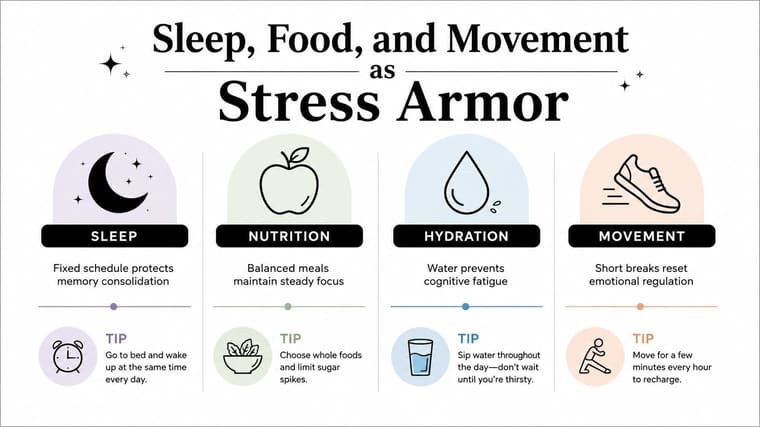
A lot of students treat sleep, meals, and exercise as optional extras during exams. That habit backfires. These three things are the infrastructure underneath memory, attention, and emotional steadiness, and once they wobble, everything else gets harder.
Sleep protects recall before it protects mood
A fixed sleep and wake time usually helps more than a longer but irregular schedule. The reason is simple, your brain likes rhythm, and irregularity keeps the body slightly alert when it should be settling. A 20-minute wind-down at night gives your nervous system a cue that the study block is over and the alertness spike can drop.
That wind-down can be plain. Dim the room, put the phone away, and do the same small sequence each night so your body learns the pattern. If you need a second resource on the physical side of stress, reduce stress with recovery tools is a useful companion read.
Food and hydration keep the engine steady
Breakfast with protein tends to help you avoid the sugar-and-caffeine crash that feels like focus for an hour and then turns into fog. During the day, slow-release meals work better than random snacking because they keep your energy from swinging wildly between studies.
Hydration is the cheapest attention tool available. A dry brain feels harder to steer, and a glass of water between blocks often does more for concentration than another anxious scroll through your notes.
Movement resets the system
You don’t need a full workout to get a benefit. 20 to 30 minutes of walking, cycling, or light strength work can be enough to clear stress and bring your working memory back online between sessions. Use movement as a transition, not as a reward you only earn after perfect studying.
A good exam-day version looks like this.
- Before your first block: eat something steady, drink water, and keep the caffeine small.
- Between blocks: walk, stretch, or do a quick cycle around the block.
- At night: protect the wind-down instead of squeezing in one more chapter.
The point is not to turn exam season into a wellness retreat. The point is to stop asking the brain to perform while the body is running on fumes.
Cognitive and Relaxation Techniques to Rehearse
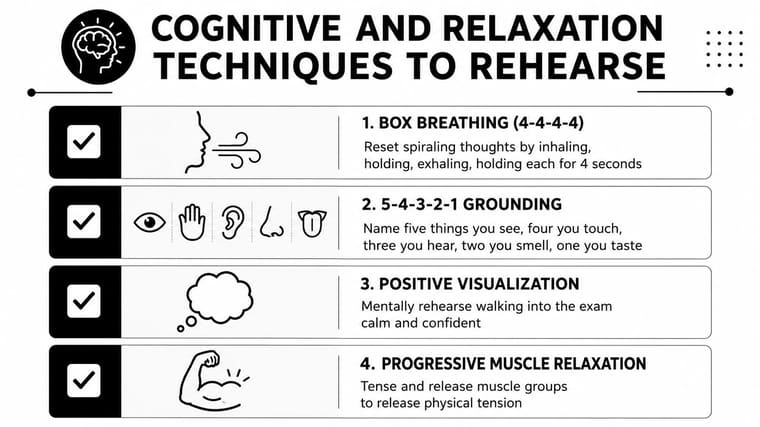
Calm techniques work best when they’re familiar. If you only try them for the first time while your heart is pounding, you’re asking your body to learn under pressure. Rehearse them twice in the week before exams, then use them automatically when the pressure rises.
Four techniques worth practising
Box breathing, 4-4-4-4. Inhale for four counts, hold for four, exhale for four, hold for four. Use it when your thoughts start racing or when you can feel your chest tighten before opening the paper.
5-4-3-2-1 grounding. Name five things you see, four you can touch, three you hear, two you smell, and one you taste. This is useful when panic starts pulling your mind away from the room.
A short reframing script. Say, “I prepared, I can attempt the first question, and I only need the next step.” That kind of self-talk doesn’t deny the pressure, it stops the mind from jumping straight to catastrophe.
Progressive muscle relaxation. Tighten and release muscle groups from forehead to feet. Do it at night if your body feels wired, or in a quiet minute before sleep if the day has left you tense.
When to switch techniques
If breathing helps but your thoughts keep spiralling, move to grounding. If grounding helps but your body still feels stiff, use muscle relaxation. If all of that still feels too intense, stop trying to “think your way out” and return to the body first.
Useful habit: rehearse each technique when the stress is low, then use the one that matches the symptom, not the one that sounds smartest.
For a broader menu of calming approaches, stress reduction techniques can help you compare options without turning it into a theory lesson. If you also like structured wellbeing content, partial-match anchor with body resilience may be worth a look, especially if you want to understand resilience as something you build, not something you wait for.
By the time exam week arrives, these techniques should feel ordinary. That’s what makes them dependable.
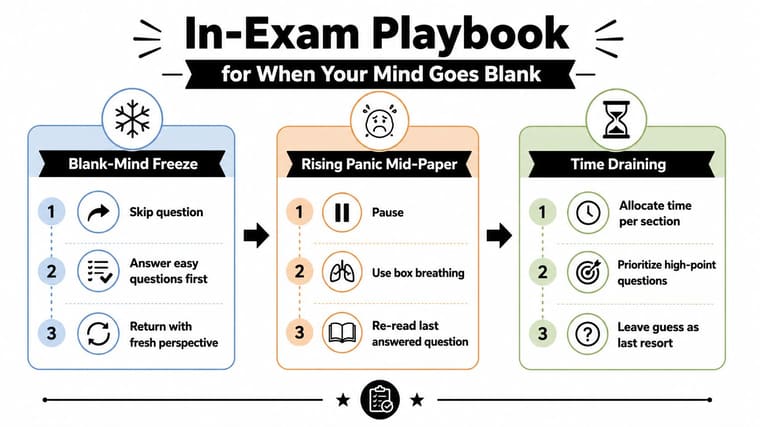
In-Exam Playbook for When Your Mind Goes Blank
Inside the exam room, you don’t need a grand strategy. You need a sequence you can run while your hands are cold and your attention is narrowing. The trick is to match the symptom to the response, then act before panic gets louder.
If the first hard question freezes you
Skip it. Move to the easiest question you can answer and bank a win. That first answer does more than earn marks, it tells your nervous system the paper is survivable.
If the stuck question keeps tugging at you, write down everything you remember about it for 20 to 30 seconds. Externalising the details frees up working memory, which is often the thing that has locked up, not your actual knowledge.
If panic rises mid-paper
Pause your pen. Take one cycle of box breathing or a slower 4-7-8 breath if that’s the one you rehearsed. Then re-read the last question you answered well, because a small success can reset the tone of the room.
If your chest tightens and your reading starts to blur, don’t keep forcing speed. Reset first, then return to the paper.
If time starts draining fast
Budget time per mark before you open the paper, then keep checking the clock in small, fixed intervals. Skip and flag questions rather than grinding on one that is eating your minutes. A guessed answer is often better than a blank one, but only after you’ve spent the time on the questions with the highest value.
Here’s the simple order to keep in mind.
- Scan the paper quickly.
- Answer the easiest questions first.
- Flag the rest and return with calmer eyes.
One more point matters here. Students sometimes think the goal is to feel calm before they start. That’s backwards. The goal is to keep moving while calm enough to think clearly, and that comes from a rehearsed response, not from waiting for nerves to disappear.
Visualize Deadlines With Pretty Progress Widgets
There’s a quiet kind of stress that comes from checking the calendar in your head all day. The exam date never leaves, it just keeps circling in the background. Offloading that job to the screen can make a surprising difference, because the deadline stops being a mental chore and becomes a glanceable object.
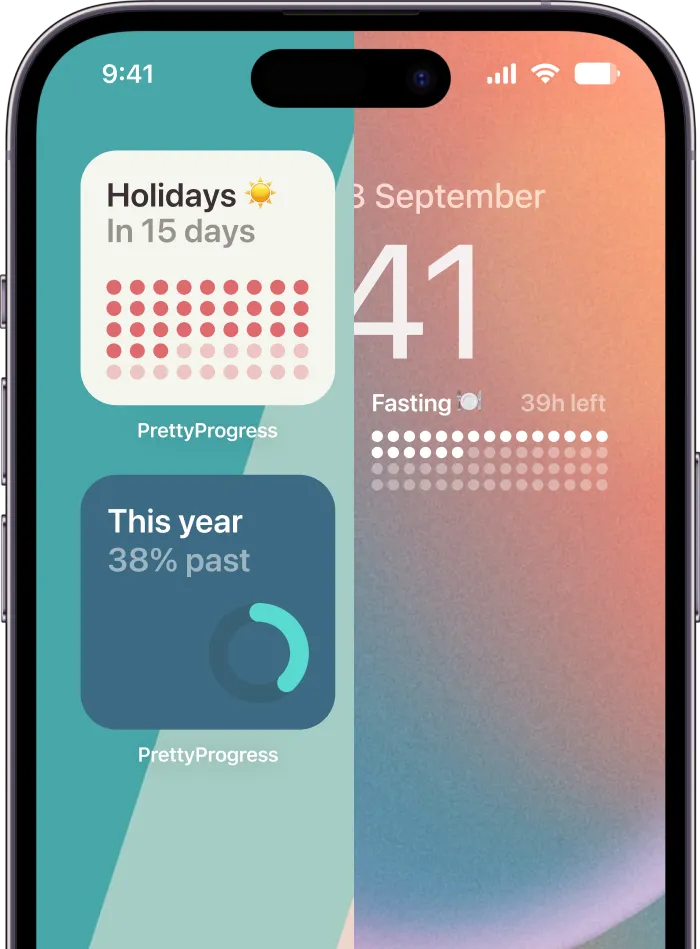
Here’s how a student might set it up. On Monday morning, they pin a countdown widget for the first exam to the phone’s home screen. The number of days left is visible without opening the calendar, and that alone cuts down the tiny recurring calculation of “how long do I have?” A second widget tracks progress by chapter or practice paper, so the study plan has a visible finish line.
For a single exam, one clean widget stack works well. Put the countdown at the top, then place a progress bar underneath it that fills as chapters or papers are completed. For a busier term, use a multi-exam dashboard, one widget for each date, arranged in the order they’ll arrive.
The benefit is not decoration. It’s external memory. The calendar doesn’t need to live in your head all day if your screen is already showing the next step. That frees up attention for actual study, not repeated checking.
If you want a deeper look at the timer style setup, study countdown timer shows how students can turn deadlines into something visible and manageable. Pretty Progress offers countdown and progress widgets that can be customised with dates, names, colours, and layouts, which makes it one practical option for students who want the plan on their home screen instead of buried in an app.
A good ritual is to glance at the widgets each morning before the first study block. That takes only a few seconds, but it ties the visual reminder to the day’s plan. Over time, the widget stops feeling like extra tech and starts acting like a calm prompt to begin.
Your One-Page Exam Stress Recap
Keep the whole thing simple enough to print. If you can’t explain your plan on one page, it’s probably too scattered to hold up under pressure. The strongest routine is the one you can repeat when you’re tired, not the one that sounds impressive on a good day.
The four loops to run
First loop, the three-week prep arc. Week one is triage, week two is active retrieval and spaced study, week three is timed practice and tapering. Keep the exam dates visible in a widget or dashboard so you don’t spend energy mentally checking them.
Second loop, the daily baseline. Protect a fixed sleep and wake time, eat steady meals, hydrate, and move between blocks. These are not side notes, they are the conditions that let revision stick.
Third loop, the 10-minute reset. Use breathing, grounding, reframing, or muscle relaxation the night before and again on the morning of the exam. Rehearse the same small routine until it feels automatic.
Fourth loop, the in-exam playbook. If your mind blanks, skip the question and answer an easier one. If panic rises, pause and reset. If time drains, prioritise marks and leave low-value guessing for the end.
The Pretty Progress widget belongs in all four loops because it keeps the countdown and the progress visible without demanding attention. A glance in the morning tells you what’s next, and the fill of the bar tells you what’s already been done. That combination matters more than people expect, because stress often grows in the unseen spaces between tasks.
After the exam
Don’t rush straight into self-judgment. Do a short brain-dump review, take a walk, drink water, talk to someone normal, and leave grade checking alone for 48 hours. That pause gives your nervous system time to settle instead of instantly attaching a new wave of stress to the old one.
If you keep just one idea from this guide, keep this one. How to manage exam stress is not about becoming fearless, it’s about building a repeatable routine that protects sleep, steadies the body, and gives the mind something solid to follow.
If you want a simple way to make your revision plan visible, Pretty Progress turns exam dates and study milestones into glanceable widgets on your screen. It’s a practical fit for this kind of routine, because it helps you see deadlines shrink while you keep your attention on the next task.