
July 20, 2026
Master Stress Reduction Techniques: Your 2026 Guide
Explore 10 science-backed stress reduction techniques, including breathing, mindfulness, exercise, & CBT. Get how-to steps, tracking tips, & routines for 2026.
Stress by the numbers starts with a business signal, not just a wellness one. The global workplace stress management market is projected to reach $18.06 billion by 2031, which tells you something important: stress is no longer treated as a vague personal problem. People and organizations are actively looking for repeatable, practical stress reduction techniques that fit into daily life.
That demand makes sense. The most effective approaches usually aren’t dramatic. They’re small actions you can repeat when pressure builds: a breathing drill before a meeting, a walk that resets your attention, a progress widget that turns an overwhelming deadline into a visible plan. Research also shows that digital stress interventions can reduce occupational stress and that benefits can last beyond the initial intervention period, which supports a routine-based approach instead of one-off fixes.
This guide groups the top stress reduction techniques by category so you can choose what fits your situation, build habits around it, and troubleshoot when motivation drops. The unique angle is simple: the best method is the one you’ll keep doing, and passive visual tools often make consistency easier than willpower alone.
Table of Contents
- 1. Visual Progress Tracking
- 2. Mindfulness Meditation
- 3. Physical Exercise and Movement
- 4. Deep Breathing Techniques
- 5. Cognitive Behavioral Therapy
- 6. Time Management and Goal Breaking
- 7. Social Connection and Support
- 8. Journaling and Expressive Writing
- 9. Nature Exposure and Outdoor Time
- 10. Sleep Optimization and Sleep Hygiene
- 10 Stress-Reduction Techniques Comparison
- Building a Stress-Resilient Routine
1. Visual Progress Tracking
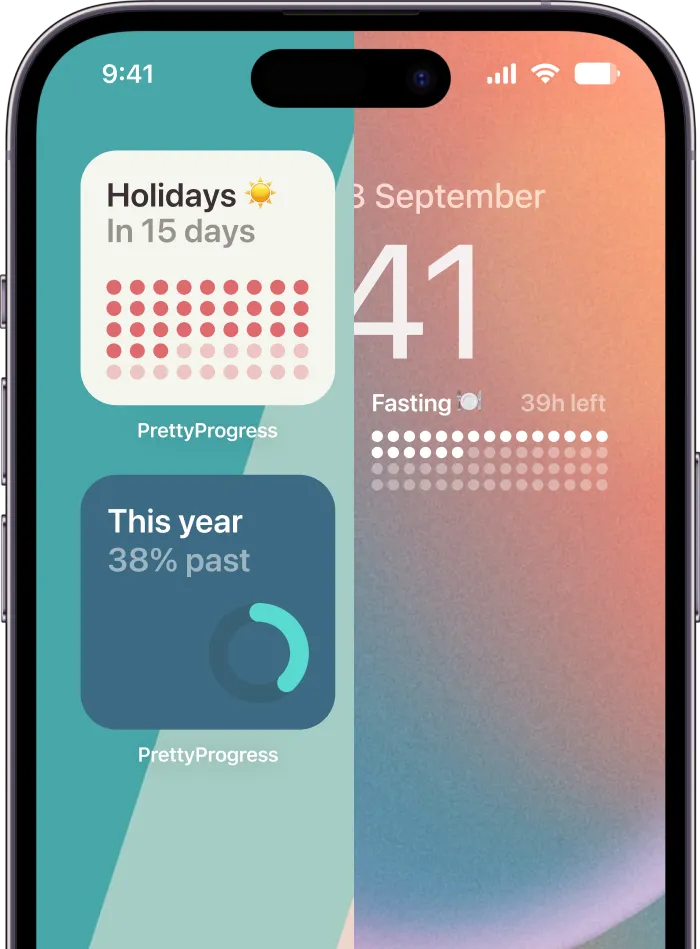
A lot of stress comes from ambiguity. You know a deadline is coming, but your brain treats it like a fog bank instead of a plan. Visual progress tracking reduces that mental load by turning time and effort into something you can see: a countdown on your lock screen, a progress bar for a semester project, or a milestone tracker for a job search.
That sounds simple, but the psychology matters. An always-on visual reminder removes decision friction. You don’t have to open an app, log a mood, or start a guided session. You glance, orient, and continue. For some people, especially remote workers and students, that passive format may be easier to maintain than active routines.

Why passive visuals work
A 2025 RAND-related finding summarized in an NCBI Bookshelf resource on stress interventions noted that 42% of remote workers abandoned stress-reduction apps within two weeks because setup and maintenance felt too demanding, yet those same users reported relief from always-on visual cues that required no interaction. That’s a useful correction to standard advice. More effort doesn’t always produce more consistency.
Use that insight directly:
- Track fewer goals: Start with three to five priorities, not every area of your life.
- Place widgets where stress starts: Home Screen, Lock Screen, desktop, or watch face.
- Break big goals into visible stages: A thesis, product launch, or exam season needs milestones, not one final date.
- Review once a week: Change dates and scope before the plan becomes unrealistic.
Practical rule: If a stress tool asks for too much upkeep, you’ll stop using it when you need it most.
A student counting down to finals, a project manager tracking launch phases, and a freelancer pacing invoice deadlines all use the same principle. Make progress visible, and the mind has less room to catastrophize.
2. Mindfulness Meditation
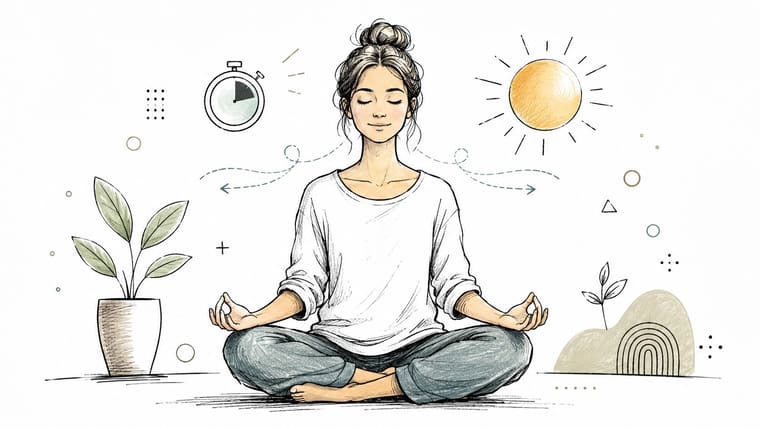
Mindfulness meditation earns its place in stress management because it targets the mechanism that often keeps stress running. Attention gets pulled into threat scanning, rumination, and future rehearsal. Meditation trains the return path.
A large body of clinical research supports that use case. Reviews of meditation programs have found evidence for reducing anxiety and smaller but measurable effects on depression and pain. The practical takeaway is narrower than many wellness claims. Meditation is not a fast personality change. It is a repeatable attentional skill that can lower stress reactivity with practice.
How to make meditation stick
The main failure point is not technique. It is adherence.
That is why this category works best when you treat meditation as a tracked habit rather than a mood-dependent choice. A five to ten minute session attached to an existing cue, after brushing your teeth, before opening email, or right after lunch, is easier to repeat than an abstract plan to “meditate more.” Visual completion matters here. A simple streak counter, calendar fill, or home screen progress widget gives you proof of repetition before you feel dramatic benefits.
Use this structure:
- Choose one format for two weeks: Breath awareness, body scan, or guided mindfulness. Constantly switching makes it harder to judge what works.
- Start with a duration you will repeat: Five minutes done six days a week beats twenty minutes done twice.
- Track sessions visibly: A habit widget or simple log helps you spot drop-off points. This fitness progress tracking approach adapts well to meditation because the same consistency rules apply.
- Troubleshoot by symptom: If sitting still increases irritation, use walking meditation. If your mind races at night, do a body scan before bed. If boredom is the issue, use guided sessions with a fixed endpoint.
- Review weekly: Look at completion, time of day, and friction points. Keep the routine if adherence is high. Change the cue or format if adherence is low.
The useful benchmark is consistency, not depth. Early sessions often feel plain, distracted, or restless. That does not mean the practice failed. It means you noticed where your attention went and brought it back.
This category also combines well with movement-based stress routines. An athlete might use a short body scan before training, then improve running with strength training as part of a broader regulation plan. Different tools can sit in the same routine if each one has a clear job.
A nurse ending a shift, a founder before a difficult meeting, and a student before exam prep may all use the same structure. Short session. Fixed cue. Visible tracking. Weekly adjustment. That combination is what turns mindfulness from good advice into a durable practice.
3. Physical Exercise and Movement
Regular physical activity is one of the most repeatable ways to lower stress because it acts on several mechanisms at once. It burns off physiological arousal, interrupts rumination, improves sleep, and reduces the muscle tension that often shows up as headaches, neck pain, or a tight back. For daily stress management, that combination matters more than whether the session looks impressive.
The practical question is not which workout is best in theory. It is which category of movement you can repeat under real conditions such as low motivation, limited time, or mental fatigue.
Here’s a useful movement demo to keep the barrier low:
Build the routine by movement category
Different formats solve different stress problems, so it helps to group them by job instead of treating exercise as one habit.
- Walking or light cardio for mental overload: Good for days when your thoughts feel noisy and you need a low-resistance reset.
- Strength training for accumulated tension: Useful when stress shows up physically and you want a structured task that creates a clear sense of progress.
- Mobility, yoga, or stretching for stiffness: Best when sitting, commuting, or poor sleep has left your body tight and uncomfortable.
- Short mixed sessions for busy schedules: Ten to fifteen minutes of squats, brisk walking, and mobility work often gets better adherence than an ambitious plan you keep postponing.
Tracking matters here because exercise is easy to overestimate. A visible log makes patterns obvious. You can track workout consistency with a simple visual progress system and review which category you find yourself using when stress is high, not which one sounds best on paper.
A useful weekly review is simple. Check completion, time of day, and how you felt an hour later. If walks happen but strength sessions keep slipping, keep the walk as the baseline and shorten the lifting plan until adherence improves.
Runners often benefit from pairing aerobic training with resistance work because it supports resilience, posture, and confidence in the body under load. If that matches your routine, this guide on how to improve running with strength training is a practical add-on.
The durable version of this habit is usually smaller than people expect. A 20-minute walk after work, two short strength sessions each week, or five minutes of mobility before bed can be enough to shift your stress baseline if the routine is stable.
4. Deep Breathing Techniques
Breathing is the fastest tool on this list. You can use it in a meeting, in traffic, before an exam, or right after a difficult email. That makes it different from habits that need more setup. It’s both a skill and an emergency brake.
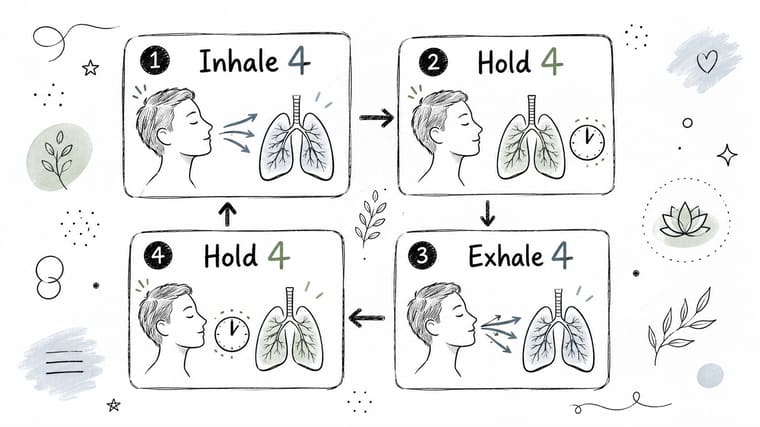
The mechanism is well established. Relaxation and stress management techniques such as deep breathing, progressive muscle relaxation, guided imagery, and mindfulness meditation activate the relaxation response and can produce meaningful reductions in blood pressure that persist for up to three months of follow-up, according to a systematic review and network meta-analysis published via PMC. The reported changes may be small, but they are clinically relevant for cardiovascular risk mitigation.
When breathing works best
People often wait until they’re already overwhelmed. That’s backwards. Practice when you’re calm, so the technique is available under pressure.
A useful setup looks like this:
- Use short sessions: Two or three minutes is enough to change your state.
- Anchor it to known stress points: Before presentations, after Slack pings, or while waiting for a call.
- Add a visual pause: Check your deadline widget, then take one breathing cycle before reacting.
- Keep the method simple: Box breathing and diaphragmatic breathing are easier to repeat than anything complicated.
A breathing technique is most valuable when you can remember it in the exact moment you feel your chest tighten.
Emergency clinicians, students before exams, and managers heading into conflict-heavy meetings all benefit from the portability. No equipment. No privacy required. Just repetition.
5. Cognitive Behavioral Therapy
Some stress isn’t about workload. It’s about interpretation. CBT helps when your mind turns uncertainty into disaster: “If I miss this deadline, everything falls apart.” “If my manager is quiet, I must be in trouble.” That thought pattern creates stress before reality has done anything.
CBT works because it forces a separation between event, interpretation, and action. Once you can see those pieces clearly, you get choices back. That’s why CBT shows up in therapy, workplace mental health programs, chronic pain treatment, and student support services. It gives people a structured way to challenge distorted thinking instead of arguing with their emotions in circles.
A practical CBT reset
Use this when you notice a spike:
- Catch the thought: Write the exact sentence running through your mind.
- Test it: Ask what evidence supports it and what evidence doesn’t.
- Replace it: Swap in a more realistic sentence, not a fake positive one.
- Act on the next step: Send the email, schedule the call, or break the task down.
For deadline stress, visual tools help here too. If your widget shows a realistic timeline, it’s harder for perfectionism to hijack the plan. If needed, work with a therapist trained in CBT for faster pattern recognition.
A common example is a university student who thinks one poor grade means long-term failure. Another is a founder who interprets every slow sales week as proof the business is collapsing. CBT slows that reflex and makes room for proportion.
6. Time Management and Goal Breaking
Poor time structure creates a special kind of stress because it keeps everything urgent at once. The fix isn’t becoming a productivity robot. It’s reducing uncertainty. When a project is split into concrete steps, the nervous system stops treating it like one giant threat.
Visual tracking and practical planning naturally overlap. A final deadline alone creates pressure. Intermediate milestones create traction. That’s why teams using sprint planning, editorial calendars, and launch checkpoints often feel calmer even when the workload is high. Structure reduces guesswork.
How to break a stressful project down
Break the work until each piece looks doable in one sitting or one clear block of focused time.
- Define the actual deliverables: Draft, review, revision, approval, launch.
- Assign separate deadlines: Don’t track only the final due date.
- Add buffer time: Delays happen. Build room for them.
- Review weekly: Timelines that never get updated become stress multipliers.
If procrastination is part of the problem, pair planning with a visible countdown for the next task, not just the finished outcome. This guide on how to stop procrastinating with better progress tracking fits that approach well.
A marketing team preparing a campaign, a student writing a dissertation, and an author drafting chapters all benefit from the same rule. Big goals feel less threatening when the next action is obvious.
7. Social Connection and Support
Social isolation is consistently linked with worse stress outcomes, while supportive relationships are associated with better emotional regulation and recovery after pressure. The CDC includes social connectedness among the factors that protect mental health across the lifespan. That matters because stress is not only an individual experience. It is shaped by whether you have people who help you interpret problems accurately, recover faster, and avoid carrying every demand alone.
The quality of support matters more than the number of contacts. A responsive friend, an honest colleague, or a therapist who helps you reality-check a situation can lower the sense of threat. A draining relationship often does the opposite. For stress reduction, the useful category is not “more socializing.” It is reliable, low-friction contact with people who leave you clearer and calmer.
Turn support into a repeatable habit
Support is more effective when it is built into routines instead of reserved for bad weeks. Treat it like any other stress-reduction category in your system and track it visibly.
- Set one recurring touchpoint: A weekly call, shared lunch, walking meeting, or study session.
- Match the support to the stressor: Use peers for work or school pressure, close friends for emotional support, and a clinician for ongoing anxiety or conflict.
- Track consistency, not intensity: A simple habit widget with checkmarks for contact can reveal when isolation starts creeping back in.
- Audit the aftereffect: After time with someone, note whether you feel steadier, more confused, or more activated.
- Plan a low-effort fallback: A short voice note or ten-minute call works better than waiting until stress peaks.
Good support improves accuracy as much as comfort. You feel less alone, and you think more clearly.
A remote employee might schedule a standing coworking block twice a week and mark it on the same tracker used for meditation or exercise. A student may rely on one dependable study partner instead of a large group that turns into distraction. A parent under strain may protect one recurring call with a friend who listens well and does not minimize the problem.
That pattern is easy to miss without review. If your stress log shows harder days clustering around stretches with no contact, the fix may be social routine, not better willpower. If support is on the calendar but still not helping, troubleshoot the source. Choose shorter interactions, switch to a more grounded person, or ask for a specific kind of help such as listening, problem-solving, or accountability.
8. Journaling and Expressive Writing
Expressive writing helps because it converts vague internal pressure into observable material. Once a stressor is on the page, you can sort it into categories such as trigger, interpretation, emotion, and next action. That shift matters. Stress often feels unmanageable because everything arrives at once.
Research supports the mechanism. In a review published by the University of Rochester Medical Center, journaling is associated with reduced stress, better mood awareness, and stronger emotional processing, especially when writing helps people organize what they are experiencing rather than replay it without structure.
Journaling is also one of the easiest techniques to turn into a repeatable practice because the setup cost is low. A notes app, a paper notebook, or a guided template all work. What improves results is consistency and a format you can repeat when your thinking is noisy.
Use prompts that reveal patterns, not just feelings
Free writing can help, but a simple framework usually produces better insight:
- Start with the event: What happened?
- Write the interpretation: What did you assume it meant?
- Name the emotion: Frustrated, embarrassed, tense, discouraged, angry.
- Mark the body signal: Tight chest, shallow breathing, clenched jaw, fatigue.
- Choose one next step: Send the email, postpone the decision, ask a question, take a walk.
This structure makes journaling more useful as a stress-reduction category, not just a place to vent. Over a few entries, the repeated links become visible. You may find that certain meetings trigger the same prediction of failure, or that late-night stress is less about workload than uncertainty. That gives you something specific to address.
A progress widget helps here. Track whether you wrote, how long you wrote, and whether the entry produced a clear next step. If the habit is slipping, reduce the target to five minutes. If you’re writing often but still ending more activated than settled, change the prompt. Focus less on retelling the whole event and more on identifying the thought pattern underneath it.
A therapist might use expressive writing between sessions to capture reactions before they blur. A student might keep a pre-exam log to separate preparation gaps from catastrophic thinking. A manager might write immediately after a difficult conversation, then review entries at the end of the week to see whether the same interpersonal trigger keeps driving stress.
The useful output is not the journal itself. It is the pattern record, the routine, and the small course corrections that follow.
9. Nature Exposure and Outdoor Time
Nature works differently from most stress reduction techniques because it asks less from you. You don’t need to perform well, think correctly, or track a detailed routine. You step outside, and your attention starts to widen on its own. That’s useful when stress has narrowed your focus into threat scanning.
A park walk after work, gardening on a weekend, or even sitting on a bench without notifications can act as a transition ritual. That’s the underused part. Nature isn’t only restorative on its own. It helps you switch states. From work mode to home mode. From rumination to observation. From urgency to pacing.
Use nature as a transition tool
Try these practical setups:
- Attach outdoor time to an existing shift: After work, after class, before dinner.
- Use sensory focus: Notice sounds, temperature, texture, and light.
- Leave the phone silent: If you’re still processing messages, you’re not really changing environments.
- Combine with gentle movement: Walking makes nature exposure easier to repeat.
A student can review flashcards in a park before heading home. A remote worker can use a short outdoor lap between meetings. A family can make a weekend garden task part of household rhythm. The effect is modest in the moment, but strong over time because it lowers the total amount of mental compression in your day.
10. Sleep Optimization and Sleep Hygiene
Poor sleep raises next-day stress reactivity, weakens attention, and makes every other stress-reduction habit harder to keep. Sleep works as a multiplier. If it slips, meditation feels less effective, workouts feel heavier, and emotional control gets less reliable.
Research on digital sleep support points in a useful direction here. A systematic review of digital behavioral interventions for sleep found consistent improvements in sleep outcomes across app-based and web-based programs, especially when they included structured routines, reminders, and self-monitoring. That fits the broader pattern in this article. Stress techniques stick better when they are visible, scheduled, and easy to repeat.
The sleep habits that matter most
Sleep hygiene is less about collecting tips and more about reducing variability. The highest-yield changes are usually simple:
- Keep a stable sleep and wake window: Regular timing helps the body predict when to feel alert and when to wind down.
- Build a short pre-sleep routine: Dim light, reduce stimulating inputs, and repeat the same 20 to 30 minutes of lower-friction activities.
- Use a planning tool for consistency: A sleep calculator for bedtime and wake-time planning can help turn intention into a repeatable schedule.
- Track the behavior, not just the outcome: Log bedtime, wake time, screen cutoff, caffeine timing, and night wakings. A simple progress widget or streak view makes patterns easier to spot than memory alone.
- Use calming methods as cues, not as rescue tools: Breathing drills or a brief body scan work best when they signal sleep onset consistently.
The useful distinction is between sleep effort and sleep setup. Trying hard to sleep often increases frustration. Improving the conditions around sleep usually works better.
A practical routine might look like this: screen cutoff at the same time each night, lights dimmed, one low-stimulation activity, then bed at a consistent hour. If that routine breaks for three nights in a row, troubleshoot the input rather than blaming motivation. Late caffeine, inconsistent wake times, intense evening work, and irregular training load are common causes.
Different groups need different adjustments. Shift workers often benefit more from anchor sleep periods and light management than from perfect consistency. Students usually need notification control and a fixed wake time. People under high occupational stress often need a clearer boundary between work completion and pre-sleep recovery, because unfinished cognitive load tends to follow them into bed.
Protecting sleep improves the rest of the system because it makes the other categories easier to perform consistently. That is why sleep belongs in the same framework as tracking, routines, and troubleshooting, not as an isolated wellness tip.
10 Stress-Reduction Techniques Comparison
| Technique | 🔄 Implementation & Resources | ⚡ Speed / Efficiency | 📊 Expected outcomes (⭐ effectiveness) | 💡 Ideal use cases / Key advantages |
|---|---|---|---|---|
| Visual Progress Tracking | Low–Medium: app/widgets setup, initial configuration time | ⚡ Moderate: immediate visual feedback; ongoing motivation | 📊 Increases motivation, reduces anxiety by ~23–30%, ⭐⭐⭐⭐ | Great for goal-oriented users, ADHD external structure, frequent milestone rewards |
| Mindfulness Meditation | Low: no equipment; requires consistent daily practice (minutes→weeks) | ⚡ Slow→Moderate: acute calm possible; major gains after 8+ weeks | 📊 Reduces anxiety/depression; large evidence base, ⭐⭐⭐⭐ | Use for long-term emotional regulation, focus improvement, pairs with guided apps |
| Physical Exercise & Movement | Medium: time commitment, possible equipment or facility; injury risk if untrained | ⚡ Fast: immediate mood lift; best with regular routine | 📊 Lowers cortisol 20–30%; improves sleep and energy, ⭐⭐⭐⭐⭐ | Ideal for mood elevation, chronic stress, social engagement, and physical health |
| Deep Breathing Techniques | Very low: learn techniques; no equipment | ⚡ Very fast: measurable calming within minutes | 📊 Rapid reduction in HR/cortisol (~25%) for acute stress, ⭐⭐⭐⭐ | Best for acute anxiety, pre-performance/meeting calm, fully portable |
| Cognitive Behavioral Therapy (CBT) | High: structured work; often requires therapist or guided programs | ⚡ Slow→Moderate: structured change over 8–12 weeks | 📊 Gold-standard for anxiety/depression; 60–80% show significant improvement, ⭐⭐⭐⭐⭐ | Best for chronic/clinical stress, changing thought patterns, long-term relapse prevention |
| Time Management & Goal Breaking | Medium: upfront planning and maintenance; tools/process adoption | ⚡ Moderate: reduces overwhelm and produces frequent wins | 📊 Structured goal-setting reduces stress ~40%, increases completion ~35%, ⭐⭐⭐⭐ | Ideal for project work, students, teams; pairs well with visual trackers |
| Social Connection & Support | Medium: time and emotional investment; access to supportive people or groups | ⚡ Moderate: immediate relief in many cases; depends on relationship quality | 📊 Strong social ties reduce stress-related risk significantly, ⭐⭐⭐⭐ | Use for emotional validation, problem-solving, accountability, combating isolation |
| Journaling & Expressive Writing | Low: time commitment (15–30 min); private or digital tools | ⚡ Moderate: benefits build with consistent practice | 📊 Lowers anxiety/depression ~20–30%; improves processing, ⭐⭐⭐ | Good for emotional processing, insight generation, therapy adjunct |
| Nature Exposure & Outdoor Time | Low–Medium: access to safe natural spaces; time/transportation required | ⚡ Fast: physiological benefits within minutes of exposure | 📊 Reduces cortisol 15–20%; restores attention and mood, ⭐⭐⭐⭐ | Best for mental restoration, chronic stress relief, pairs well with walking/exercise |
| Sleep Optimization & Hygiene | Medium: habit changes, environment adjustments; may need clinical help for disorders | ⚡ Slow: effects accumulate over weeks with consistent habits | 📊 Strong effects on resilience; reduces stress hormones 25–40%, ⭐⭐⭐⭐⭐ | Foundational for stress resilience, cognitive function, and emotional regulation |
Building a Stress-Resilient Routine
Adherence is the constraint that decides whether any stress-reduction plan works. The limiting factor usually is not knowing what helps. It is building a system simple enough to repeat during a bad week, not just a calm one.
The strongest routine usually includes three categories: one rapid downshift tool for acute stress, one baseline regulation habit that improves stress tolerance over time, and one organizational support that reduces avoidable pressure. In practice, that might mean deep breathing during spikes, movement on most days, and visual progress tracking for deadlines and unfinished tasks. This category-based structure matters because stress shows up in different forms. A single technique rarely covers physiological arousal, cognitive overload, and planning failure at the same time.
Keep the first version small. Three practices are usually enough to test fit without creating another system to manage.
Visibility increases follow-through. A progress widget, calendar block, or habit tracker keeps the routine in working memory, which is useful when stress narrows attention and pushes long-term habits out of view. That is one reason visual tracking works especially well for people dealing with deadline pressure, remote-work spillover, inconsistent schedules, or attention-related distractibility. The tracker is not the intervention itself. It is the cue that makes the intervention easier to start.
Weekly review is where the routine becomes resilient. Use a short check-in and score each habit on three questions: Did I do it, did it help, and did it feel realistic under normal conditions? Techniques that look effective on paper but create setup friction usually fail first. Techniques with modest benefits but high repeatability often produce better results over a month because they survive busy periods.
A useful troubleshooting rule is this: if a habit breaks twice in one week, reduce the scope before replacing the method. Cut a 20-minute meditation to 5 minutes. Switch from a full workout to a 10-minute walk. Change journaling from an open-ended entry to three lines. Stress routines last longer when they are designed for recovery after disruption, not perfect streaks.
As noted earlier, structured stress-management programs can produce measurable returns in health and work settings. The practical implication for an individual routine is straightforward. Consistent practice has value even when each session feels small. The benefit comes from repetition, low friction, and coverage across different stress scenarios.
If you want a low-friction way to keep stress-reducing habits visible, try Pretty Progress. It lets you create customizable countdowns and progress widgets for iPhone, iPad, Apple Watch, Mac, and Android, so your routines stay in view without extra effort. Use it to track meditation streaks, exercise plans, sleep goals, exam timelines, or project milestones, then turn stress into something clearer, calmer, and easier to manage.