
August 22, 2026
How to Achieve Goals Faster: A Step-by-Step Framework
Learn how to achieve goals faster with a proven framework. Discover habit strategies, progress tracking methods, and visual motivation tools
You sit down with a fresh plan, a clear ambition, and enough enthusiasm to believe this time will be different. Then work gets busy, your energy drops, one missed day becomes several, and the goal moves to the background. The problem usually isn’t a lack of desire. You haven’t yet built a system that makes the next action obvious, convenient, and visible.
Learning how to achieve goals faster isn’t mainly about writing more impressive goal statements. It’s about turning intention into scheduled behavior, reducing the resistance around starting, and keeping progress in view long enough for consistency to take over.
Table of Contents
- Why Most Goals Fail Before They Begin
- Clarify Exactly What You Want to Achieve
- Break Big Goals Into Doable Milestones
- Design Daily Habits That Carry You Forward
- Remove Friction and Track Your Progress
- Stay Accountable With Visual Motivation
- Your Action Plan for Faster Results
Why Most Goals Fail Before They Begin
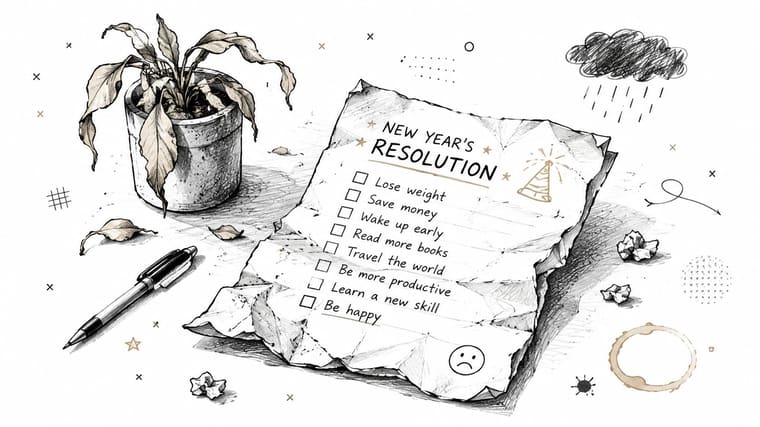
January often starts with a clean planner and a strong promise. You’ll exercise, change careers, learn a language, or finish the project that’s been waiting for your attention. By February, the planner may still look neat, but the goal has become something you think about rather than something you do.
That pattern doesn’t prove you lack discipline. It usually shows that you created a destination without a route. “Get healthier,” “grow my business,” and “write a book” describe outcomes, but they don’t tell you what to do at 7 a.m. on a difficult Tuesday.
Intention isn’t a schedule
A vague ambition forces you to make too many decisions at the moment action is hardest. You must decide when to begin, where to work, how much to do, and whether today’s effort is worthwhile. Each decision creates another opportunity to postpone.
Procrastination also deserves more attention than it gets in standard goal-setting advice. A longitudinal study found that baseline academic procrastination uniquely predicted less goal accomplishment, while a SMART-goal intervention and an implementation-intention intervention didn’t significantly reduce procrastination over the study period. The practical lesson is uncomfortable but useful: a better goal statement alone may not solve the behavior that delays completion. Read the common mistakes in goal setting with this distinction in mind.
Practical rule: If your goal doesn’t identify the next physical action, it’s still an aspiration.
Clarify Exactly What You Want to Achieve
Speed starts with precision. A clear goal reduces the mental work required to decide whether today’s action counts, and it gives you a finish line you can recognize.
Start by replacing the broad wish with a measurable outcome. “Get in shape” is difficult to execute because it could mean stronger muscles, improved endurance, different clothing, or a medical target. “Run three times per week for thirty minutes and complete a five-kilometer race under thirty-two minutes by June fifteenth” gives you a result, a behavior, and a date. If you want more guidance on structuring objectives, use this SMART objectives and goals guide.
Use the specificity protocol
Write one sentence that answers five questions:
- What will be different? Name the observable result rather than the feeling you hope to have.
- How will you measure it? Choose a count, completed deliverable, performance standard, or visible condition.
- When will it be complete? Select a date that creates urgency without demanding an impossible sprint.
- What behavior supports it? Identify the repeated action that moves the result forward.
- What does “done” mean? Define the completion criteria before you begin.
Consider how this changes different ambitions:
- Career: “Improve my career” becomes “Complete a portfolio with three case studies and submit applications for roles that match my target responsibilities by the end of the quarter.”
- Health: “Eat better” becomes “Prepare a weekday lunch at home and include a planned protein source and vegetables each day.”
- Personal project: “Learn photography” becomes “Finish a beginner course, practice one deliberate exercise each week, and publish a small portfolio by the chosen date.”
The result should be specific enough that another person could tell whether you completed it without asking what you meant. Avoid adding detail just to make the sentence sound professional. A goal becomes useful when it guides choices.
Separate the result from the process
Many people confuse an outcome with the actions that produce it. You control the actions more directly than the final result, so record both. For a job search, the result might be a completed role transition, while the process includes tailoring applications, speaking with relevant contacts, and improving a portfolio.
Don’t make every part of your life a performance dashboard. Choose one primary outcome and a small number of supporting behaviors. Too many measures turn clarity into administration, and administration can become another form of avoidance.
A useful goal should make today’s next step easier to identify, not merely make tomorrow’s ambition sound more inspiring.
Break Big Goals Into Doable Milestones
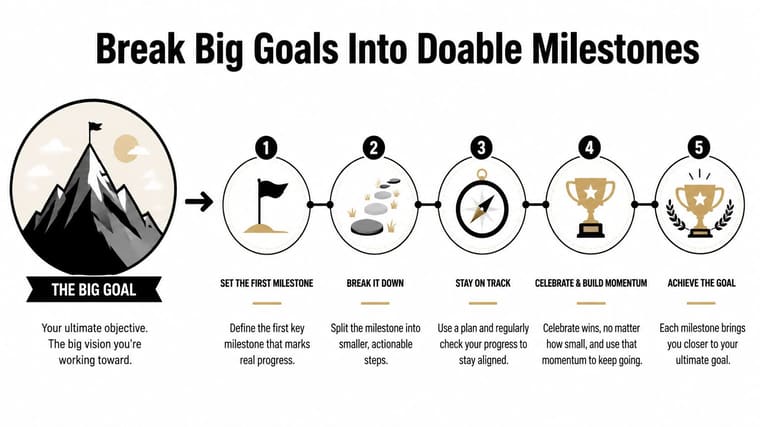
A large goal creates emotional distance between today and completion. Milestones shorten that distance, but only when they mark meaningful progress rather than arbitrary calendar points.
Compare “review progress every month” with “finish the research outline, test the central assumption, and decide whether to continue with the current approach.” The first is a checkpoint. The second is a decision gate. It produces evidence and tells you what to do next.
Map the route from outcome to action
Work backward from the finish line. Ask what must be true immediately before completion, then identify the milestone before that condition. Continue until you reach an action that fits into an ordinary work session.
A year-long professional initiative might become:
- Outcome: Deliver the completed initiative to its intended audience.
- Milestone: Approve the scope and success criteria.
- Milestone: Produce a working first version.
- Milestone: Test it with the relevant users or stakeholders.
- Milestone: Resolve the most important issues.
- Weekly action: Complete one defined piece of research, drafting, testing, or coordination.
This sequence is stronger than assigning “monthly targets” just because months exist. A milestone should answer a strategic question, reveal a dependency, or create something you can inspect. If it doesn’t change your understanding or enable the next stage, it may be a task wearing a larger name.
Use minimum viable milestones
When motivation dips, the next milestone shouldn’t require heroic effort. Define the smallest credible proof that the project is moving. For a writing project, that might be a complete outline. For a course, it might be a finished module with notes. For a product idea, it might be a tested draft rather than a polished launch.
Review points should support adjustment, not self-criticism. If a milestone takes longer than expected, ask whether the scope was too large, the dependency was missed, or the method needs changing. A schedule that can’t accommodate learning will encourage concealment and delay.
The progress schedule guide can help you turn broad timelines into visible checkpoints. Keep each milestone connected to the final outcome, and give the next action a clear home on your calendar.
Decision gate: Don’t ask only, “Did I work hard?” Ask, “What did I learn, and what decision does that evidence support?”
Design Daily Habits That Carry You Forward
Milestones tell you where to go. Daily habits determine whether you move when the initial excitement has disappeared.
The most practical tool here is an implementation intention, an if-then plan that specifies the cue and the response in advance. A meta-analysis covering 94 independent tests found a medium-to-large improvement in goal attainment, with an effect size of d = 0.65. The analysis also reported benefits for starting goal-directed behavior, resisting distractions, and disengaging from ineffective strategies. See the implementation-intentions meta-analysis for the underlying evidence.
Write the trigger before the action
Use this template:
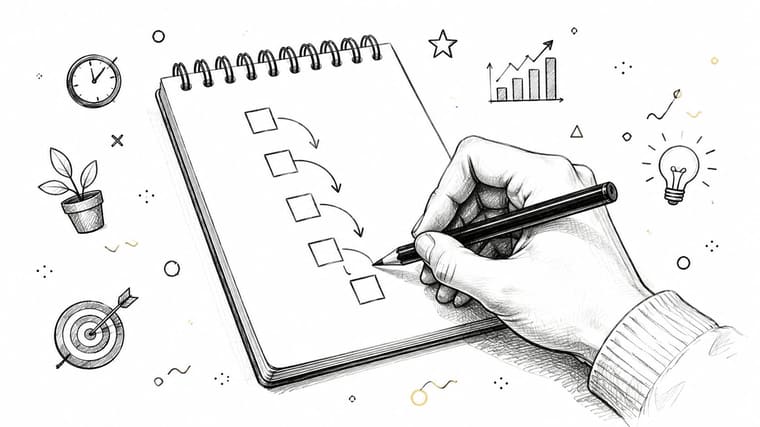
If [specific situation, time, and location] happens, then I will [specific action].
Weak version: “I’ll exercise more.”
Executable version: “If it’s 7 a.m. on a weekday, then I’ll put on my running shoes before checking my phone.”
The cue should be observable. “When I feel motivated” isn’t a cue because motivation is unreliable. A time, place, preceding routine, or external event gives your brain something concrete to recognize.
Attach the habit to an existing routine
Habit stacking works because you borrow stability from something you already do. After brushing your teeth, you might review your language cards. After opening your laptop, you might spend the first work block on the highest-value project. After dinner, you might prepare tomorrow’s equipment.
Keep the first version small enough to start on a difficult day. A short action that happens consistently gives you a stronger foundation than an ambitious routine that repeatedly collapses. Once the cue and response feel familiar, expand the work carefully.
Use this five-minute habit-stacking matrix:
- Existing anchor: What already happens reliably?
- New behavior: What action supports the milestone?
- Location: Where will the action occur?
- Preparation: What can you place or remove in advance?
- Recovery plan: What happens if you miss the preferred time?
The plan should also specify what you won’t do. “If I reach for social media during the work block, then I’ll put my phone outside the room and return to the open document.” That response protects the goal from a predictable distraction instead of relying on restraint in the moment.
The strongest habit is often the one that makes starting nearly boring. Put the shoes beside the bed, keep the document open, prepare the ingredients, or preselect the study material. You’re not trying to create a dramatic routine. You’re designing a reliable handoff from one behavior to the next.
Remove Friction and Track Your Progress
Motivation has a limited role in execution because it fluctuates with sleep, stress, workload, and the number of decisions already made. Friction is more dependable. If the environment makes an action difficult, you’ll need motivation every time. If the environment makes the action obvious and convenient, starting requires less negotiation.
Separate friction into two categories. External friction comes from the surroundings, tools, logistics, and unclear instructions. Internal friction comes from perfectionism, fear of judgment, all-or-nothing thinking, and the belief that a small effort isn’t worth doing.
Diagnose the obstacle before solving it
| Friction Type | Common Examples | Removal Strategy |
|---|---|---|
| External | Equipment is stored away, files are scattered, the next task is unclear | Prepare the environment, create one starting document, and place required tools within reach |
| External | Too many administrative steps interrupt progress | Batch routine work, use templates, and automate suitable repetitive tasks |
| Internal | “I need a perfect first attempt” | Define a rough first version and separate drafting from editing |
| Internal | “If I can’t complete the full session, there’s no point starting” | Set a minimum viable action that keeps the chain active |
| Internal | Anxiety about an unfamiliar task | Write the first physical action and work only until that action is complete |
Run a friction removal audit
Choose one goal and observe where you stop. Don’t label the problem “laziness” before you inspect the sequence. You may discover that the file is hard to find, the instructions are ambiguous, the appointment takes too long to arrange, or the first step feels exposed to judgment.
Remove one obstacle at a time:
- List the start sequence. Write every action required before meaningful work begins.
- Circle the delay point. Identify the step where you usually switch tasks.
- Shrink or relocate it. Preload the file, prepare the equipment, simplify the form, or move the action to a better time.
- Create a fallback. Decide what counts when the ideal version isn’t possible.
- Test the revised sequence. Keep what works and change what still causes hesitation.
For repetitive administrative work, automation can protect attention for higher-value actions. Someone managing a job search, for example, might explore a tool to automate your job applications with AIApply, then reserve personal effort for reviewing fit, improving materials, and preparing for conversations.
Make progress visible
Tracking isn’t decorative. A meta-analysis of 138 studies involving 19,951 participants found that interventions increased progress-monitoring frequency very strongly, with d+ = 1.98, and improved goal attainment, with d+ = 0.40. The benefit was larger when people reported results publicly and when they physically recorded progress, as described in this progress-monitoring research.
Record the behavior close to the moment it happens. A simple mark on paper, a completed task in a project board, or a visible progress bar gives you feedback that memory often blurs. The purpose isn’t to punish missed days. It’s to expose patterns early enough to adjust the system.
Stay Accountable With Visual Motivation
Willpower asks you to remember why the goal matters at the exact moment a distraction becomes available. Visual motivation works differently. It keeps the goal present during ordinary moments, including the moments when you aren’t actively thinking about self-improvement.
A spreadsheet can contain more information, but information isn’t automatically motivation. If you must open an app, find the correct tab, interpret several columns, and reconstruct your history, the tracking system adds friction. A glanceable progress bar or countdown communicates the state of a goal with almost no effort.
Turn progress into a daily environmental cue
A useful visual tracker should answer three questions quickly:
- What am I working toward?
- How far along am I?
- What happens next?
That visual cue doesn’t replace planning, habits, or accountability. It reinforces them. Your if-then plan determines the behavior, your milestone map determines the route, and the visual reminder keeps the route psychologically available.
Accountability also doesn’t require a strict coach or a public confession. You can share a target with a colleague, place a paper tracker beside your desk, or use a home-screen widget that appears whenever you check your phone. Choose the level of exposure that supports action rather than creating pressure.
Use Pretty Progress as a persistent reminder
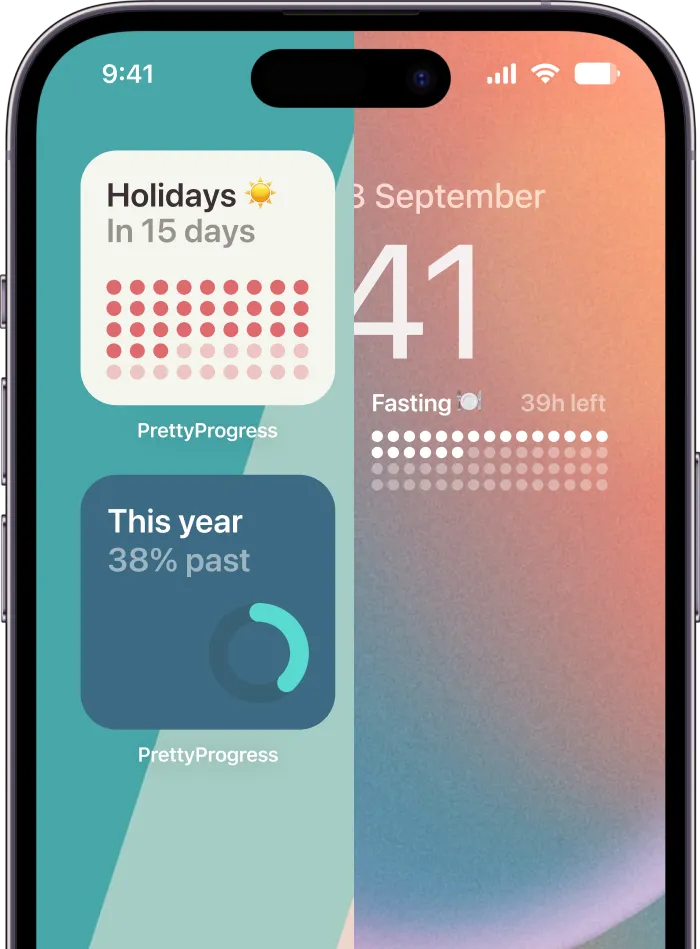
Pretty Progress is one option for turning a deadline or long-term target into a visible countdown and progress bar. It supports customizable widgets for iPhone and iPad Home and Lock Screens, Apple Watch, Mac, and Android, allowing you to display start and end dates, remaining time, or completion percentage without opening a planning document.
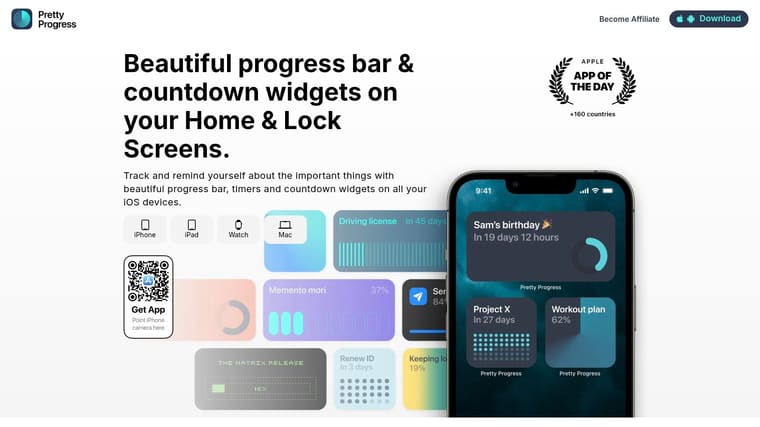
Set it up around a real milestone rather than an abstract life ambition. “Finish the portfolio” becomes a countdown to the delivery date. “Prepare for the exam” becomes a visible period with a defined start and end. A recurring setup can support ongoing targets such as routines or fasting windows.
The design matters because you’ll see the cue repeatedly. Pretty Progress includes curated themes such as Swiss Style, Minimal, Aqua, and Retro OS, along with controls for colors, gradients, bar size, shape, layout, and icons. Pick a style that stays readable and fits your screen. Excessive decoration can become another distraction, so the right design is the one you’ll notice without resenting.
Make the widget part of the system
Place the widget where your attention already goes. A Home Screen widget can reinforce a morning routine. A Lock Screen widget can remind you of a deadline before you open another app. A Mac or Apple Watch display can keep a work project visible during the day.
Use the visual cue to trigger a small action, not guilt. When you see the progress bar, review the next milestone, start the planned work block, or mark the latest completed step. The widget becomes useful when it connects directly to behavior.
Visual cue: Let the reminder prompt a decision. “What is the next action?” is more useful than “Why am I behind?”
Deadlines need nuance. A planning-fallacy model concluded that self-imposed deadlines improve task performance, while externally imposed deadlines maximize performance overall, according to the planning-fallacy research. However, deadlines aren’t universally motivating. Recent replication work found that evenly spaced deadlines didn’t improve key performance metrics, and other research indicates that deadline effects depend on attention and memory limits, as discussed in the deadline replication paper.
Use a firm date when it clarifies priority. Use gentler pacing when pressure reduces concentration or makes you avoid the work. A visible progress bar can support either approach because it shows movement without forcing every goal into an aggressive deadline.
Your Action Plan for Faster Results
Build the system over one focused weekend rather than waiting for a perfect planning day.
Tonight: Write one specific goal with a measurable outcome, a completion date, and a definition of done.
Tomorrow: Map the first three milestones backward from that outcome. Turn the first milestone into weekly actions, then write one if-then plan with an exact cue, place, time, and response.
During the week: Remove one external obstacle. Prepare the tools, simplify the start sequence, or automate a repetitive administrative task. Record each completed action where you can see it.
By Friday: Add a visual reminder for the active milestone and review whether the deadline creates useful focus or unnecessary pressure.
By Sunday: Keep the routine that worked, revise the one that failed, and choose the next decision gate.
For broader planning across personal priorities, this household goals for the year guide can help you coordinate shared targets without turning them into vague promises.
Save this checklist:
- Define: Outcome, measure, date, and completion criteria.
- Divide: Three meaningful milestones and a next action.
- Trigger: One precise if-then habit.
- Simplify: Remove one external and one internal barrier.
- Monitor: Record progress close to the action.
- Display: Keep the active goal visible.
Consistency isn’t perfection. It’s the ability to return to the next clear action quickly.
Pretty Progress turns deadlines and milestones into customizable countdowns and progress widgets across your everyday devices. Visit Pretty Progress to set up a visible reminder for the goal you’re ready to move forward today.