
May 8, 2026
SMART Objectives and Goals: A Practical Guide for 2026
Learn how to set and achieve SMART objectives and goals. This practical guide has examples, templates, and tracking tips to turn your ambitions into reality.
You start the year with energy. You write down something like “get healthier,” “be more productive,” or “finally finish that course,” and for a few days it feels real. Then life gets loud, the goal gets fuzzy, and by February you’re not sure what you were supposed to be doing in the first place.
That isn’t a motivation problem as much as a clarity problem. Individuals often don’t fail due to a lack of care. They fail because the goal lives too high in the clouds. It sounds inspiring, but it doesn’t tell them what to do on Tuesday afternoon.
That’s where smart objectives and goals become useful. Not as corporate jargon, but as a bridge between a big intention and a daily action you can follow. When you can see the goal clearly, break it into concrete steps, and track progress in a visible way, staying consistent gets much easier.
Table of Contents
- Why Most Goals Fail Before They Start
- Decoding the SMART Goal Framework
- From Vague Ambition to Actionable Objective
- SMART Goal Examples for Every Part of Your Life
- Common Mistakes When Setting SMART Goals
- How to Track Your Goals and Stay Motivated
Why Most Goals Fail Before They Start
A lot of goals die in the same quiet way. You pick a broad ambition like “get fit.” You buy a water bottle, maybe a notebook, maybe new shoes. For a week or two, that feels like progress. Then work gets busy, your routine breaks, and the goal turns into background guilt.
The problem is that “get fit” isn’t a target. It’s a theme. Themes can inspire you, but they can’t guide your next step. The same thing happens at work with goals like “improve team communication” or “grow the business.” They sound important, but they leave too much room for drift.
Even companies struggle with this. Only 20% of companies successfully complete around 80% of their strategic goals, according to a summary cited by Tableau’s explanation of SMART goals. If organizations with managers, meetings, and planning tools miss the mark this often, it makes sense that individuals do too.
Vague goals create emotional pressure without giving you a map.
That’s also why goals often trigger mental spinning. If you’re stuck in the loop of “I know this matters, but I don’t know where to begin,” it helps to learn how to stop overthinking. Overthinking thrives in ambiguity. Clear objectives reduce the space where anxiety likes to grow.
A better approach is to turn the ambition into something observable and schedulable. Instead of “be more consistent,” you define what consistency looks like, how you’ll notice it, and when you’ll review it. If you’ve struggled with follow-through, this guide on staying consistent with goals is useful because consistency usually comes after clarity, not before it.
Decoding the SMART Goal Framework
What SMART was designed to fix
SMART stands for Specific, Measurable, Achievable, Relevant, and Time-bound. The framework was first described in print in 1981 by George T. Doran as a response to poorly defined organizational goals, and its underlying principles connect to Management by Objectives programs that increased productivity in 68 out of 70 studies. That background is summarized in the earlier-cited Tableau reference.
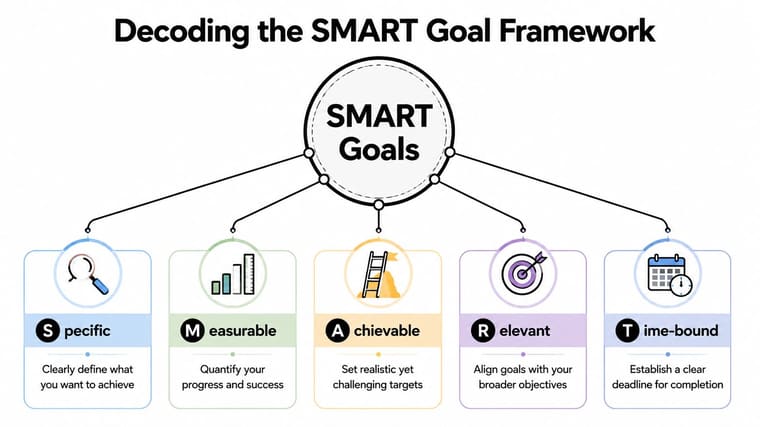
The reason SMART has lasted is simple. It forces a fuzzy wish to become a decision. You stop saying “I want to do better” and start saying what better means in real life.
The five letters in plain English
Think of SMART like setting a route in a GPS.
If you type only the name of a city, you’ll get somewhere in the area. If you type a full address, you know where you’re going. That’s Specific.
If you’re playing a game, the scoreboard tells you whether you’re winning, tied, or falling behind. That’s Measurable.
If the route asks you to drive across an ocean, the plan is broken. That’s Achievable.
If the destination has nothing to do with where you meant to go, even a perfect route is wasted. That’s Relevant.
If there’s no arrival time, you can keep delaying forever. That’s Time-bound.
Here’s what each letter looks like in everyday language:
-
Specific means naming the exact outcome.
“Read more” is vague. “Read one nonfiction book related to leadership” is clearer. -
Measurable means deciding what evidence will show progress.
That might be pages read, workouts completed, lessons finished, or applications sent. -
Achievable means honest sizing.
It should stretch you, but it should still fit your actual week, energy, and responsibilities. -
Relevant means the goal matters to your bigger picture.
A goal can be precise and well planned but still be a distraction. -
Time-bound means giving it a finish line.
Deadlines create healthy pressure. Without one, goals stay in the “someday” pile.
Practical rule: If a stranger read your goal and still had to ask “What exactly are you doing?” or “How will you know you did it?” the goal isn’t finished yet.
A good SMART objective doesn’t need fancy wording. It just needs enough detail to remove confusion. For example:
| Weak version | Stronger SMART version |
|---|---|
| Get better at writing | Write for 20 minutes after dinner on weekdays and complete one article draft by the end of the month |
| Exercise more | Walk for 30 minutes on Monday, Wednesday, and Saturday for the next six weeks |
| Save money | Transfer money into savings every Friday until the chosen purchase date |
Notice what changed. The stronger versions tell you what to do, when to do it, and what counts as progress. That’s why smart objectives and goals feel less inspiring at first glance, but work better in practice.
From Vague Ambition to Actionable Objective
Start with the bigger goal
Let’s use a common high-level goal: “I want to read more.”
That’s a fine ambition. It tells you the direction, but not the behavior. It’s like saying you want to “travel more.” It may be true, but it doesn’t help you book a train, pack a bag, or choose a date.

A high-level goal is the umbrella. The SMART objective is the handle you can grab. Confusion often arises here. People think the abstract goal is wrong. It isn’t. It’s just incomplete.
For example:
- Big goal: Be healthier
- Objective: Prepare lunch at home on workdays for the next month
Or:
- Big goal: Grow professionally
- Objective: Finish a specific course and apply the new skill in one work project by a chosen date
Turn the idea into a usable objective
Let’s walk the reading example through the filter.
Start broad: I want to read more.
Now sharpen it:
-
Specific
What kind of reading counts? Books, articles, fiction, research, or study material? -
Measurable
Will you track books completed, pages read, or reading sessions? -
Achievable
Given your schedule, what’s realistic? One book a week may sound exciting, but one book a month may fit your actual life better. -
Relevant
Why this goal? For enjoyment, career growth, concentration, or reducing screen time? -
Time-bound
By when?
That turns into something like this:
Read 12 nonfiction books by December 31, 2026, by reading for 20 minutes before bed at least five nights a week, to support professional growth and reduce idle phone time.
That objective has shape. You can act on it tonight.
A useful way to think about this is to separate goal, objective, and system:
| Layer | What it means | Example |
|---|---|---|
| Goal | The broad direction | Become more knowledgeable |
| Objective | The SMART version | Read 12 nonfiction books by the end of the year |
| System | The recurring behavior | Read 20 minutes before bed and track each finished book |
If you want help turning the finished objective into something you can monitor day to day, a goal progress tracker app can make the shift from intention to routine much easier.
A short visual walkthrough can help if you want to see this transformation in action:
SMART Goal Examples for Every Part of Your Life
Examples are where this framework starts to feel practical. Another definition of SMART isn’t often required. Instead, the focus should be on seeing what a weak goal sounds like next to a usable one.
Before and after examples
Here’s a simple table you can borrow from and adapt.
| Category | Vague Goal | SMART Objective |
|---|---|---|
| Professional Development | Get better at my job | Complete one job-relevant course and use one lesson from it in a current project by a set review date |
| Academic Studies | Study more consistently | Review class notes for 30 minutes after school on weekdays and finish weekly revision before the weekend |
| Health and Fitness | Get fit | Walk after dinner on four evenings each week and log each session until your chosen milestone date |
| Personal Habits | Be less distracted | Keep your phone in another room during one focused work block each weekday for the next month |
| Reading | Read more | Finish one book each month by reading before bed on most nights |
| Finances | Save money | Transfer money to savings on payday and review spending at the end of each week |
| Relationships | Stay in touch better | Call a family member every Sunday evening for the next two months |
| Home Life | Be more organized | Declutter one drawer or shelf every Saturday morning until the room is finished |
A few patterns are worth noticing.
First, the vague goals use soft language like “better,” “more,” and “less.” Those words feel meaningful, but they hide the action. Second, the stronger versions include a repeatable behavior. That matters because outcomes often lag. You may not see the result right away, but you can still complete the behavior today.
If your goal can’t survive a normal Wednesday, it’s probably too abstract or too ambitious.
This matters in long-term areas too. Financial planning is a good example. “Feel more secure” is emotionally valid, but hard to act on. A more grounded version might focus on routine reviews, savings transfers, or spending boundaries. If you’re thinking about money not just as accumulation but as time freedom, this piece on optimizing your Freedom Age with data offers a useful lens.
Here’s a quick rewrite pattern you can use on your own goals:
- Start with the wish: “I want to…”
- Replace vague verbs: swap “improve,” “get better,” or “do more” for an observable action
- Add evidence: decide what you’ll count
- Check the fit: make sure it matches your real week
- Name the deadline: even a gentle one is better than none
That simple pattern helps smart objectives and goals feel less like a worksheet and more like a translation tool.
Common Mistakes When Setting SMART Goals
A lot of people think they’re using SMART goals when they’re really writing polished wish lists. The words sound structured, but one or two letters are doing no real work.
When measurable goes missing
The most common miss is Measurable. Research highlighted by Mooncamp’s summary of goal-setting statistics found that less than 25% of goals in one study of health interventions clearly identified how achievement would be measured.
That mistake shows up everywhere:
- “I want to be more productive”
- “I want to improve my health”
- “I want to make progress on my side project”
None of those tells you what success looks like. You can’t finish what you can’t identify.
Try these fixes instead:
- If the goal feels foggy: add a count, frequency, duration, or completion marker.
- If progress feels emotional: choose an external sign, like sessions completed or milestones finished.
- If you keep changing the standard: decide in advance what “done” means.
“Measurable” doesn’t mean everything has to become a spreadsheet. It means you need a reliable way to tell whether you moved.
Other traps that make a good goal go stale
Some goals fail because the A is off. They’re technically specific and measurable, but wildly mismatched to real life. A person who hasn’t exercised in months sets a daily training plan. A busy student promises hours of study every night. The plan looks disciplined, but it collapses on contact with reality.
Other goals fail at Relevant. You can write a perfect SMART statement for a goal you are not invested in. If the objective exists because you feel you “should” do it, motivation leaks fast.
Use this quick self-check:
| Symptom | Likely issue | Fix |
|---|---|---|
| You keep avoiding the first step | Achievable may be too aggressive | Shrink the scope until starting feels reasonable |
| You’re busy but not satisfied | Relevant may be weak | Ask why this goal matters now |
| You don’t know whether you’re improving | Measurable is missing | Add a clear marker for progress |
| The goal keeps drifting into next month | Time-bound is vague | Pick a real review date |
The framework works best when it’s honest. Not impressive. Honest goals are the ones people complete.
How to Track Your Goals and Stay Motivated
Writing the goal is only half the job. The other half is keeping it visible long enough for action to repeat.
Why visibility changes behavior
When goals disappear into a notes app or the back page of a notebook, they stop influencing your day. Visible tracking keeps the objective in your line of sight and gives you a small cue to keep going.
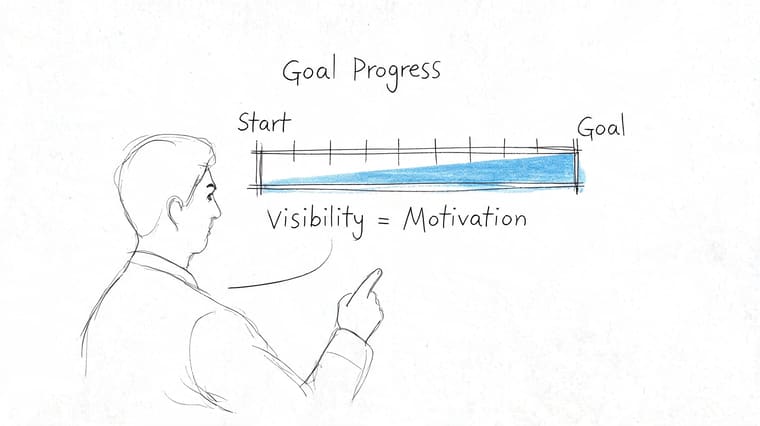
That matters because setting specific, ambitious goals with a deadline can boost attainment by 42% compared to vague goals, and visual cues from tracking tools can provide dopamine reinforcement that supports habit formation, according to the Minnesota Department of Health resource on SMART objectives.
You don’t need a complicated system. A checklist, a weekly review, a progress bar, or a countdown can all work. The key is that progress becomes visible before motivation fades.
A simple tracking rhythm
A lightweight rhythm works better than an elaborate one you won’t maintain:
- Keep the goal visible: put it somewhere you’ll see
- Review weekly: ask what moved, what stalled, and why
- Track behavior, not just outcomes: especially when results take time
- Use visual feedback: progress bars and countdowns make distance feel concrete
If visual tracking helps you stay engaged, this guide to SMART goals visual tracking shows why people respond so well to seeing progress instead of just thinking about it.
A goal you can see is harder to forget, easier to return to, and more satisfying to continue.
If you want a clean way to keep goals visible every day, Pretty Progress turns your deadlines, habits, and long-term plans into customizable countdowns and progress widgets on your devices. It’s a simple way to keep smart objectives and goals in front of you, so they stay active in daily life instead of slipping back into the “someday” pile.