
April 17, 2026
How To Stay Consistent With Goals & Achieve Success
Master how to stay consistent with goals. Our 2026 guide offers practical steps: clarify, break down, and track for lasting habit formation.
You probably know the pattern. You start a goal with clean energy, a fresh app, a new notebook, and a convincing speech to yourself about how this time will be different. Then work gets busy, your routine shifts, you miss a day, and the goal slides out of view. Not because you stopped caring. Because the goal stopped being present.
This is a common problem for those trying to figure out how to stay consistent with goals. The goal lives in your head, but your day lives on your phone, your calendar, your inbox, and your habits. If the goal isn’t visible inside that environment, it gets crowded out by whatever feels urgent.
Consistency rarely breaks because a person is lazy. It usually breaks because the system asks for too much memory, too much motivation, and too many fresh decisions. A better approach is to make the goal hard to ignore, easy to act on, and simple to recover when life gets messy.
Table of Contents
- Why Willpower Fails and Systems Succeed
- Step 1 Define a Goal That Pulls You Forward
- Step 2 Create an Actionable Micro-Plan
- Step 3 Make Your Progress Visible and Constant
- Step 4 Build a Simple Accountability Loop
- Step 5 Troubleshoot When You Fall Off Track
Why Willpower Fails and Systems Succeed
Most goals don’t die in dramatic fashion. They fade. A few skipped workouts become a two-week gap. One missed study session turns into vague guilt. A writing habit gets pushed to tomorrow until tomorrow stops meaning anything.
That’s why willpower is such an unreliable foundation. Willpower depends on energy, mood, sleep, stress, and how many decisions you’ve already made that day. It works in short bursts. Goals that matter usually take longer than your motivation lasts.
A system works differently. It reduces choice. It adds cues. It gives your goal a place in your normal day instead of asking you to remember it from scratch every morning. If you’ve ever tried to create a morning routine that actually sticks, you’ve already seen the difference between a vague intention and a repeatable structure.
Why motivation drops so fast
The common advice is to “want it more.” That sounds strong, but it doesn’t solve the problem. On low-energy days, people don’t need a speech. They need a setup that tells them what to do next.
A useful system does three things:
- It removes ambiguity. You know the next action without negotiating with yourself.
- It stays visible. The goal appears in your environment instead of hiding in a planner you forgot to open.
- It survives imperfect days. Missing once doesn’t turn into quitting.
Consistency doesn’t come from feeling ready. It comes from making the next step obvious enough that you do it before your mood gets a vote.
What usually works and what usually fails
Here’s a common trade-off:
| Approach | What happens |
|---|---|
| Relying on inspiration | Strong start, weak follow-through |
| Making a huge plan | Feels productive, becomes hard to execute |
| Tracking only outcomes | Creates pressure when results lag |
| Building a visible daily system | Keeps the goal active in real life |
The mistake isn’t caring too little. The mistake is expecting emotion to carry a long-term goal by itself.
If your past attempts have felt inconsistent, that doesn’t mean you lack discipline. It usually means your goal depended on memory, mood, and self-control. That’s a fragile setup. A stronger one starts with a goal that means something, then turns it into actions, visual cues, and social follow-through.
Step 1 Define a Goal That Pulls You Forward

A goal should create direction, not just pressure. If the goal only sounds impressive, it won’t hold up when the work gets repetitive. The goals people stick with are usually tied to identity, values, or a life they want to live.
The PACT methodology gives a useful frame here: Purposeful, Actionable, Continuous, Trackable. Goals rooted in core values sustain motivation better than shallow rewards, and this approach can boost long-term consistency rates to 65-75% in professional and student cohorts according to the PACT framework overview.
Start with identity, not achievement
A weak goal says, “I want to run a marathon.”
A stronger goal says, “I’m building a life where I’m disciplined, healthy, and someone who keeps promises to myself.”
The second version matters because it changes the role of each daily action. A short run is no longer “too small to count.” It becomes evidence of the person you’re becoming.
If you coach others, manage a team, or tend to set polished but hollow goals, this deeper framing is worth studying. Mastering Coaching Goal Setting is a useful resource for thinking through goals that connect behavior to real change instead of surface-level ambition.
Use questions like these:
- What value sits underneath this goal? Health, mastery, freedom, reliability, service, creativity.
- Who do I become if I stay with this for a year?
- Would I still care about this if nobody saw the result?
Practical rule: If a goal only excites you at the finish line, it probably won’t carry you through the middle.
Make the goal concrete enough to guide today
Meaning matters, but meaning alone is too abstract. A strong goal needs enough shape to influence today’s behavior.
Try this simple progression:
- Name the bigger aim. “I want to become financially calmer.”
- Tie it to identity. “I want to be someone who makes deliberate money decisions.”
- Translate it into a current target. “I will review spending every Sunday and save consistently.”
You can also use tools that make long-range goals feel more tangible. A simple example is this life expectancy calculator, which can prompt a different kind of reflection about time, priorities, and what deserves sustained effort.
The point isn’t to make the goal dramatic. It’s to make it emotionally honest and behaviorally useful.
A quick visual explanation can help if you tend to overcomplicate this stage:
Step 2 Create an Actionable Micro-Plan
A meaningful goal still won’t happen if the daily action is fuzzy. “Work on my book,” “get healthier,” and “prepare for exams” all sound serious. They also create hesitation because they don’t tell you what to do at 7:10 p.m. on a tired Tuesday.
That’s where a micro-plan matters. It turns intention into a script.
Turn the goal into a script
Implementation Intentions are one of the cleanest tools for follow-through. They use a simple formula: I will [BEHAVIOR] at [TIME] in [LOCATION]. According to James Clear’s summary of implementation intentions, this approach is backed by over 300 meta-analyses, can double goal adherence rates, increases follow-through by 200-300% across domains, and helps bypass the 65% of failures in vague goals tied to willpower depletion.
Examples work better than theory:
- Study goal: I will review biology flashcards at 6:30 p.m. at my desk.
- Fitness goal: I will walk for 15 minutes at 7:00 a.m. after coffee in my neighborhood.
- Writing goal: I will draft 200 words at 8:15 p.m. at the kitchen table.
That sentence matters because it removes three common stalls: deciding what, deciding when, and deciding where.
Shrink the action until resistance drops
Many people sabotage themselves at this step by making the daily action too ambitious. They build a plan for their ideal self, not their real schedule.
A better rule is to make the first action almost too easy to refuse.
- If the habit is new, shrink it. Ten minutes of reading beats a one-hour reading plan you avoid.
- If the day is unstable, use a minimum version. “One paragraph” protects the writing habit when “write for an hour” doesn’t happen.
- If the task feels abstract, define the first motion. Open the document. Put on shoes. Set the timer. Start the practice test.
A micro-plan should feel a little boring. That’s a good sign. Boring plans survive real life.
For deadline-based goals, it also helps to reverse-engineer the timeline with a visual tool like this date countdown calculator. It can turn a distant date into a sequence of smaller windows for weekly action, which makes the plan easier to honor.
The best daily plan is not the one that looks impressive on paper. It’s the one you can still do when your energy is average.
Step 3 Make Your Progress Visible and Constant
Out of sight is a bigger threat to consistency than lack of ambition. People don’t usually stop because they’ve carefully decided the goal no longer matters. They stop because the goal disappears behind messages, meetings, errands, and whatever else is flashing for attention.
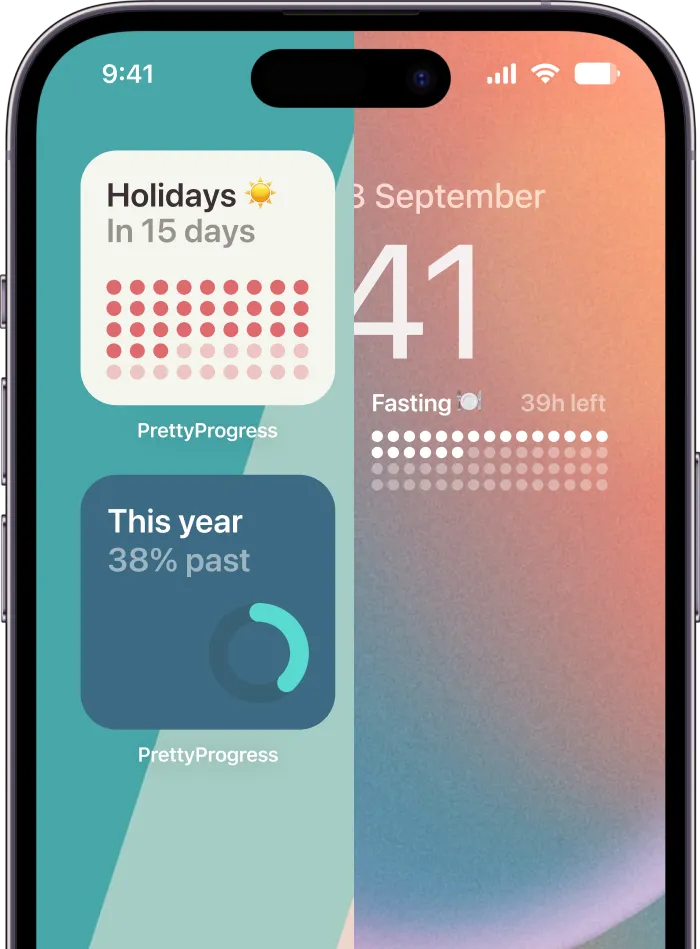
Visibility changes that. When a goal sits on your home screen, lock screen, watch face, or desk, it becomes part of your environment instead of another promise stored in memory.

Track what you control
Many digital systems go wrong. They highlight outcomes that you can influence but not fully command. That can create pressure fast.
According to Ethos Colorado’s discussion of consistency and controllable actions, digital tools can increase anxiety if they focus only on outcomes. Configuring visual trackers around process-based goals instead of outcome-dependent metrics is proven to reduce procrastination and increase psychological safety.
That means:
| Better to display | More stressful to display |
|---|---|
| Days practiced | Days until ideal body weight |
| Writing streak | Book sales target |
| Next workout session | Deadline with no action plan |
| Weekly outreach count | Promotion result |
A process display keeps attention on the action that moves the goal. That lowers friction because the next step feels doable.
Build a visual environment that nudges you
A visible system should answer one question quickly: what am I trying to stay in motion on?
One practical setup is:
- Main widget or tracker for the overall milestone. Exam date, project deadline, race day, launch date.
- Smaller visual trackers for process goals. Practice streak, study sessions completed, days since restart, next review block.
- One screen location you see often. Lock screen beats a buried dashboard.
For people who want a dedicated widget-based option, Pretty Progress can place countdowns and progress bars on iPhone screens so the goal stays glanceable throughout the day. The important part isn’t the brand name. It’s the principle. Your system should interrupt forgetfulness without requiring extra effort from you.
If you want to know how to stay consistent with goals, don’t just ask whether the plan is good. Ask whether the plan is visible.
The right visual cue is quiet, persistent, and hard to miss. It doesn’t nag. It keeps the goal alive.
Step 4 Build a Simple Accountability Loop
Private goals feel safe. They also disappear easily. The moment your goal includes another person, even in a lightweight way, follow-through changes because the commitment now exists outside your own shifting moods.
That doesn’t mean you need a coach, a mastermind, or a public challenge. You will often find more success with something smaller and repeatable.
Use social pressure the right way
Research on accountability is hard to ignore. People who commit their goals to someone else increase their chances of success to 65%, and that rises to 95% when they schedule ongoing accountability appointments, according to the accountability findings summarized here. The same source notes that writing down goals and sharing weekly updates with a friend leads to a 76% success rate, compared to 43% for those who don’t.
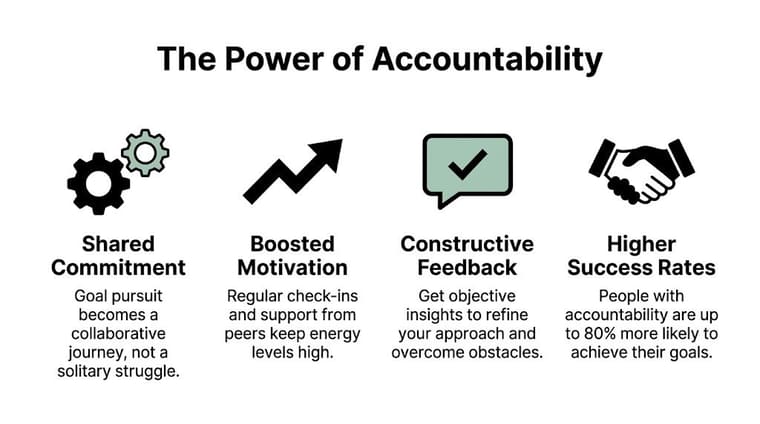
The practical takeaway is simple. Accountability works because it creates a recurring moment where you have to tell the truth about what happened.
What helps most is not intense scrutiny. It’s regular contact.
Keep the check-in boring and repeatable
A good accountability loop should feel almost mechanical. Avoid making it emotional, complex, or dependent on long conversations.
Try one of these:
- Weekly text check-in: Send three lines every Friday. What I planned. What I did. What I’ll do next week.
- Shared note: Keep a running log with one friend. Add updates on the same day each week.
- Recurring calendar appointment: Fifteen minutes, same time, same questions, no rescheduling unless necessary.
What doesn’t work as well:
- Waiting until you “have progress” to report
- Choosing someone vague or inconsistent
- Making the check-in about excuses instead of actions
You also need the right person. Pick someone reliable, calm, and comfortable being direct. The best accountability partner doesn’t shame you. They notice patterns and ask whether your system still fits your life.
Step 5 Troubleshoot When You Fall Off Track
The most dangerous moment in any goal is not the hard day. It’s the story you tell yourself after the hard day. Many people treat one miss as proof that the plan has failed, or that they’ve failed with it.
That reaction is where goals usually collapse.
Research summarized in Psychology Today’s analysis of goal failure notes that 92% of people never achieve their goals, and after experiencing failure, 88.9% of individuals choose an easier task, effectively abandoning the more ambitious one. The same source frames success as belonging to the 8% who stay with meaningful goals.
Treat missed days as system feedback
When you fall off, don’t ask, “What’s wrong with me?”
Ask better questions:
- Was the daily action too big?
- Did I lose the visual cue?
- Did the time or location stop fitting real life?
- Did I avoid the check-in because I was embarrassed?
That shift matters. Shame makes people hide. Analysis helps people adjust.
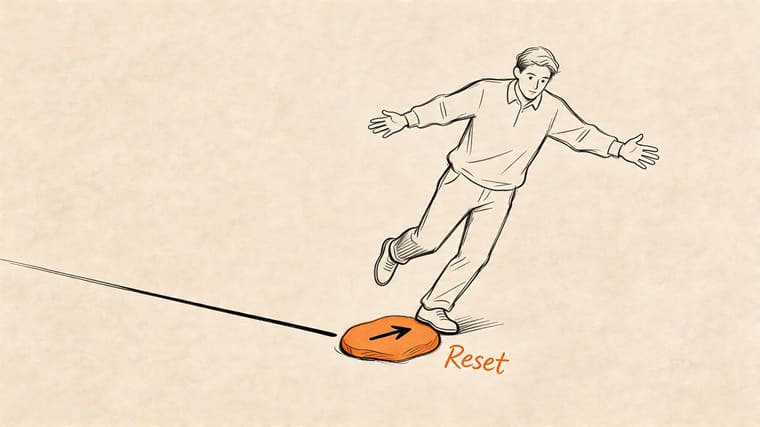
Missing once is an event. Quitting is a decision made after the event.
Use a reset that happens fast
Your recovery plan should be short enough to use immediately.
Try this reset sequence:
- Resume with the smallest valid version. Five minutes counts if the alternative is another lost day.
- Restore the cue. Put the tracker back where you’ll see it.
- Message your accountability partner. One honest sentence is enough.
- Review the failure point. Change the plan, not just your attitude.
One hard truth from coaching is that consistency doesn’t come from perfect execution. It comes from fast recovery. People who keep going aren’t the ones who never slip. They’re the ones who return before the gap turns into a new identity.
If you want a low-friction way to keep a goal visible every day, Pretty Progress can help you place countdowns and progress bars on the screens you already check. That works well for long-term goals because it reduces the need to remember, re-motivate, and re-decide. The goal stays present, and that simple shift often makes consistency easier to maintain.