
June 9, 2026
Progress Schedule: A Guide to Visualizing Your Goals
Learn what a progress schedule is and how to use visual timelines to track goals, manage deadlines, and stay motivated. Perfect for students, pros, and ADHD.
You open your phone to “get organized,” then freeze.
There’s a paper due in a few weeks. A savings goal that keeps slipping. A fitness plan you meant to restart on Monday. The problem usually isn’t knowing what you want. It’s that the distance between where you are now and done feels blurry, huge, and hard to trust.
That’s where a progress schedule helps.
In professional settings, the term comes from serious planning work. Construction teams, engineers, and project managers use progress schedules to map sequence, timing, and progress across complicated jobs. But the same core idea works for regular life too. You can turn a vague goal into something visible, current, and easier to act on.
A good progress schedule is basically a visual answer to one calming question: How far along am I, and what happens next?
When you can see your place on the path, big goals stop feeling like fog. They start feeling like a route.
Table of Contents
- That Overwhelming Feeling and the Power of a Visual Plan
- What Is a Progress Schedule Really
- The Four Key Components of a Personal Progress Schedule
- Why Visual Progress Is a Game Changer for Your Brain
- Real-World Examples You Can Set Up Today
- Setting Up Your First Progress Schedule in 3 Minutes
- Best Practices to Keep Yourself on Track
That Overwhelming Feeling and the Power of a Visual Plan
A lot of people hit the same wall. The task itself isn’t impossible, but the timeline feels too big to hold in your head.
A student stares at a thesis deadline and keeps thinking, “I still have time,” until suddenly it feels late. A professional knows a launch is coming but only feels the pressure when the calendar gets tight. Someone trying to build a habit says they want consistency, but each day feels disconnected from the bigger goal.
That’s why a visual plan matters.
A progress schedule takes something abstract and gives it shape. Instead of “I should work on this more,” you get a visible track from start to finish. You can tell whether you’re early, behind, or right on pace. More importantly, you stop relying on mood to decide what to do next.
Practical rule: If a goal only exists in your head, it will usually feel larger and less manageable than it really is.
This is one reason visual trackers feel so relieving. They reduce mental load. You don’t have to recalculate the whole goal every morning. The schedule holds the structure for you.
For personal goals, this can be very simple. A countdown to an exam. A bar showing how much of the month has passed. A tracker for a fasting window. A savings target that fills as you move closer. Each one gives you a small but important signal: you are here.
That sense of location changes behavior. People tend to act more steadily when progress is visible, because the work stops feeling endless. It becomes measurable.
And that’s the bridge from professional planning to personal productivity. You don’t need a giant project or a team meeting to use a progress schedule. You just need something that matters to you, and a way to see it clearly.
What Is a Progress Schedule Really
A progress schedule sounds technical because it started that way.
The modern idea has deep roots in project scheduling history. One early visual method was Joseph Priestley’s 1765 bar chart. Later, Karol Adamiecki formalized the Gantt chart as a “harmonogram” in 1896, and Henry Gantt independently popularized it in 1903. It was used during World War I (1914–1918) to improve munitions production, then again in the 1940s, and became a construction and engineering staple in the 1950s, as described in this history of construction scheduling.

The professional meaning
In formal project work, a progress schedule is not just a pretty chart. It helps teams coordinate work, see dependencies, and compare planned progress with actual progress.
Later scheduling methods made this even more structured. In the 1950s, PERT and CPM changed scheduling from static bars into network-based systems. According to Project Management Institute history on PERT and CPM, PERT used three time estimates for each activity, while CPM used one time estimate. That shift mattered because managers could start thinking in terms of milestone risk, uncertainty, and completion probability.
The personal meaning
For many, though, a progress schedule is much simpler.
It’s a visual representation of progress over time. That’s it. If you’ve ever watched a loading bar, a download meter, or a countdown timer and immediately understood what was happening, you already understand the basic idea.
Here’s the simplest version:
- You choose a start point
- You choose an end point
- You track where you are now
- You display that movement in a visual form
That visual form might be a progress bar, a countdown circle, a calendar strip, or a percentage tracker. The format matters less than the clarity.
A useful progress schedule doesn’t need to be complex. It needs to answer one question quickly: what does progress look like right now?
That’s why the concept works so well outside project management. A person training for a race, paying down debt, preparing for exams, or trying to stay consistent with a habit all benefit from the same principle. When progress becomes visible, decisions get easier.
Instead of asking, “Do I feel like doing this today?” you start asking, “What would keep this moving?”
The Four Key Components of a Personal Progress Schedule
Professional schedules often include more than dates. Some require milestones, constraints, procurement tasks, and physical progress curves, as outlined in Colorado Springs Utilities schedule requirements. For personal use, the lesson is simple. A useful progress schedule needs more structure than “I’ll get to it sometime.”

A clear start point
A surprising number of goals fail before they begin because the start is fuzzy.
If your goal is “get healthier,” when does that begin. Today, next week, after your trip? A progress schedule needs a real opening point. Once the clock starts, your brain stops treating the goal like a someday idea.
For a student, the start might be the day a semester begins. For a savings goal, it might be the day you make the first transfer. For a habit, it could be the first day of the month.
A firm end point
An end point creates pressure in a useful way.
Without one, progress is hard to measure because there’s no finish line. A thesis due date, a race day, a vacation date, or a target amount for savings gives your effort a boundary. It also makes planning more honest.
If you need help making that finish line more realistic, this guide to SMART goals with visual tracking pairs well with a progress schedule.
Your current position
This is the part many people skip. They set the goal and the deadline, but they don’t define where they are now.
Current position can mean time elapsed, tasks completed, money saved, pages written, workouts done, or hours fasted. The unit should match the kind of goal you’re tracking.
Here’s a quick comparison:
| Goal type | Good unit to track | Why it works |
|---|---|---|
| Exam prep | Study sessions or days left | Makes a distant test feel concrete |
| Savings | Amount saved toward target | Shows visible movement |
| Writing project | Words, pages, or chapter milestones | Breaks large output into chunks |
| Habit streak | Days completed | Reinforces consistency |
A visual display
Here, the system becomes motivating.
A visual display turns status into something you can read at a glance. Progress bars work well because they show movement. Countdown timers work well when urgency matters. Milestone markers work well when the path has stages.
- Bars help with momentum: You can see completion growing.
- Countdowns help with urgency: Time feels real, not abstract.
- Milestones help with pacing: Big goals feel less all-or-nothing.
When people say a tool “keeps them on track,” they usually mean it keeps the goal visible enough to influence daily choices.
A personal progress schedule doesn’t need professional jargon. It just needs these four pieces working together.
Why Visual Progress Is a Game Changer for Your Brain
Many people search for a progress schedule when they really want a visual tracker for deadlines or goals. The key insight from HUD scheduling guidance is that schedules are only useful when they match actual work cadence and are updated regularly. That’s why visual systems can feel motivating in one situation and useless in another.
A good visual tracker doesn’t just look neat. It reduces ambiguity. It gives your brain feedback before panic sets in.
Students
Students often struggle with goals that are large, delayed, and mentally heavy.
An exam date on a calendar is easy to ignore because it’s just one square. A progress schedule makes that date active. You can track days remaining, reading milestones, revision blocks, or assignment stages.
That changes the emotional feel of studying. “I have a lot to do” becomes “I’m on step three of eight.” Smaller framing usually lowers resistance.
If you want examples of visual goal systems built around deadlines, this article on visual goals is a useful next read.
Professionals
Professionals already use timelines all the time, but not always in a way that helps daily action.
A work deadline often lives in a project tool, an email thread, and a meeting note, yet still feels vague. A visual progress schedule sharpens that into something operational. You can see the runway left, the stage you’re in, and whether work is flowing or stalling.
This is especially helpful for recurring work. Weekly reports, monthly reviews, hiring cycles, launch prep, and client deliverables all benefit from a visible progress rhythm. It keeps the schedule attached to real cadence instead of wishful planning.
If your tracker updates but your plan doesn’t, you’re not managing progress. You’re watching drift happen in a nicer format.
Habit-builders
Habits often fail because each repetition feels too small to matter.
A visual schedule fixes that by making consistency visible. One completed workout may not feel dramatic. But a growing streak, a monthly completion bar, or a step-by-step habit calendar gives the action weight. You’re not just doing today’s task. You’re extending a visible pattern.
This is one reason simple trackers work so well for routines like reading, walking, budgeting, language practice, or meditation. The schedule makes invisible accumulation visible.
A few design choices help a lot:
- Use one unit per habit: Days, sessions, or minutes. Don’t mix them.
- Keep the visual clean: Too many colors or labels can make it easier to ignore.
- Choose a review rhythm: Daily glances, weekly check-ins, or both.
People with ADHD
This may be where a progress schedule helps most.
ADHD often makes time feel slippery. Future tasks can feel emotionally distant until they become urgent. That’s why people talk about “time blindness.” A visual schedule gives time shape. Instead of a vague future deadline, you get a visible countdown or progress bar that keeps moving whether you think about it or not.
That matters because motivation often improves when the task becomes concrete. A visible tracker can lower the activation energy for starting. It can also reduce the overwhelm that comes from trying to hold an entire plan in working memory.
But there’s an important caution. If the tracker is too detailed, too busy, or too disconnected from your actual routine, it becomes background noise. For ADHD, simpler usually works better. One clear widget is often more useful than a complicated dashboard.
Real-World Examples You Can Set Up Today
Formal construction schedules can be highly technical, with logic ties and network structures used for delay analysis and payment, according to Denver’s construction scheduling specification. Personal use doesn’t need that level of machinery. You can get the same core benefit, visible progress, with a start date, an end date, and one meaningful unit.

Five simple setups
Here are examples that work immediately:
- Vacation countdown: Start on the day you book the trip. End on departure day. Track days remaining.
- Year progress bar: Start on the first day of the year. End on the last day. Track percentage of the year completed.
- Savings goal: Start with your first deposit. End when you reach your target amount. Track money saved toward the goal.
- Weekly report cycle: Start when the reporting week begins. End at submission time. Track days or hours left.
- Fasting window: Start when the fasting period begins. End when it ends. Track elapsed hours.
Each of these works because the measurement matches the goal. Time-based goals use time. Money goals use money. Routine-based goals use repeated completions.
A few less obvious examples
A progress schedule also works well for slower, meaningful goals.
If you’re reading through a spiritual study plan, for example, a visual tracker can help the practice feel steady instead of random. Someone working through a beginner’s guide to Scripture could track reading days, sections completed, or time remaining until a target finish date.
The same idea helps with home projects, language learning, or creative work. A person revising a novel can track chapters completed. A job seeker can track applications sent by week. A family can track the countdown to a move.
Turning examples into widgets
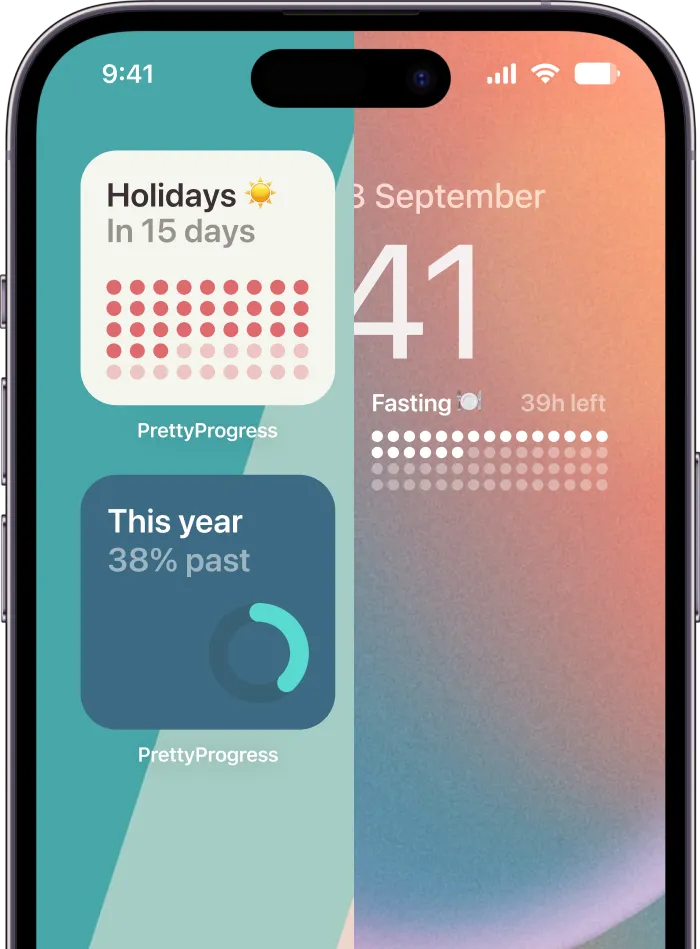
If you want these trackers visible on your phone, Pretty Progress is one tool that lets you create countdown and progress widgets using start dates, end dates, and customizable visual styles. That’s useful when you want the schedule in front of you on your Home Screen or Lock Screen instead of hidden inside a notes app.
The simpler the setup, the more likely you are to keep using it.
That’s the crucial test. Not whether a tracker looks advanced, but whether it helps you act today.
Setting Up Your First Progress Schedule in 3 Minutes
The fastest way to make a progress schedule useful is to build one before you overthink it.
Start with a goal you can describe in one line. Not your entire life plan. Just one thing with a real finish point, like an exam, trip, bill payoff, savings target, or routine you want to keep visible.

Step 1
Download the app you want to use. If you want a widget-based option, this overview of a goal progress tracker app shows the kind of setup that works well for visual scheduling.
Don’t spend long comparing every feature. Pick one tool and build one schedule.
Step 2
Create a new tracker and give it a short title.
Good titles are concrete. “Biology exam,” “Vacation,” “Emergency fund,” or “Reading streak” all work better than “Stuff I need to do.” You want something you can understand instantly when you glance at it.
Step 3
Set the start and end.
This is the backbone of the whole schedule. If the goal tracks time, enter the start date and the actual finish date. If the goal tracks a target amount, use the dates that define the effort period and connect them to the amount you want to reach.
A short checklist helps here:
- Use a real start: Not “sometime soon”
- Choose a visible finish: A due date or target date
- Match the unit to the goal: Days, hours, sessions, or money
Step 4
Choose a visual style you’ll notice.
Some people respond to a clean monochrome bar. Others need bold color or a larger display. The best design is the one your eye doesn’t skip over. If it blends into the background, it won’t influence behavior.
Quick check: If you can’t understand the tracker in one glance, simplify it.
Step 5
Place it where it can interrupt autopilot.
A progress schedule works best when it shows up before distraction wins. Put it on a main Home Screen, Lock Screen, tablet, or watch face, wherever you naturally look throughout the day. The visual cue should meet you in real life, not wait inside an app you forget to open.
Once it’s live, you’re done. You can refine it later. What matters first is that the goal has become visible.
Best Practices to Keep Yourself on Track
A progress schedule stops helping when it turns into decoration.
Public project guidance emphasizes that schedules should be updated regularly, discussed, and used to analyze delays. The personal lesson from Michigan DOT guidance on progress schedules is straightforward. Your schedule has to reflect reality, or you’ll stop trusting it.
Keep it honest
If the deadline changed, update it. If the target was unrealistic, adjust it. If your routine changed, rebuild the schedule around the way you work now.
Trust matters more than perfection. Once your tracker feels fake, your brain stops listening.
Make visibility do the work
Put your progress schedule somewhere hard to ignore. Home Screen, Lock Screen, desktop, planner, fridge, or notebook cover. The best location is the one that catches you before your day gets noisy.
A good example is exercise planning. If you’re trying to stay consistent, pairing your tracker with a practical routine helps. This guide on developing a sustainable exercise plan is useful because it focuses on a schedule you can keep, not just one that looks ambitious.
Review lightly but regularly
You don’t need a dramatic reset every day. A short check-in is enough.
- Ask what changed: Did life shift, or did you avoid the work?
- Look at the next move: Not the whole mountain.
- Protect clarity: If the schedule feels cluttered, simplify it.
A progress schedule works best as a living tool. It should help you decide, adapt, and keep moving.
If you want a simple way to keep deadlines and goals visible, Pretty Progress lets you create countdowns and progress bars with customizable widgets for your devices, so your schedule stays in view instead of getting buried in a list.