
August 19, 2026
What 1 Million Hours Really Means
Discover what 1 million hours means in years and days, plus ways to track this timespan.
One million hours equals about 114.08 years, or roughly 41,666.67 days when converted using 24 hours per day and 365.25 days per year (Oreate AI’s time-scale explanation). That isn’t just a large duration. It’s a span that reaches beyond one ordinary lifetime and stretches across multiple generations.
The phrase sounds like a conversion problem, but arithmetic alone doesn’t make the scale memorable. To understand 1 million hours, you need to translate it into calendars, working lives, family timelines, machine reliability, and something you can see every day. A countdown or progress widget can turn an abstract milestone into a visible reminder on your phone.
Table of Contents
- Why 1 Million Hours Feels Impossible to Picture
- Converting 1 Million Hours Step by Step
- Real-World Ways to Feel the Scale of 1 Million Hours
- 1 Million Hours of Work and the Limits of Individual Effort
- What 1 Million Hours Really Means in Reliability Engineering
- Why Persistent Visual Reminders Beat Willpower Alone
- Setting Up a Pretty Progress Widget for Your Own Million-Hour Goal
Why 1 Million Hours Feels Impossible to Picture
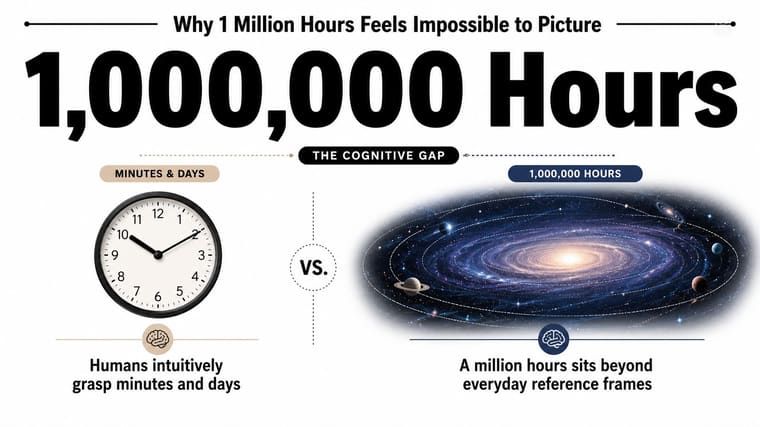
Most individuals have useful mental anchors for minutes, days, and perhaps a workweek. A day has 24 hours. A standard workweek has 40 hours. A year contains about 8,766 hours when calculated using 365.25 days. These reference points help us plan ordinary life, but they don’t prepare us for a number with six zeroes.
1,000,000 hours is about 114 times the length of a 365.25-day year, yet the number still looks like a simple enlargement of something familiar. That creates the cognitive gap. Your mind recognizes “hours” as a daily unit, while “one million” belongs to a scale used for populations, budgets, or long historical periods.
Start with a familiar unit
The first useful move is to stop staring at the raw number. Divide it by 24, and it becomes 41,666.67 days. Days are easier to imagine because they connect with sleep, meals, school, work, weekends, and birthdays.
Divide that result by the length of a year, and the duration becomes roughly 114.08 years. At that point, the number stops behaving like a deadline for one person. It becomes a historical span, suitable for thinking about institutions, families, infrastructure, or long-running records.
Practical rule: A large time figure becomes meaningful only after you compare it with a scale you already understand.
The rest of the answer depends on the question behind the conversion. If you’re curious about the calendar length, the answer is about 114 years. If you’re measuring labor, the answer describes an enormous cumulative workload. If you’re looking at equipment reliability, the same figure means something statistical rather than guaranteed. And if you’re tracking a personal ambition, the best use may be to break the milestone into visible daily progress.
Converting 1 Million Hours Step by Step
The conversion is straightforward, but writing every stage down prevents a common mistake: treating a precise unit conversion as a vague estimate.
The basic chain
Start with the number of hours:
1,000,000 hours
Convert hours to days:
1,000,000 ÷ 24 = 41,666.67 days
Then convert days to years. Using 365.25 days per year:
41,666.67 ÷ 365.25 = 114.08 years
The extra .25 day in 365.25 represents the average effect of leap years across the calendar. Using 365 days instead gives a slightly different result, about 114.16 years. For a duration this long, the 365.25-day convention is a practical way to account for leap-day effects, and the resulting figure is reported as roughly 114.08 years by CalculateMe’s hour-to-year conversion.
The smaller-unit conversions are exact:
1,000,000 × 60 = 60,000,000 minutes
1,000,000 × 3,600 = 3,600,000,000 seconds
A week contains 168 hours, so:
1,000,000 ÷ 168 = 5,952.38 weeks
Using the average month length implied by the year conversion, the duration is approximately 1,389 months. That monthly figure is an approximation because calendar months don’t all have the same length.
| Unit | Value | Note |
|---|---|---|
| Hours | 1,000,000 | Starting amount |
| Minutes | 60,000,000 | Exact multiplication by 60 |
| Seconds | 3,600,000,000 | Exact multiplication by 3,600 |
| Days | 41,666.67 | Divide by 24 |
| Weeks | Approximately 5,952 | Divide by 168 |
| Years | Approximately 114.08 | Divide by 365.25 |
| Months | Approximately 1,389 | Based on average month length |
For a date-specific calculation, a tool such as the hours-between-two-dates calculator can account for the exact start and end points. The key lesson is simple: each operation changes the unit, not the underlying duration. Whether you call it 60 million minutes, 41,666.67 days, or 114.08 years, you’re describing the same stretch of time.
Real-World Ways to Feel the Scale of 1 Million Hours
A calendar answer gives you accuracy. Analogies give you texture.
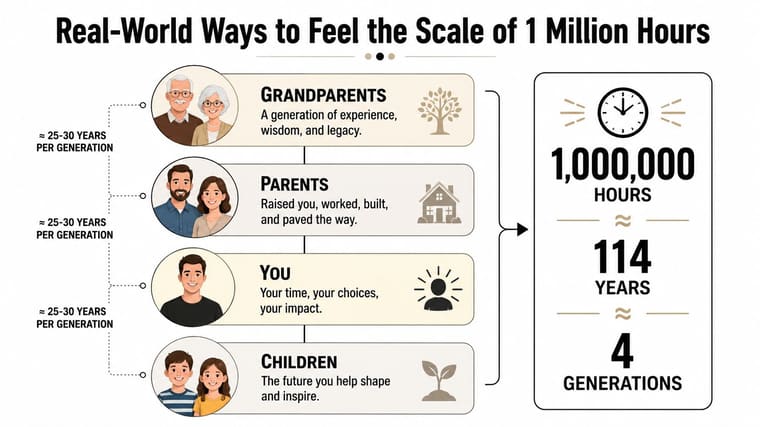
Start with a family tree. A human generation is often discussed as roughly 25 to 30 years, so about 114 years can reach across roughly four overlapping generations. One person may begin a story, another may maintain it, and later descendants may inherit its consequences. The duration is long enough to connect grandparents, parents, children, and grandchildren in one historical frame.
Sleep offers a more intimate comparison. At eight hours per night, a person spends about one-third of each day asleep. Across a full human lifetime, that produces a substantial block of time devoted to rest, but even that familiar routine doesn’t make a million hours feel personal. The million-hour figure remains much larger than the sleep accumulated by one individual.
Repetition reveals the size
A two-hour film repeated 500,000 times would occupy the full million-hour span if played continuously. You wouldn’t experience that as a collection of movie nights. You’d experience it as a duration extending through more than a century, with the same film continuing while generations came and went.
Reading creates another useful frame. If reading aloud a 400-page book takes about 10 hours, then one million hours could support roughly 100,000 such readings. That isn’t a prediction about how anyone should spend the time. It’s a way to convert a silent quantity into a repeated human activity.
These analogies shouldn’t be treated as new measurements of the duration. They’re mental models. The family comparison emphasizes inheritance, the sleep comparison emphasizes daily life, and the reading example emphasizes cumulative effort.
A million hours isn’t one enormous day. It’s an accumulation so large that ordinary activities become historical patterns.
The most helpful baseline depends on your purpose. A family wants to understand generations. A learner may think in practice sessions. A planner may think in years. The arithmetic stays constant, while the analogy changes to match the decision you’re trying to make.
1 Million Hours of Work and the Limits of Individual Effort
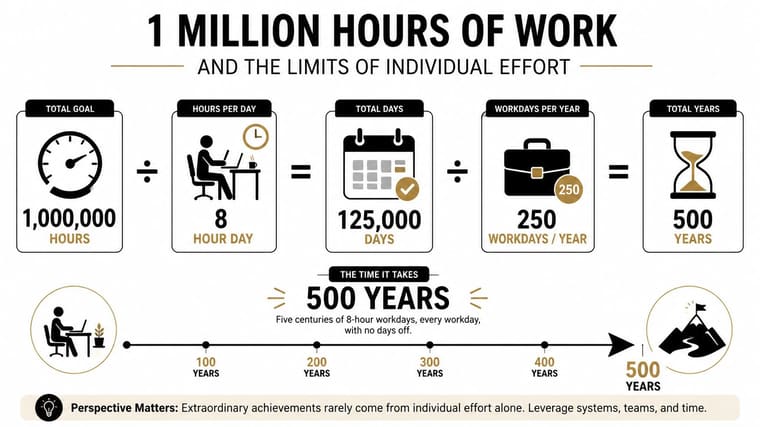
1,000,000 hours of work equals 500 years of full-time labor when each workday contains eight hours and each year contains 250 workdays:
1,000,000 ÷ 8 = 125,000 working days
125,000 ÷ 250 = 500 years
The result describes accumulated labor, not a schedule one person could follow. A single worker has limited daily hours, rest, and a finite lifetime. The number therefore belongs more naturally to teams, institutions, and communities, where many contributions combine into one total.
Why teams change the calendar
At a standard 40-hour workweek, one million hours equals about 25,000 workweeks. The labor-focused explanation from Oreate AI describes the total as roughly 48 years of full-time employment for one person working continuously. That comparison helps, but it can also confuse elapsed time with productive work time. A million hours on a clock and a million hours spent working measure different realities.
A team changes the calendar by distributing the total. Ten people contributing similar amounts can accumulate the same work in less elapsed time than one person, while a larger organization can spread it across departments, shifts, and years. The total then describes organizational capacity rather than an individual achievement.
That distinction also keeps comparisons with manufacturing, construction, or specialist training honest. Without verified hours for a particular car, house, or profession, precise examples would suggest more certainty than the evidence supports. The reliable conclusion is broader: a million hours of work represents sustained capacity, not a normal personal target.
Bureau of Labor Statistics figures summarized in the same labor source report that employed persons averaged 5.02 hours per day working in 2025, or 7.66 hours on days worked. Those figures anchor the difference between all available clock time and the portion people spend working.
What 1 Million Hours Really Means in Reliability Engineering
A reliability label can make 1,000,000 hours MTBF sound like a promise that one machine will operate for about 114 years. That interpretation is wrong.
MTBF, or mean time between failures, is a statistical average for repairable systems across a population. It doesn’t guarantee that each individual device will last for the average duration, and it doesn’t function as a warranty period. A component may fail earlier, while another may operate longer.
The verified engineering example makes the distinction concrete. In a fleet of 1,000 units, each specified at one million hours MTBF, roughly nine failures per year can still occur even though the rating sounds enormous (Flex’s explanation of power-module reliability predictions).
Read the metric as a fleet signal
A million-hour MTBF rating describes expected behavior across operating exposure. It doesn’t tell an operator that one selected unit will run uninterrupted for 114 years. Maintenance schedules, operating conditions, manufacturing variation, thermal stress, repair practices, and the size of the installed population all affect what people observe.
| Scenario | Devices | Time to accumulate 1 million hours | Realistic lifetime expectation |
|---|---|---|---|
| One device operating continuously | 1 | The device would need to operate for about 114.08 calendar years to accumulate that exposure | The rating doesn’t guarantee that one device will last that long |
| A fleet sharing operating exposure | 1,000 | The fleet accumulates operating hours far faster than one device | Failures can appear much earlier because the metric is probabilistic and aggregate |
The distinction between repairable and non-repairable equipment also matters. MTBF generally applies to repairable systems, while non-repairable components are commonly described with mean time to failure, or MTTF. Both metrics require careful interpretation because an average describes a population pattern, not an individual destiny.
Engineering takeaway: Treat a million-hour reliability rating as an aggregate expectation, not a countdown to guaranteed failure-free operation.
Why Persistent Visual Reminders Beat Willpower Alone
A long-term goal can feel inspiring when you choose it and invisible when you return to ordinary life. Motivation rises and falls. A visible reminder gives the goal a stable place in your environment, so you don’t have to reconstruct your intention from memory every day.
A countdown and a progress bar create different emotional signals. A countdown emphasizes what remains, which suits a deadline, event, or finite window. A progress bar emphasizes what you’ve completed, which often fits practice, saving, fitness, study, or a long creative project.
Match the display to the goal
Consider the type of feedback your goal needs:
- A countdown works for a launch date, an examination, a trip, or a personal deadline. It makes remaining time concrete.
- A progress bar suits accumulated effort. Log hours practiced, focused work completed, or time invested in a meaningful routine, then watch the fill advance.
- A recurring timer can support a daily ritual. It gives you a clear start and end point without pretending that one session will complete a historical-scale objective.
A home-screen widget is useful because it places the cue where you already look. The design still needs restraint. If the widget competes with every notification and shortcut, your brain may stop registering it. A quiet visual that remains legible can work better than an elaborate display that demands attention.
People who struggle with attention may find persistent visual cues especially practical, but the principle isn’t limited to one audience. The guidance in this article about visual reminders for ADHD also points toward a broader idea, externalizing a reminder can reduce the need to hold the entire goal in working memory.
Start with a behavior, not a grand statement. “Reach one million hours” is too distant to guide tomorrow morning. “Log today’s practice” or “record the focused work I completed” gives the widget a useful input and gives you an action you can repeat.
Setting Up a Pretty Progress Widget for Your Own Million-Hour Goal
A million-hour goal is too large to watch directly. Make it trackable by defining what each logged hour represents.
You might record hours of practice, focused work, volunteering, study, or time invested in a relationship. The point isn’t to claim that every hour has identical value. The point is to create a consistent measurement that lets a distant intention acquire daily movement.
Build the goal in small stages
-
Define the activity. Write down exactly what counts as a logged hour. If the category is vague, your progress will become difficult to trust.
-
Choose the target format. Use a countdown when you care about time remaining until a date. Use a progress-fill display when you want to accumulate completed hours toward a large total.
-
Enter the starting point and target. A practical starting value may be zero or an amount you’ve already tracked. Keep the measurement honest rather than inflating the baseline.
-
Select a readable theme. Choose colors with enough contrast against your wallpaper. A widget that can be understood at a glance is more useful than one that looks impressive only when examined closely.
-
Place it consistently. Pin the widget to a fixed spot on your Home Screen or Lock Screen. Avoid a crowded page where it becomes indistinguishable from unrelated app icons.

Turn viewing into a ritual
Check the display in the morning and decide what contribution is realistic for the day. In the evening, log the time you completed. This two-part ritual turns the number from decoration into feedback.
Pairing the display with a complementary focus or habit widget can help, as long as the Home Screen remains calm. The home-screen timer guidance from Pretty Progress offers another way to think about placement and glanceable time tracking.
A progress bar won’t make a million-hour target finish quickly. It does something more useful: it gives each ordinary session a visible relationship to the larger goal. Over time, the abstract figure becomes a record of repeated choices rather than an intimidating block of zeroes.
Pretty Progress offers customizable countdown and progress widgets for Home and Lock Screens across Apple devices and Android, so you can turn an hours-based goal into a glanceable visual reminder. Visit Pretty Progress, choose a countdown or progress display, and give your next logged hour a visible place in your day.