
October 10, 2026
Late Application Deadlines: What to Do
Don't panic if you missed the cutoff. Learn how to handle late application deadlines and still secure your spot in 2026.
You open the application portal, ready to submit, and find that the deadline passed yesterday. Or perhaps the portal still accepts uploads, but your transcript is missing, your recommender hasn’t responded, and the scholarship form closed weeks ago. Panic makes every problem look identical. It isn’t.
A late application is rarely one missed date. It’s a chain of separate deadlines governing submission, documents, funding, housing, visa processing, and enrollment. Some doors are firmly shut. Others are still open but lead to fewer choices. Your job isn’t to rush blindly. It’s to identify which doors remain real, then submit a complete file before another deadline disappears.
Table of Contents
- When the Deadline Has Already Passed
- The Five Deadlines Inside Every Late Application
- Triage Your Situation Before You Touch the Application
- Contacting Admissions Without Sounding Desperate
- Alternatives Worth Taking Seriously
- Build a Deadline Tracking System That Actually Prevents This
- Your Next 48 Hours and the Honest Bottom Line
When the Deadline Has Already Passed
You log in, see that the deadline passed yesterday, and your stomach drops. Then you notice the worse problem. The portal may still accept uploads, but your recommendation is pending, your transcript has not landed, or the scholarship form closed earlier than the application itself. Treat that as four separate deadlines, not one missed date.
Maya ran into exactly that situation with a graduate program while finishing a major final project. She had a polished statement, strong grades, and a professor ready to recommend her. Her instinct was to submit the statement first and patch the rest together afterward.
That move usually burns time. A partial file can sit in the system and never become reviewable. Start by checking the department deadline on the program page, then confirm whether late files are reviewed, whether funding is already gone, and whether the program is still considering applicants for your intended term. If those answers are weak, stop forcing the application and protect your time for better options.
Undergraduate applicants face the same problem. In the UK, UCAS separates the main equal consideration date from later windows. For most undergraduate courses, applications sent by the January Equal Consideration Date are intended to receive equal treatment. Later applications may be considered only where a course still has capacity. In 2024, UCAS reported that 78% of applicants applied by the January Equal Consideration Date, compared with 96% of UK applicants aged 18, and nearly 62,000 applicants applied after that deadline but before 30 June (UCAS admissions data).
That should change how you read an open portal. Open does not automatically mean available in any meaningful sense. Some programs leave the form live because they are still reviewing complete late files. Others leave it open because the system has not shut yet, even though funding, housing, interview slots, or realistic seat availability are already gone.
For 2026 entry, UCAS states that applications received after 30 June 2026 are held and are not forwarded to institutions. That is a system cutoff, and no persuasive email changes it.
Ask a harder question than “Can I submit?” Ask whether a complete application still has a real path to review, funding, and enrollment.
Handle late applications like triage. Separate the submission deadline from documents, aid, awards, and enrollment logistics. Then act only on programs that still have capacity and a realistic path to a complete file. That is how late applicants recover ground. It is also how you avoid spending a week on an application that was effectively dead before you opened the portal.
The Five Deadlines Inside Every Late Application
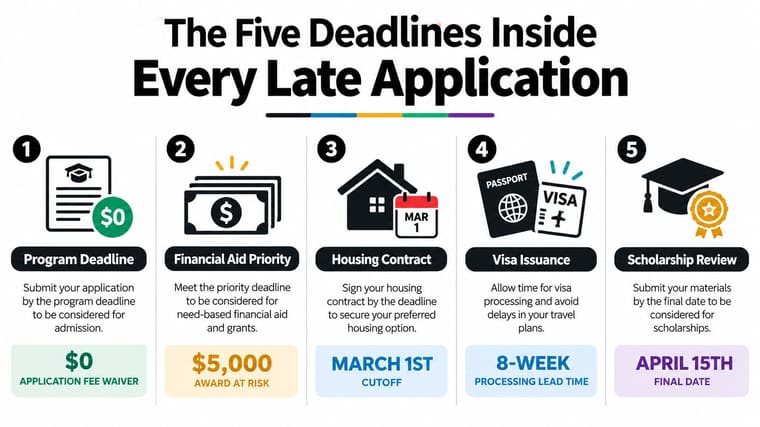
Applicants often optimize for the most visible date, the application submission deadline. That date controls only one part of the decision. A program can accept your form while its funding pool, housing allocation, or international processing timeline has already moved on.
Map every date before deciding
Submission deadline determines whether the institution will accept the application itself. Supporting-document deadline determines whether transcripts, references, test results, and credential evaluations arrive in time for a file to become complete. A submitted form with missing evidence may not be reviewable.
Financial-aid deadline can operate independently. MIT says a late financial-aid application may still be reviewed without a penalty, but the decision arrives later, while missing the final academic-year cutoff can remove eligibility for institutional and federal aid (MIT financial-aid guidance). Harvard similarly says a late aid application doesn’t remove eligibility but delays the financial-aid decision (Harvard financial-aid guidance).
Enrollment deadline controls whether you can accept an offer, pay any required deposit, complete registration, and start on time. It may become the obstacle when admission arrives late.
Priority deadlines often govern scholarships, housing, or earlier review. Missing one may not block admission, but it can remove benefits that made the offer workable. International applicants also need to account for document authentication and visa processing, which can create an earlier practical cutoff than the published admissions date.
| Deadline Type | What It Controls | Typical Late Penalty |
|---|---|---|
| Application submission | Whether the institution accepts the form | File may be rejected or reviewed only if capacity remains |
| Supporting documents | Whether the file is complete | Delayed or incomplete review |
| Financial aid | Need-based and institutional funding decisions | Later decision or lost eligibility |
| Enrollment confirmation | Whether you can begin the term | Offer may lapse or enrollment may become impossible |
| Priority date | Scholarships, housing, or earlier consideration | Fewer awards, rooms, or choices |
Use this structure in your own tracker, and keep separate fields for the date, time zone, required materials, and confirmation contact. A simple multiple-deadline planning method can prevent you from treating one visible date as the entire admissions process.
Triage Your Situation Before You Touch the Application
Don’t start by rewriting your personal statement. Spend a short, focused period establishing whether the application has a real path forward.
Ask four questions in order
-
Which deadline applies? Check the department or program page, not only the university-wide admissions calendar. Departmental deadlines can override institution-wide dates, particularly in graduate study and professionally regulated subjects.
-
What kind of program is this? Classify it as rolling, space-limited, or closed. A rolling program reviews applications as they arrive until capacity is reached. A space-limited program may accept a late file only when staff, places, or resources remain. A closed program has no useful path unless admissions confirms an exception.
-
Did funding close earlier? Look for separate scholarship, assistantship, fellowship, financial-aid, and housing dates. Ask whether applying late affects only the timing of the decision or eligibility itself.
-
Can the file be complete in time? List every missing transcript, reference, test result, portfolio item, and verification document. If the department can’t process the file before enrollment activities begin, submission may create false hope rather than an opportunity.
Colorado State says late graduate applications may be considered according to available space and resources, while applications that can’t be processed may be deferred or withdrawn (Colorado State graduate admissions policy). Wichita State likewise says applications after priority or program deadlines may be reviewed only “as time permits,” and late completion doesn’t guarantee enough time for enrollment (Wichita State graduate admissions guidance).
Use a clear decision signal
Proceed now when the program confirms late review, capacity remains, funding is still possible or isn’t essential, and you can submit a complete file promptly.
Proceed with a backup when the portal is open but capacity, funding, or enrollment timing is uncertain. Submit only after admissions gives a useful answer, preferably in writing.
Stop for this term when the program is closed, documents can’t arrive in time, funding is unavailable, or the institution says the file won’t be reviewed.
For programs without a hard closing date, the University of Central Arkansas recommends completing the application at least one month before the term begins and warns that accommodating late applicants doesn’t guarantee permission to enroll (UCA graduate admissions bulletin). Use that as a practical benchmark, not permission to wait.
Email admissions with this sentence:
“Could you confirm whether a complete application submitted on [date] for [program and term] will be reviewed for that intake, whether any documents or funding deadlines have passed, and whether late enrollment remains operationally possible?”
Contacting Admissions Without Sounding Desperate
You missed the deadline, the portal still looks open, and your first instinct is to write a long apology. Don’t. Admissions teams are sorting volume, checking policy, and deciding whether your file can still move. A short, specific message gives you a real answer faster.
Your goal is simple. Find out whether this program still has room for a complete late application, and which deadline applies now. For late applicants, that usually means more than the submission date. A program may still accept the form while documents, funding, housing, or enrollment steps have already closed. Ask about all of them in one email so you do not waste days chasing a dead option.
Start with the program name, degree level, and intended intake. State your situation in one sentence. Then ask whether a complete file submitted by your date will be reviewed, and whether any separate funding or enrollment deadline has passed. Skip the emotional backstory unless the institution specifically invites context.

Use the right message for the situation
When an extenuating circumstance applies:
Subject: Late application question for [program and term]
Dear [Admissions Team or Name],
I’m preparing an application for [program] for [term]. I missed the published deadline because [brief, factual explanation]. I can submit the application and all supporting materials by [date].
Could you confirm whether the department will review a complete late application for this intake, and whether funding or enrollment deadlines have already passed?
Thank you for your guidance, [Name]
[Applicant ID, if available]
When the program appears to use rolling admissions:
Subject: Application availability for [program and term]
Dear [Admissions Team or Name],
I’m interested in applying to [program] for [term]. I see that applications remain open, and I can submit a complete file by [date].
Could you confirm whether places remain, whether late applicants receive full consideration, and whether scholarships, housing, and enrollment are still available?
Thank you, [Name]
If you do not have a serious reason, say so plainly. “I missed the deadline and want to confirm whether a complete application can still be reviewed” reads better than a dramatic explanation that falls apart under scrutiny.
Make the file complete, not merely fast
Speed matters. Completeness matters more.
Request recommendation letters right away and send referees the program link, your draft statement, résumé, deadline, and submission instructions. Order official transcripts through the school’s approved channel. An uploaded copy may help you start an application, but it may not satisfy verification. Do not assume the portal being open means your file can be processed in time.
Submit a partial file only if admissions says incomplete materials will be held and reviewed. Otherwise, wait long enough to assemble the required pieces. UCAS choice data shows that 5.5% of all 2025 main-scheme applicants, about 36,400 people, added at least one choice after their initial submission, which confirms that choices can shift later in the cycle. It does not change the core problem. Later options often come with less space and fewer resources.
If email gets no response and the deadline is close, call during office hours:
“Hello, I’m calling about a late application for [program and term]. I can submit a complete file by [date]. Could you tell me whether late applications are still reviewed and which deadline controls funding or enrollment?”
Write down the name of the person you spoke with, the time, and the answer. Then send a short follow-up that confirms what you heard. If you need a structure for that message, use this deadline reminder email format.
Some institutions will give you a firm no. Princeton’s Graduate School states that it doesn’t accept late applications and that deadlines vary by department. Accept that answer quickly. Even a “no” provides the information needed to redirect your efforts.
Alternatives Worth Taking Seriously
A missed deadline doesn’t automatically require a gap year. It does require a wider search and a sharper understanding of trade-offs.
Rolling admissions can provide a legitimate route when a program reviews complete files as they arrive. Adult learner and non-traditional programs may offer more flexible start dates or study patterns for people balancing work and education. Transfer admission can let you begin elsewhere, build a stronger academic record, and apply later with completed college work.
A late-deadline compilation lists examples extending into May, July, or with no fixed deadline, while warning that program availability can become limited or space-dependent (late-deadline college guidance). Treat those examples as leads, not promises. Verify every date with the institution.
| Applicant Situation | Best Route | Main Trade-Off |
|---|---|---|
| Complete file ready soon and flexible about institution | Rolling admission | Places, aid, housing, and course choices may shrink |
| Working applicant or returning student | Adult or non-traditional program | Schedule flexibility may come with a different campus or course structure |
| Missed a selective deadline but can begin elsewhere | Transfer pathway | You must earn strong results before reapplying |
| International applicant with limited processing time | Program that confirms visa and document capacity | An open portal may not leave enough time for visa or authentication work |
| Applicant whose grades or qualifications need strengthening | Later term or access route | You delay the target start while improving readiness |
For students whose grades didn’t meet an expected offer, Access Courses Online options can help identify alternative preparation routes rather than forcing an unsuitable application.
Test whether “open” means viable
Ask the institution these questions before paying an application fee:
- Are places still available in this specific program, not just at the university?
- Will a late applicant receive the same academic consideration?
- Are scholarships, grants, and housing still open?
- Can transcripts and credential evaluations be completed in time?
- Can international applicants obtain the required visa documentation before enrollment?
- What happens if the application is submitted but enrollment capacity fills first?
A “yes” to the portal isn’t enough. You need confirmation that admission, funding, housing, document processing, and enrollment can all happen on your timeline.
Build a Deadline Tracking System That Actually Prevents This
A single calendar entry labeled “college application due” hides too much. Build one record for every action that can block the application, then assign an owner and a confirmation status to each item.
Create five visible milestones
Track submission, supporting documents, recommendation letters, financial aid, and enrollment separately. Add scholarship and housing priority dates when they apply. For international applications, include credential evaluation, language scores, visa documentation, and any institutional verification step.
Use a countdown for immediate deadlines that need daily attention. Use a weekly view for milestones that require coordination, such as a recommender’s letter or an official transcript. Once a deadline is close, switch from “days remaining” to a progress bar showing how much of the preparation is complete.
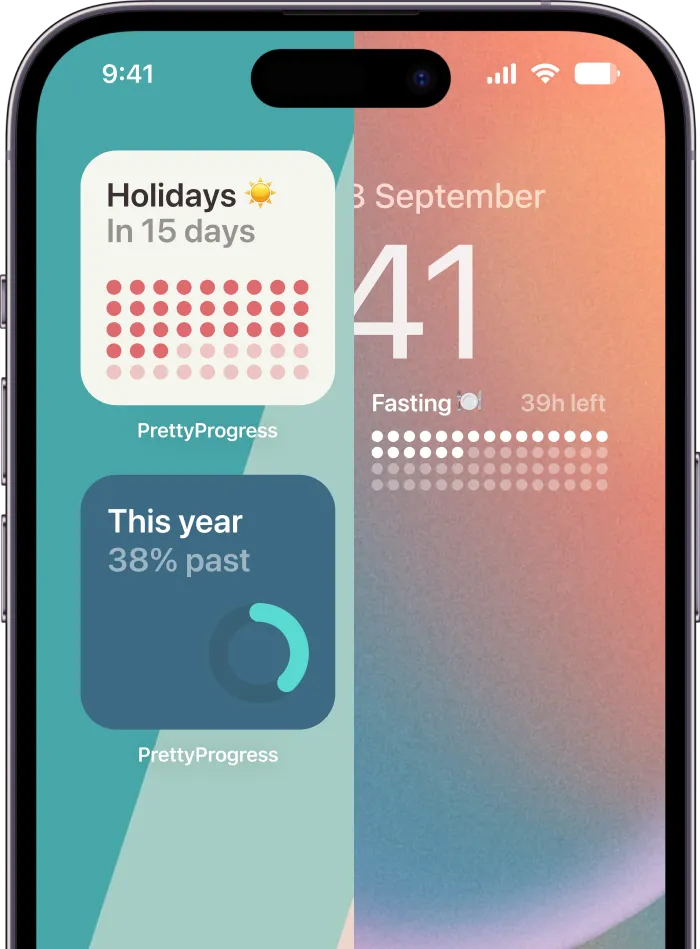
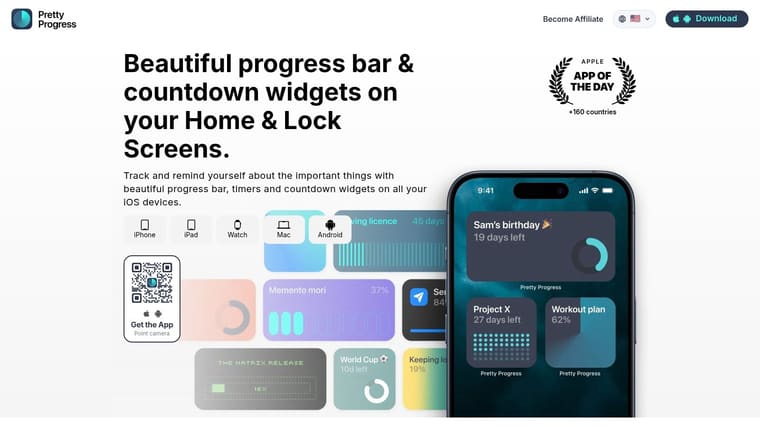
Pretty Progress can create countdown and progress widgets with start and end dates for an application deadline and display them on compatible phone, tablet, watch, or computer screens. Configure one widget per milestone, use color coding for urgency, and place the most time-sensitive dates on your Home or Lock Screen.
Make the system operational
Set a red widget for a deadline that can close the application, amber for documents or funding, and blue for longer-term preparation. Keep the actual submission deadline visible, but give recommendation letters their own countdown because you can’t control a referee’s schedule by watching the final date.
Use business-day calculations when an institution says documents must arrive through an office or third-party evaluator. For recommendation follow-ups, set an initial request date, a first reminder, and a final confirmation checkpoint. An app such as Eztrackr task tracker setup can help you turn those separate obligations into assigned tasks rather than leaving them as notes.
Import calendar events or reminders when possible, but verify every imported date against the program’s official page. A calendar can repeat an outdated deadline perfectly. Your tracker should record the source, time zone, required action, and evidence that the institution received the item.
For a broader student workflow, use this assignment tracker for students approach to separate tasks from dates. The principle is simple: a deadline tells you when the result is due, while a task tells you what must happen before then.
Your Next 48 Hours and the Honest Bottom Line
It is 10:40 p.m. The portal still says open, your transcript request is pending, your recommender has not replied, and the aid page has a different date from the application form. Treat that as five separate deadlines, because that is what it is. Your job over the next 48 hours is to find out whether this program can still take a complete application, or whether the open portal is just lagging behind reality.
Start with a triage pass on every target program. Check submission, supporting documents, funding, enrollment deposit, and any priority review date. Label each one open, unclear, or closed. Then look for the pages that decide your odds, the department page, the graduate or undergraduate admissions page, the funding page, and the international applicant guidance if it applies to you.
By tomorrow morning, send one clean email to admissions. Ask three things. Will a complete application still be reviewed for your intended term? Is the cohort still accepting students? Which funding, visa, or enrollment deadlines have already passed? While you wait, get the parts you control into final shape, your statement, résumé, transcript request, references, and a brief explanation if you had real extenuating circumstances.
By day three, choose between two paths. Submit because all five milestones are still viable, or stop chasing this intake and move to a later start, a transfer route, an adult learner option, or a confirmed rolling program with space.
That distinction matters. An open portal signals access. Capacity decides whether applying still makes sense. Some institutions continue reviewing late files when they have room. Others leave the form available after the practical chance of admission, funding, or enrollment has narrowed to almost nothing. And some doors are shut. A post-30 June UCAS application for 2026 entry will not be forwarded to institutions, and a program with a strict no-late policy, such as Princeton’s Graduate School, is closed regardless of how persuasive your email sounds.
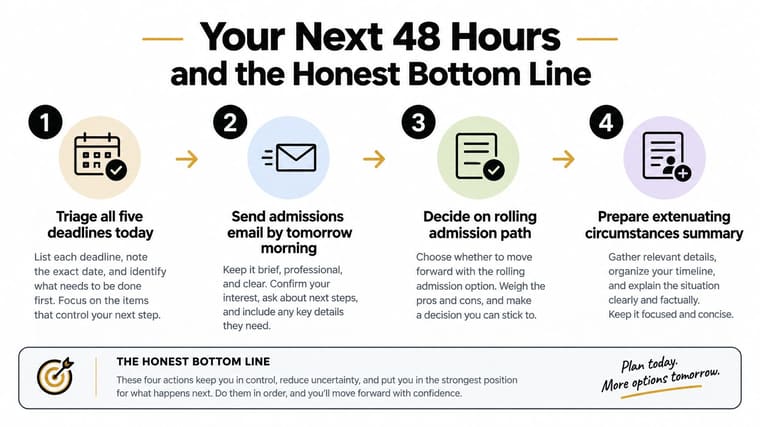
Submit only when all five milestones are complete enough to survive review. If they are not, choose the next term today and start building a stronger file instead of forcing a weak late attempt.
Pretty Progress lets you create separate countdowns and progress widgets for submission, documents, recommendations, financial aid, and enrollment deadlines. Set up those milestones today and visit Pretty Progress to keep the remaining time visible instead of relying on one easily missed calendar alert.