
October 1, 2026
How to Motivate Yourself Daily and Actually Stick with It
Learn how to motivate yourself daily with a practical system built on routines, micro-tasks, and visible progress. Includes tips, examples, and a low-day reset
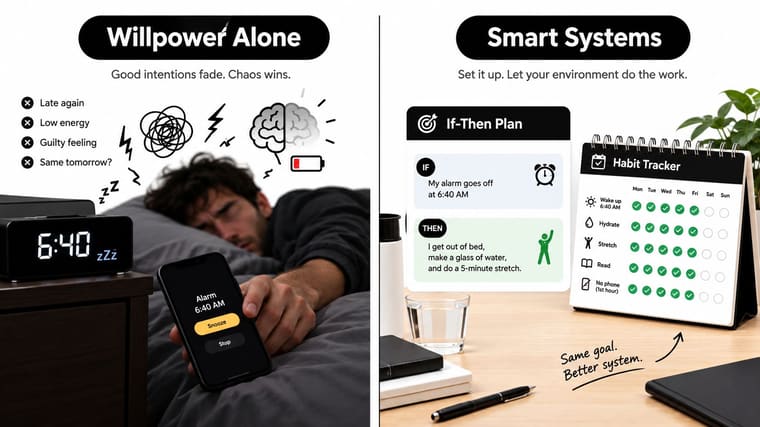
At 6:40, your alarm rings. You reach for your phone, knowing exactly what you planned to do, then scroll for twenty minutes before getting out of bed. By Wednesday, the routine that felt exciting on Monday already feels like another demand you can’t meet.
That pattern doesn’t mean you’re lazy or incapable of commitment. It usually means you’ve built a plan that depends on feeling ready. Daily motivation is less a personality trait than an environment and feedback design problem. When the cue is clear, the first action is small, and progress stays visible, you can begin before enthusiasm arrives.
I rebuilt my morning routine after burning out twice, and the most useful lesson was uncomfortable: inspiration wasn’t the missing ingredient. The system asked too much from tired mornings. The solution was to reduce decisions, attach actions to things I already did, and put progress where I couldn’t miss it.
Table of Contents
- Why Willpower Alone Fails by Wednesday
- Designing a Daily Routine That Starts Your Motivation
- Habit Stacking and If-Then Plans That Actually Trigger
- Breaking Goals Into Micro-Tasks You Can Finish Today
- Using Glanceable Progress Cues to Stay on Track
- Building Accountability Without Burning Out
- A Reset Protocol for Low-Motivation Days
Why Willpower Alone Fails by Wednesday
The 6:40 alarm isn’t the actual problem. The problem is the gap between knowing what matters and making the first movement toward it. Your phone offers an immediate reward, while exercise, studying, writing, or planning offers a benefit that arrives later. In that moment, an abstract goal has to compete with a screen designed to remove effort.
Willpower can help occasionally, but it makes a poor daily operating system. Sleep debt, low energy, emotional strain, and a long list of decisions all make the next action feel heavier. If your routine requires you to negotiate with yourself each morning, the negotiation eventually goes in favor of the easier option.
Practical rule: Don’t ask, “How can I feel motivated?” Ask, “What can make the first useful action easier to recognize and start?”
The redesign model works differently. You place your shoes beside the door, decide tomorrow’s first task before shutting down, connect journaling to coffee, and show the day’s progress on the screen you already check. The environment handles part of the work before your mood gets a vote.
This doesn’t mean your reasons are irrelevant. Meaning still matters, especially when a task is difficult or repetitive. But purpose works better when it is connected to a practical next step. For readers who want to connect everyday conduct with a wider spiritual purpose, living out salt and light daily offers a useful reflection on turning values into ordinary action.
The rest of the system follows that logic. Build a routine with replaceable blocks, attach actions to stable cues, shrink goals until they fit your current energy, and make completion visible. You aren’t trying to become a person who never loses motivation. You’re building a setup that still gives you somewhere to begin when motivation is missing.
Designing a Daily Routine That Starts Your Motivation
A useful routine has a shape you can repeat, not a schedule you have to defend. Keep the blocks short enough for a difficult day and specific enough that you know when one begins.
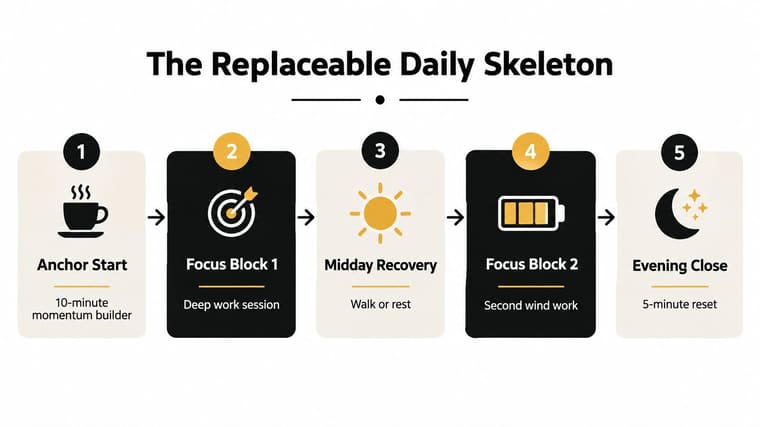
Use five replaceable blocks
-
Anchor start: Spend ten minutes on one predictable action, such as water, light movement, opening your notebook, or reviewing the single task chosen the night before. This block reduces friction rather than demanding deep focus.
-
Focus block one: Work on the pre-decided priority. The task should be written as an action, not a category. “Draft the opening paragraph” is easier to start than “work on the project.”
-
Midday recovery: Walk, eat without a screen, stretch, or sit somewhere different. Recovery isn’t a reward you earn after perfect output. It protects the attention needed later.
-
Focus block two: Choose a smaller second task. Many routines fail here because they expect the afternoon version of you to perform like the morning version.
-
Evening close: Take five minutes to record what finished, choose tomorrow’s first action, and clear the workspace. A shutdown creates a clean starting line instead of leaving tomorrow to inherit today’s unfinished decisions.
A 9-to-5 worker might use an anchor before commuting, a first focus block after arriving, a midday walk, a second focus block in the afternoon, and an evening close before dinner. A parent with fragmented time might use the first available quiet moment for the anchor, one short focus block during school or nap time, recovery during a meal, a second block after bedtime, and the same five-minute close.
The anchor and evening close are essential because they stabilize the system. The focus blocks and recovery activity are swappable. A routine should adapt to your life, not grade your personality. The practical value of routines is also explored in BionicGym routine benefits, particularly the way repeated structure can support consistency.
For a more detailed way to place actions across a day, use this habit schedule guide as a planning reference. The aim isn’t to fill every minute. It’s to give important behaviors a reliable place to land.
Habit Stacking and If-Then Plans That Actually Trigger
“I should journal more” is a preference, not a plan. It doesn’t tell you when to begin, where the notebook is, or how much counts as enough. On a low-energy morning, your brain has to solve all of those questions before writing a word.
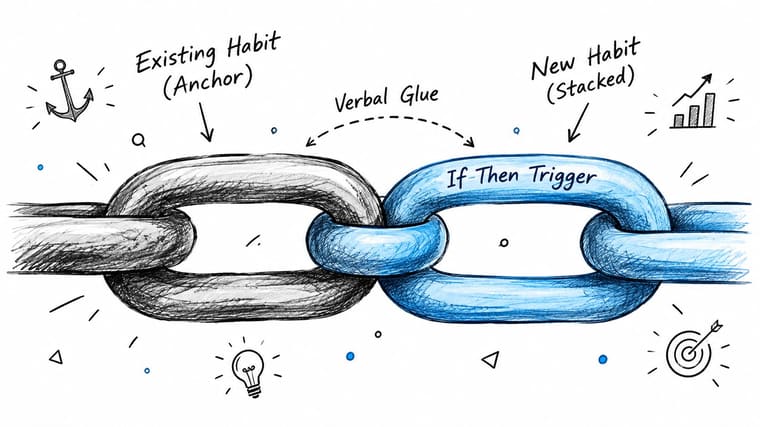
Habit stacking supplies the anchor. You attach a new behavior to something already happening, such as pouring coffee, brushing your teeth, or opening your laptop. Then an if-then plan supplies the verbal instruction: if a specific cue appears, then you take a specific action.
The vague version becomes:
After I pour my morning coffee and sit at the table, I will write one sentence in my notebook.
That plan works because it removes choice at the moment motivation is least dependable. One sentence also gives you a clear finish line. You can continue if you want, but you don’t need to negotiate for a larger commitment.
Add the feedback cue to the same moment
Put the progress signal beside the trigger rather than somewhere you may remember later. When you sit down with coffee, open the note, check the habit counter, or glance at the widget. The sequence becomes cue, action, visible acknowledgment.
Try these stacks:
- Workout: After I put on my morning clothes, I will complete two minutes of movement before deciding whether to continue.
- Study: After I close my lunch container, I will open the course document and answer one practice question.
- Inbox cleanup: After I finish my first drink of water at work, I will process one message and archive or schedule it.
A plan usually fails for one of four reasons. The cue happens irregularly, the action is too broad, the location isn’t specified, or the progress signal appears too late. Rewrite the plan until someone else could observe the trigger and know exactly what happens next.
The strongest if-then rule is boringly precise. That’s a feature, not a limitation. Repetition becomes easier when you stop asking motivation to invent the behavior each day.
Breaking Goals Into Micro-Tasks You Can Finish Today
Large goals often create a false starting requirement. You tell yourself you need a free morning, the right mood, or a long uninterrupted session. Instead, shrink the goal until the next action fits the energy you have now.
Use a three-pass method:
- Name the goal. Be honest about the outcome you want.
- Find the smallest visible output. Identify something you can point to when it is complete.
- Cut that output in half until it fits inside two minutes.
Examples make the difference clear. A 45-minute workout can become putting on your shoes and taking a two-minute walk around the block. A four-hour study block can become one page of notes and one practice question. A side-project milestone can become opening the file and writing one sentence.
The micro-task isn’t supposed to complete the entire goal. It breaks the avoidance loop and gives you evidence that starting is possible. Once you begin, you can decide whether to continue from a more informed state instead of predicting your energy from bed.
Use a visible mark for every completed micro-task. One checkmark can represent the walk, the page, or the sentence. A progress tracker turns an invisible internal effort into an external record, which matters when the final outcome still feels distant.
The energy test: If you can’t finish the task in one sitting with your current energy, it isn’t small enough yet.
Don’t make the first step “plan the perfect workout” or “research the best study method.” Make it an action with a clear endpoint. The smaller the starting unit, the less your routine depends on a dramatic change in mood.
Using Glanceable Progress Cues to Stay on Track
Motivation weakens when progress exists only in your memory. You may have completed useful work, but if the day still looks unfinished in your head, your brain receives no clear signal that effort is accumulating.
Self-monitoring and visible feedback are practical supports for goal attainment. A summary of the Dominican University finding reports that checking off progress and tracking goals can raise success rates by up to 42%, while the same page discusses a large habit study linking habit-boosting techniques with more successful practice and higher self-reported motivation with additional habit performances. These findings don’t make a widget a substitute for action. They explain why a concrete record can support action better than a private intention.
Make the phone show progress, not just temptation
A glanceable cue has three qualities:
- It sits where you already look. Use the lock screen or home screen instead of burying the signal inside an app.
- It updates with little effort. A checkmark, count, bar, or countdown should communicate progress quickly.
- It reinforces a behavior. The cue should answer, “What have I done?” or “What am I moving toward?” rather than add another instruction list.
Wire it into the routine you created earlier. During the anchor start, look at the widget before opening social media. During the evening close, update the completed action and check the next starting point. This turns the phone from a distraction surface into a feedback surface.
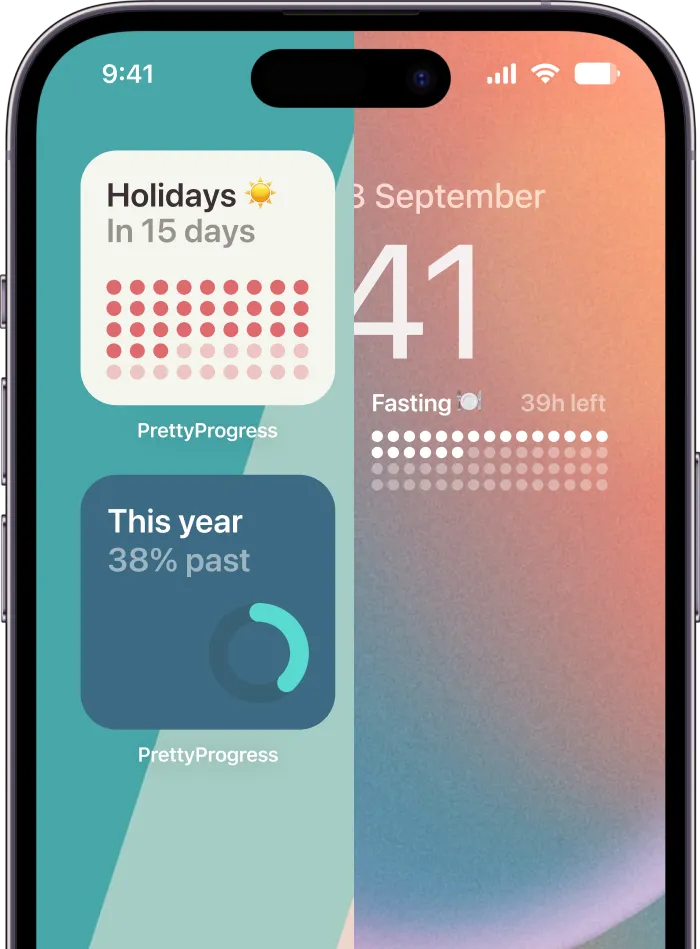
A tool such as Pretty Progress can place customizable countdowns and progress bars on Home and Lock Screens, with options for dates, colors, layouts, and icons. Used carefully, it can show a deadline or goal at the same moments your if-then plan asks you to act.
For more ideas on choosing a display that stays useful rather than noisy, see this guide to a visual habit tracker. Keep the screen simple. If the cue requires interpretation, it has already become another task.

The best display doesn’t scold you. It makes completed effort easy to see, which gives tomorrow’s action a stronger starting point.
Building Accountability Without Burning Out
Accountability works when it creates a small feedback loop, not when it turns your life into a performance report. Pressure can get you moving briefly, but a system that demands constant explanation becomes another source of avoidance.
Choose one format based on how much social energy you have. A private Sunday check-in suits someone who needs reflection without exposure. A partner loop helps when another person’s simple expectation makes the action more concrete. A shared public log can work when recording completion feels encouraging, but it should stay lightweight.
| Loop Type | Minimum Commitment | Frequency | Best For |
|---|---|---|---|
| Private self-check-in | Three written answers | Weekly | People who need reflection |
| Partner update | One line or one message | Weekly | People who respond to a trusted person |
| Shared log | One completion note or screenshot | Only on completion days | People who enjoy visible momentum |
For the self-check-in, answer: What shipped? What stalled? What changes next week? For the partner loop, exchange one sentence on Friday, such as “I completed the first draft” or “I kept the anchor but changed the task.” For a shared log, post only when something is complete. Silence isn’t failure, and you don’t need to manufacture updates to prove commitment.
The repair rule matters more than the perfect streak. If the loop breaks for a full week, restart at the lowest frequency. A public log can become a private check-in, or a partner message can become a Sunday note. This approach fits the broader idea of navigating life cycles for resilience, where sustainable effort has to account for changing capacity.
Use this accountability-building framework to choose the smallest arrangement that gives you useful feedback without creating dread. The right loop helps you return. It doesn’t punish you for needing to reset.
A Reset Protocol for Low-Motivation Days
A low-motivation day is information. It tells you that something in the current setup, your available energy, or the task itself needs inspection. Treating it as a moral failure adds shame without identifying the obstruction.
The reset below takes about ten minutes. It isn’t designed to force a full productive day. It gives you a controlled way to preserve the thread and learn what blocked you.
Name the drag
Write one sentence that describes the obstacle without criticism. “I slept poorly and the first task feels too large” is useful. “I’m useless today” isn’t. The first statement points toward a change, while the second only repeats the distress.
Look for the actual category:
- Poor sleep: Reduce the day’s target to one essential action and protect an earlier shutdown.
- Skipped meals: Eat something practical before evaluating your capacity.
- Decision fatigue: Choose from a prepared shortlist instead of creating a new plan.
- Social comparison: Close the comparison channel and return to your own next visible output.
Choose one two-minute anchor
Pick an action that proves contact with the goal, not completion of the whole project. Open the notebook. Put on the shoes. Create the document. Write the first sentence. The action should be so clear that you can begin without researching, organizing, or optimizing.
If you planned to study, opening the book and marking the relevant page may be enough. If you planned to exercise, putting on the clothes and walking briefly can re-establish the sequence. The point is to reconnect cue and behavior.
Lower every other stake
Cancel optional calls, postpone nonessential decisions, and stop pretending that a low-capacity day can carry a normal workload. Keep one meaningful commitment and make the rest swappable. Rest is not a reward for finishing everything. Sometimes it is the adjustment that prevents a difficult day from becoming a longer collapse.
This is also where intrinsic motivation matters. Goals connected to personal meaning tend to offer a stronger reason to return than goals pursued only for external approval, while immediate enjoyment can make an action easier to repeat. The Yale School of Management discussion of intrinsic motivation is useful context for separating a goal you value from pressure you have merely absorbed.
Schedule one follow-up
Set one review time, such as a 9 p.m. reminder. Ask what helped, what remained heavy, and what tomorrow’s smallest starting action should be. Don’t use the review to write a dramatic recovery plan. Use it to make one adjustment while the evidence is fresh.
Keep this playbook on your lock screen or in a note you can reach without searching:
- Morning two-minute start: Complete one tiny action tied to the day’s priority.
- One stacked trigger: Attach the next action to coffee, dressing, lunch, or opening the laptop.
- One micro-task: Shrink the goal until the finish line fits your current energy.
- Widget checks: Look once during the anchor start and once during the evening close.
- Reset phrase: “What is the drag, and what is the smallest useful action?”
The order matters because it reduces cognitive load. You don’t need to remember the entire productivity philosophy on a hard morning. You need a visible sequence that tells you what to do first, what counts, and when to review.
Your honest commitment is simple: choose one change from this article and run it for seven days before adding anything else. Pick the morning anchor, the precise if-then rule, the two-minute micro-task, or the progress cue. Consistency will teach you more than another ambitious plan.
Pretty Progress offers customizable countdowns and progress bars for Home and Lock Screens, so you can keep a deadline, habit target, or meaningful milestone visible while your routine runs. Visit Pretty Progress and set up one visual cue for the single change you’re committing to this week.