
October 19, 2026
How Many Weeks Are in an Academic Year by System
Learn how many weeks are in an academic year across semester, trimester, and quarter systems, with a simple formula to calculate your own school's calendar.
An academic year is typically 30 to 40 weeks of instruction, depending on the system. The calendar span is always longer than the instructional weeks because breaks, holidays, and exam periods sit between the first and last day.
If you’ve ever put two school calendars side by side and got two different answers, you’re not miscounting. You’re probably counting two different things. One document counts every week from opening day to closing day. The other counts only weeks when teaching happens. That small difference explains most of the confusion around how many weeks are in an academic year, and once you can name which count you need, the math gets simple.
Table of Contents
- Why There Is No Single Number for an Academic Year
- Key Terms Every Student Should Know First
- Semester, Trimester, and Quarter Systems Compared
- A Simple Formula to Calculate Any School’s Weeks
- Three Real Examples Across Countries and Levels
- Why Accurate Week Counts Matter for Deadlines and Countdowns
- Common Misconceptions and a Quick-Reference Checklist
Why There Is No Single Number for an Academic Year
A freshman I once helped had saved three dates on her phone. Her older brother’s college ended in May, her own classes ended weeks later, and a cousin at a primary school abroad finished later still. She asked which school had made a mistake. None of them had.
Schools answer to different rules. A primary school follows a national or local calendar. A university sets its own terms, often within a national framework for funding or accreditation. Even within one country, a school for young children and a university rarely start, break, and finish together.
What Changes the Answer
Three questions decide your number before you do any math.
- Which level: Primary and secondary schools usually run more teaching weeks than universities.
- Which country: OECD data on how the school year is organised puts the typical primary and lower-secondary year at approximately 38 school weeks, with individual countries ranging from under 36 weeks to more than 40 weeks.
- Which definition: You might mean the full calendar span, the teaching weeks only, or teaching plus study and exams.
Asking how long an academic year lasts works the same way. Do you mean the full span from the first day to the final day, or only the weeks spent in actual classes? Both answers can be correct. They just measure different stretches.
Practical rule: Never compare two schools by week count until you check whether both counts include breaks and exams.
That’s why a single tidy number misleads you. A range, plus a short formula you can run on your own calendar, serves you far better. You’ll learn that formula soon, and you’ll be able to check any school’s claim for yourself in about a minute.
Key Terms Every Student Should Know First
Picture a film production. There’s the whole production schedule, the days cameras roll, and the wrap at the end. School calendars work the same way, and the vocabulary maps neatly onto that picture.
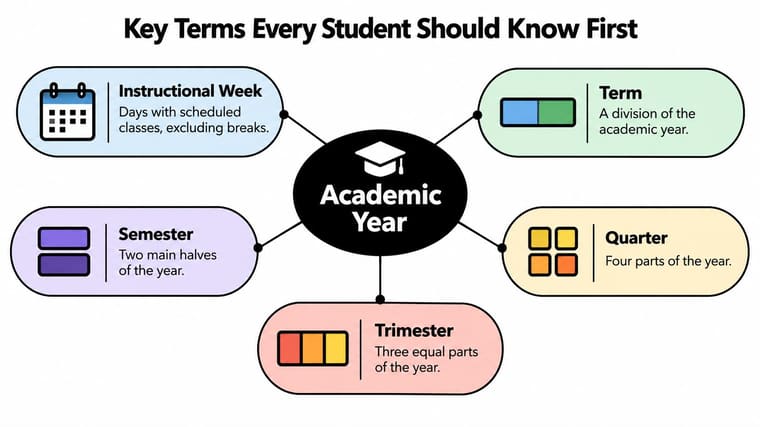
- Academic year: The full production schedule. It’s the official period from the start of the first term to the end of the last one.
- Term: One shooting block. It’s any single division of the year, whatever the school calls it.
- Semester: The year split into two main blocks.
- Trimester: The year split into three blocks.
- Quarter: The year split into four shorter blocks.
- Instructional week: A week when cameras roll, meaning classes are scheduled.
- Contact hour: Time you’re timetabled with a teacher, as opposed to studying on your own.
The One Distinction That Matters Most
Calendar weeks count everything between start and finish, including holidays. Instructional weeks count only weeks with scheduled teaching. Exams are the wrap party in our film analogy. You’re still working, but nobody’s teaching new material.
Mixing those two counts is the single most common counting error students make. It’s also why two honest calendars can disagree. If you’re curious how schools use technology to personalise this kind of planning, this guide to ML for Irish learners shows how adaptive tools adjust to each student’s pace within those fixed term structures.
Keep that one distinction in mind and every table and formula ahead will read clearly.
Semester, Trimester, and Quarter Systems Compared
Start with the shape, not the numbers. A semester system gives you two long blocks, so each course stretches out and exams come less often. A trimester system cuts the year into three, which many primary and secondary schools prefer because breaks land more evenly. A quarter system runs four short blocks, so courses move faster and you start fresh subjects more frequently.
Real calendars show how teaching and exam weeks combine. The University of Auckland’s academic calendar introduction describes two semesters of about 15 weeks each, with roughly 12 teaching weeks followed by three weeks for study and examinations, while Wichita State University defines its year as a 16-week fall semester plus a 16-week spring semester, totaling 32 weeks.
Academic Calendar Systems at a Glance
| System | Number of Terms | Teaching Weeks per Term | Exam Weeks per Term | Total Instructional Weeks |
|---|---|---|---|---|
| Semester | Two | Longer blocks, teaching plus a study and exam stretch | Included at the end of each block | The longer university pattern illustrated above |
| Trimester | Three | Medium blocks with breaks between | Shorter assessment periods | Adds up across three terms |
| Quarter | Four | Short, fast blocks | Brief exam periods | Adds up across four terms |
Read the table as a shape finder, not a promise. Your school’s handbook gives the exact split for your terms. Project-based subjects feel these shapes strongly, since a multiweek piece of work has to fit inside one block, which is why teachers planning ahead often find KS3 art projects for schools matched to the length of a single term rather than the full year.
Two schools can both run semesters and still differ by several weeks, because one counts study and exam weeks inside the term and the other counts them separately.
Find your system in the table, note how your school treats exam weeks, and you already know which rows of your calendar to count.
A Simple Formula to Calculate Any School’s Weeks
Here’s the tool this whole article has been building toward. It fits on a sticky note.
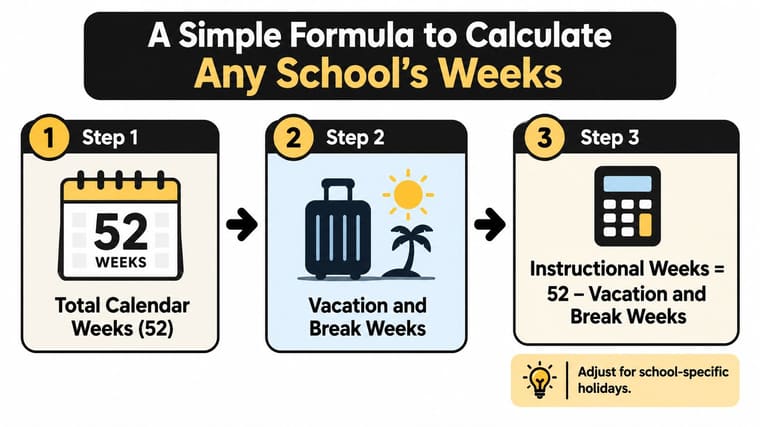
Instructional Weeks = Total Calendar Weeks − Vacation and Break Weeks
Worked Example One
Take a US college on semesters. You count the weeks from the first day of fall classes to the last spring exam. Then you subtract winter break, spring break, and any weeks with no scheduled classes. What remains is instructional time. As a sanity check, the US Department of Education’s guidance on academic years defines an academic year for federal student-aid purposes as at least 30 weeks of instructional time for credit-hour programs and at least 26 weeks for clock-hour programs. If your subtraction lands below that floor for a credit-hour program, you’ve probably subtracted a week that did contain classes or exams.
Worked Example Two
Now take a primary school on three terms. Count the calendar weeks from the September start to the summer finish. Subtract the half-term breaks, the winter and spring holidays, and the summer weeks before the next year begins only if you included them in your span. The remainder is the weeks children are in class.
Follow these steps with your own dates.
- Mark the span: Write down the first teaching day and the last exam or class day.
- Count the span: Use a days between two dates calculator and divide by seven for whole weeks.
- Subtract empty weeks: Remove any full weeks with no classes or exams scheduled.
- Label your answer: Note whether exams are included, so future you doesn’t recount.
One adjustment catches people out. A partial week with even one scheduled class still counts as an instructional week in most school counts, so don’t delete short weeks around holidays. Count the week, then handle the missing days separately if you’re planning study hours.
Three Real Examples Across Countries and Levels
The formula travels well. These three families used the same subtraction on very different calendars.

A US High School Sophomore
Maya’s district published first and last days but not a week count. She counted the full span, subtracted winter and spring breaks and a week of staff-only days with no students, and got her answer. Her takeaway was practical. She stopped planning revision across break weeks she’d be travelling, and her study schedule finally matched the weeks she was in school.
A UK Undergraduate on Three Terms
Tom’s university listed three terms with reading weeks in the middle. His mistake was deleting those reading weeks entirely. His lecturers expected coursework progress during them, so for deadline planning they counted as working weeks even though no lectures ran. He now keeps two numbers, one for teaching weeks and one for working weeks, and plans essays against the second.
The short video below walks through reading a university calendar the same way Tom learned to.
An Australian Primary School Parent
Priya planned family travel around a longer southern hemisphere school year that starts in their summer. She counted term by term instead of across the long end-of-year break, which kept her from inflating the total. Her takeaway is worth borrowing. When a calendar crosses New Year, calculate each term separately and add the pieces.
Same subtraction, three countries, three levels. The inputs change, the method doesn’t.
Why Accurate Week Counts Matter for Deadlines and Countdowns
A countdown is only as honest as its end date. If you count calendar weeks when you meant teaching weeks, your revision plan gains phantom weeks that are holidays. You feel ahead in October and panicked in the final stretch, and the plan takes the blame for a counting error.
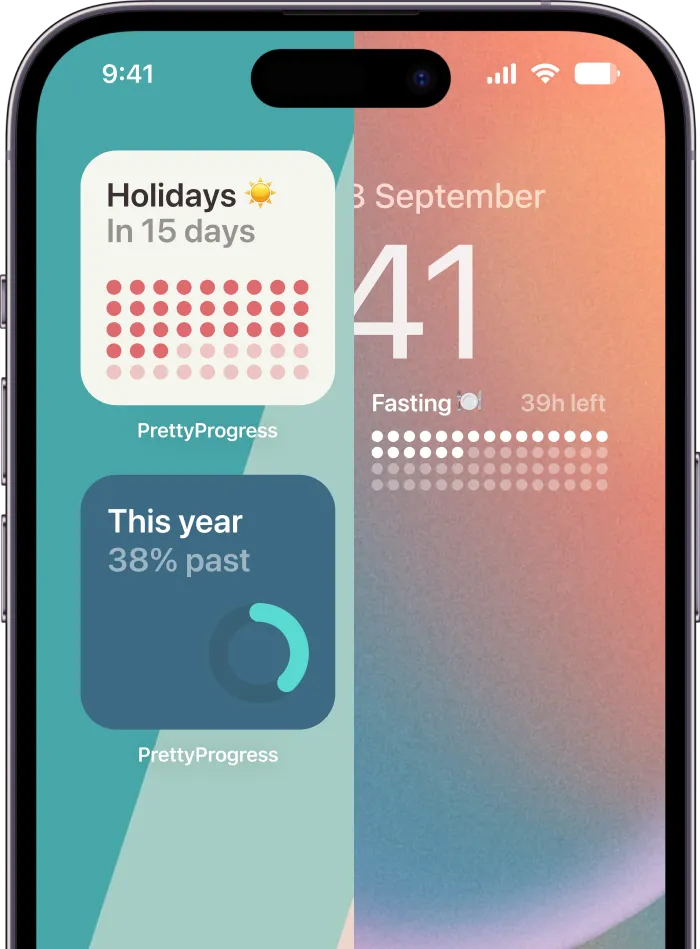
Fix it at the source. Set your target to the actual last teaching day, or the exam date, whichever you’re preparing for. Pretty Progress is one option that lets you set custom start and end dates on a home screen countdown widget, so the percentage you see each morning reflects real instructional time rather than a rounded guess. Pair that with a study countdown timer approach for individual exams and each deadline gets its own honest clock.
Families teaching at home face the same trap in reverse, since they build the calendar themselves. Laying terms out visually with homeschool year overview templates helps them see break weeks before they promise a finish date.
Planning check: If your countdown ends on a round date you picked from memory, it’s probably wrong. Use the date printed on your school’s calendar.
Accurate weeks turn a vague sense of time left into a number you can divide work across. That’s the whole payoff of counting carefully.
Common Misconceptions and a Quick-Reference Checklist
Three myths cause nearly every wrong answer to how many weeks are in an academic year.
- Myth one, it’s 52 weeks: OECD Education at a Glance data on classroom time puts school breaks at an average of 13 weeks across OECD systems, ranging from under 12 weeks in Costa Rica to more than 18 weeks in Latvia, so teaching never fills the calendar year.
- Myth two, one universal answer exists: Country, level, and system each move the number, as the earlier examples showed.
- Myth three, every week in term is a teaching week: Reading weeks, exam weeks, and staff-only days sit inside terms without new teaching.
Your Five-Question Checklist
- What are my first and last dates on the official calendar?
- Which system does my school use, semester, trimester, or quarter?
- Which full weeks have no classes or exams?
- Am I including exams in my count, and have I labelled that?
- Where will I track it, such as an assignment tracker for students tied to real dates?
Run those five questions, apply the subtraction, and you’ll never need to search this question again.
Now that you can calculate your real instructional weeks, put that number somewhere you’ll see it daily. Pretty Progress lets you set your exact term start and end dates as a customisable countdown or progress widget on your phone, so your remaining weeks stay accurate through every break and exam period. Set yours up today and let your home screen keep the count for you.