
August 26, 2026
Daylight Saving Time Adjustment: A Practical Guide for 2026
Make your daylight saving time adjustment easier with a practical 2026 plan. Sleep shifts, light and caffeine tips, device changes, and family routines that
The second Sunday in March arrives, and you stumble into the kitchen at what feels like 7:00 a.m. The microwave says 8:02. The coffee maker is late, the school reminder fired at the wrong-feeling hour, and even the dog looks betrayed. Your body doesn’t care that the phone updated itself overnight. It still thinks someone stole an hour.
That reaction isn’t a personal failure. Daylight saving time adjustment is a mismatch between an official clock and a biological schedule, and spring forward creates a sharper mismatch than fall back. The practical answer is to stop treating both changes as one twice-yearly nuisance. Spring needs preparation. Fall needs a simpler reset.
This guide gives you a four-day pre-shift plan, device and calendar safeguards, a widget-based reminder system, and separate instructions for children, pets, and shift workers. It also answers the larger question, whether changing the clocks still makes sense.
Table of Contents
- Why the Clock Change Always Sneaks Up on You
- Spring Forward vs Fall Back, Which One Is Harder
- Four Days of Pre Shift Sleep Adjustments
- Light, Caffeine, and Wind Down Habits That Actually Move the Needle
- Devices, Calendars, and Countdown Widgets
- Adjusting Kids, Pets, and Shift Workers
- Your One Week Checklist and the Bigger Question
Why the Clock Change Always Sneaks Up on You
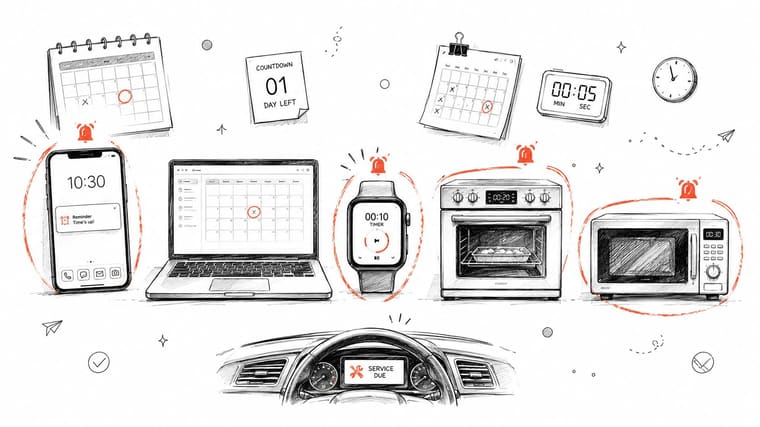
Don’t forget daylight saving time because of a missing calendar. The change is forgotten because modern devices hide it until the consequences arrive. Your phone adjusts overnight, but the oven, microwave, wall clock, car dashboard, coffee maker, or office system may not. By breakfast, you’re doing mental arithmetic before you’ve had caffeine.
The change also lands in the space between clock time and body time. A meeting can appear correctly on a calendar while your sleep pressure, hunger, and alertness remain tied to yesterday’s schedule. That’s why a reminder that says “spring forward tonight” is less useful than a sequence of prompts that tells you when to dim the lights, stop drinking coffee, prepare the children, and check each device.
The two transitions need different treatment
Spring forward removes an hour from the night and places the resulting fatigue directly in front of work, school, driving, and other Monday obligations. Fall back gives the clock an hour, but early waking and darker evenings can still unsettle routines. Treating them identically encourages people to overprepare for fall or underprepare for spring.
The global picture reinforces that point. Time and Date’s DST statistics report that 143 countries have used daylight saving time at least once, while 71 countries were using it in 2023, down from 76 in 2019 and 75 in 2020 through 2022. The practice is widespread, but it isn’t universal, and local rules differ.
A better operating rule
Start with the transition that can take sleep away, spring forward. Build your plan around the four days before it, then use lighter maintenance for fall. Put the plan somewhere visible, such as a home-screen countdown widget, because memory is a poor project manager when you’re tired.
Practical rule: Don’t wait for the clock change to remind you. Make the reminders part of the adjustment.
The rest of the process is straightforward. Move sleep in small increments, use light deliberately, cut stimulants earlier than usual, update devices before they create confusion, and protect the people and animals whose routines depend on you.
Spring Forward vs Fall Back, Which One Is Harder
Spring forward is the harder adjustment for most adults. You lose sleep when the clock advances, and the first workday arrives before your body has accepted the new schedule. Fall back is usually less punishing because the clock offers more night-time sleep, but it can still shift morning waking, meals, childcare, and evening activity.
A review reported in Continuum, summarized by MedicalXpress, describes average sleep loss of 25 to 60 minutes during the first days or weeks after spring forward. The same review reports no average sleep loss after the fall shift. That distinction should determine how much preparation you do.
| Factor | Spring Forward, lose hour | Fall Back, gain hour |
|---|---|---|
| Sleep effect | Average loss of 25 to 60 minutes in the initial adjustment period | No average sleep loss reported |
| Main difficulty | Earlier clock time arrives before the body is ready | Earlier waking and changed evening timing |
| Safety concern | Higher concern during the early adjustment window | Still disruptive, but generally milder |
| Best response | Four-day preparation and cautious Monday scheduling | Lighter weekend reset and consistent morning routine |
| Priority | Morning light, earlier bedtime, reduced caffeine | Evening light management and avoiding premature waking |
The health and safety evidence also isn’t symmetrical. A 2025 systematic review on the spring and fall transitions associated the spring DST-onset change with higher risk of acute myocardial infarction and fatal traffic accidents. It found some opposite effects after the fall DST-offset change, including decreased all-cause mortality and fewer workplace accidents, alongside more crimes involving physical harm.
That doesn’t mean every person faces the same outcome. It means spring forward deserves the serious plan. For fall, shift your bedtime and wake time gradually if you can, but don’t turn a milder transition into a week-long sleep experiment. Keep meals, light exposure, and wake time steady, then let your body settle.
Four Days of Pre Shift Sleep Adjustments
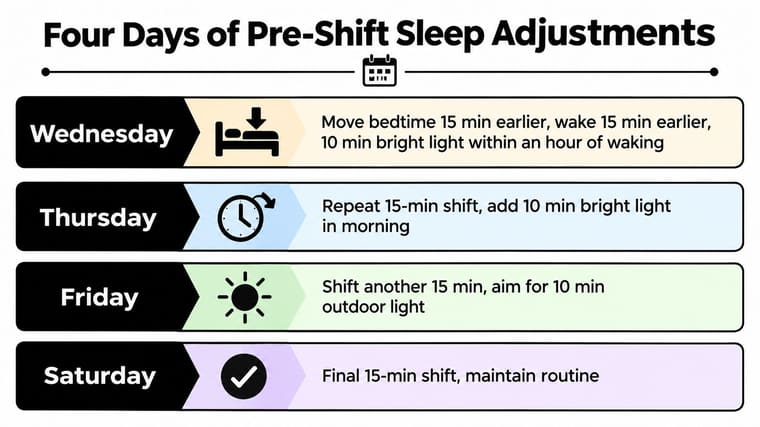
Start on the Wednesday before spring forward. The aim isn’t to force a dramatic overnight change. Four 15-minute shifts reduce the shock by distributing it across several nights, while morning light tells your body when the new day begins.
If your usual bedtime is 10:30 p.m. and wake time is 6:30 a.m., use the following anchors:
Wednesday
Go to bed at 10:15 p.m. and wake at 6:15 a.m. Get bright light within an hour of waking, ideally outdoors. Skip an afternoon nap, because you want enough sleep pressure at the earlier bedtime.
Thursday
Move both anchors another 15 minutes, to 10:00 p.m. and 6:00 a.m. Get morning light again, stop caffeine after 1:00 p.m., and serve dinner according to the shifted schedule. Meal timing gives your evening a firm boundary instead of letting the day drift.
Friday
Use 9:45 p.m. as bedtime and 5:45 a.m. as wake time. Add a short early-evening walk, preferably outside, but keep it easy. This isn’t the night for a hard workout that leaves you wired at bedtime.
Saturday
Hold the final shift, 9:30 p.m. to 5:30 a.m., as consistently as possible. Set your phone and other adjustable devices to the new time before bed, then stop checking the clock. The purpose is to sleep through the transition rather than negotiate with it at midnight.
These exact anchors assume a schedule like the example above. If your normal bedtime and wake time differ, preserve the same 15-minute progression, not the displayed clock numbers. If you start on Thursday, make two 15-minute shifts on Saturday only if you can still protect adequate sleep. Don’t try to recover by staying up late and sleeping in.
A sleep calculator can help you check whether the revised bedtime gives you a realistic sleep window. Use the sleep calculator as a planning aid, then favor a stable wake time over chasing a perfect bedtime.
The plan is deliberately boring. Boring works better than a heroic reset on Sunday night.
Light, Caffeine, and Wind Down Habits That Actually Move the Needle
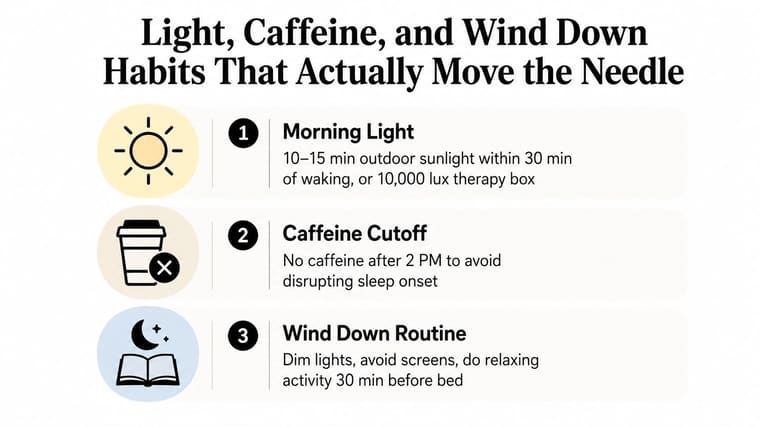
Morning light comes first. Get 10 to 15 minutes of outdoor sunlight within 30 minutes of waking, or use a 10,000-lux light therapy box if it’s still dark and a clinician has confirmed it’s appropriate for you. Light is the strongest practical signal in this routine, so don’t replace it with another productivity trick.
Caffeine comes next. Set your cutoff at noon during the pre-shift days, even if you normally drink coffee later. The goal is to protect the earlier bedtime, not to prove you can function through fatigue. Skip the post-5:00 p.m. espresso on Thursday and Friday.
A schedule you can paste into your notes
- 6:30 a.m. Get outdoor light soon after waking.
- 12:00 p.m. Have your last coffee or caffeinated drink.
- 8:30 p.m. Start reducing lights and nonessential activity.
- 9:30 p.m. Turn screens off or switch them to grayscale.
- 10:00 p.m. Begin a quiet routine, such as reading or a shower.
- 10:30 p.m. Lights out, adjusted earlier as your four-day plan progresses.
Room temperature matters less than consistency, but a cool room can make wind-down easier. If sleep onset feels unsettled, try slow breathing such as the 4-7-8 pattern, and keep the routine uncomplicated.
Skip the popular fixes that create more problems than they solve. Don’t take melatonin gummies unless a healthcare professional has advised you to. Avoid naps longer than 20 minutes, and don’t use alcohol as a sedative. It can make you drowsy while fragmenting the sleep your body needs during the adjustment.
Morning light is especially useful after spring forward because the new morning feels darker. Keep the same approach after fall back, but be more careful with bright evening light if you start waking too early. For broader routine ideas, this guide to healthy habits for life can help you build the surrounding habits without turning the clock change into a complete lifestyle overhaul.
If you want a visual demonstration of sleep-supporting routines, watch this short video after you’ve finished your evening setup:
Devices, Calendars, and Countdown Widgets
Treat the clock change like a small software migration. Make a list, check each item, and don’t assume that because your phone updated, every other device did too.
Start with the devices people trust without thinking:
- Wall clock: Check the clock in the bedroom, kitchen, hallway, and office.
- Coffee maker: Verify its programmed start time, especially if it runs before you wake.
- Work laptop: Confirm its time zone and calendar settings before Monday meetings.
- Oven and microwave: Update manual displays that create morning confusion.
- Car dashboard: Check the clock before the first commute.
- Smartwatch: Make sure it syncs with the correct phone and time zone.
Calendar entries deserve the same attention. Review recurring meetings that fall on the Monday after the change, then add a 60-minute review buffer where a time-zone error could cause trouble. Add a one-time 15-minute buffer on Tuesday, and tag children’s school, sports, and activity times so notifications surface them clearly.
Build reminders you can see
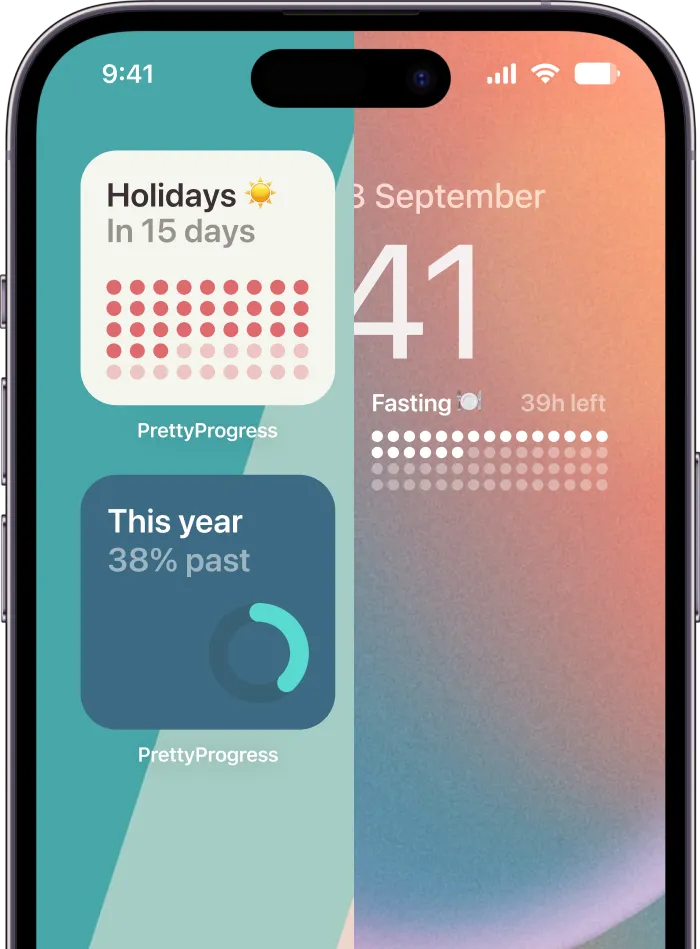
A countdown widget works better than a buried calendar note because it stays in your field of view. Set one to the relevant 2026 DST date, pin it to both the Home Screen and Lock Screen, and use a simple visual code. Green can mark days when your schedule is aligned. Amber can mark the adjustment days when bedtime, light, and caffeine need extra attention.
Use a Shortcuts automation or phone Routine to fire at 9:00 p.m. on the Friday before the change. Have it lower brightness, silence nonessential alerts, and keep notifications quiet until your new wake time. The best reminder isn’t dramatic. It appears at the moment you can still make the right choice.
The home-screen timer guide can help you set up a glanceable reminder without adding another complicated system. Keep one countdown visible, not five competing alerts.
Adjusting Kids, Pets, and Shift Workers
The adult plan needs bending for people whose schedules are less flexible. Children respond well to visible routines, pets respond to repeated cues, and shift workers often need protection from a transition that lands in the middle of an already difficult sleep pattern.
| Group | Start shifting | Strongest anchor | Top mistake to avoid |
|---|---|---|---|
| Children | Begin earlier than the adult plan when possible | Dinner, bedtime story, and a visual wake signal | Changing every routine at once |
| Dogs | Start on the Wednesday before | Walks and feeding on the new clock | Feeding by the old time |
| Night shift workers | Request a transition shift or recovery day | Protected sleep window and controlled light | Treating a workday like a normal Sunday |
| Rotating workers | Plan around the specific roster | Blackout curtains and consistent sleep cues | Relying on willpower after a short sleep |
For children, move dinner and bedtime in small steps, and keep the bedtime story at the same point in the routine. A magnet clock or color-changing wake clock gives the child something concrete to follow. Don’t let the clock change erase the cues that already work.
For dogs, move the morning walk earlier during spring preparation and feed according to the new clock. A cat will probably ignore the plan, so protect your own routine instead of trying to negotiate with the animal.
Night shift nurses and rotating workers should ask for the transition shift or a day away from duty if the roster allows it. Use blackout curtains, one consistent white-noise source, and carefully timed light therapy. The mistake to avoid is driving or performing safety-critical work while drowsy. A technical review of DST transition rules emphasizes that schedules differ by jurisdiction, and it reports that fewer than 40% of countries use DST, with 70 countries using it in 2025 and 2026. Check the rule that applies to your workplace rather than assuming every location changes together.
Your One Week Checklist and the Bigger Question
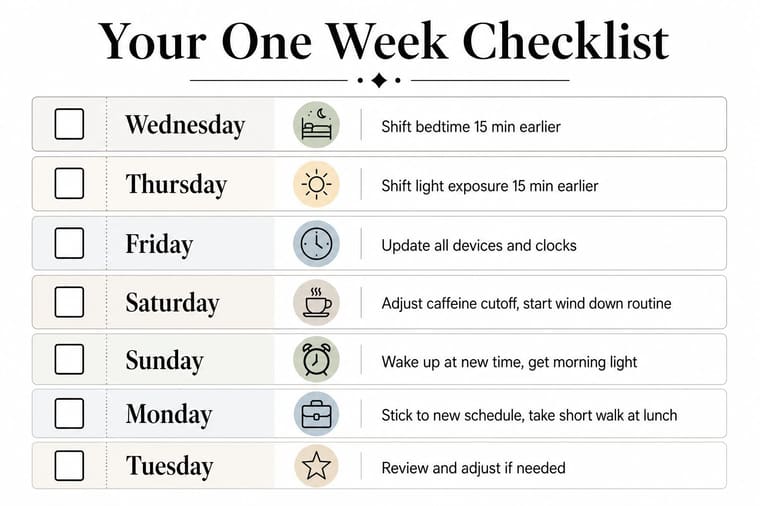
Use one task per day. That keeps preparation visible without making it another project that collapses under ordinary life.
- Wednesday: Shift bedtime and wake time 15 minutes earlier.
- Thursday: Move morning light exposure earlier and stop caffeine after noon.
- Friday: Update manual clocks, review calendars, and pin the countdown widget.
- Saturday: Prepare children’s visual schedules, pet meals, and the evening wind-down.
- Sunday: Wake at the new clock time, get morning light, and avoid unnecessary high-risk tasks if you feel impaired.
- Monday: Keep the revised schedule and take a short walk during the day.
- Tuesday: Review energy, sleep quality, and alertness, then make only small corrections.
The practical plan solves the immediate problem, but it doesn’t settle the policy question. The 2025 U.S. survey reported by The Guardian found that 18% preferred keeping the twice-yearly clock changes, while 68% preferred some form of year-round single time. Official U.S. rules still schedule spring forward for March 8, 2026, and fall back for November 1, 2026, so individuals need a plan even while public debate continues.
My recommendation is clear. Abolishing the spring change is worth advocating for, and permanent standard time deserves serious consideration because it better supports morning light and stable sleep timing. Permanent DST would remove the clock change but could preserve a chronically later light schedule. Until policy changes, prepare for spring, simplify fall, and don’t pretend the two transitions carry equal costs.
Set the countdown widget today, then use it as your one-week launch signal. When it turns amber, start the plan instead of waiting for Sunday morning chaos.
Pretty Progress gives you customizable countdown and progress widgets for iPhone, iPad, Apple Watch, Mac, and Android, so the DST date and daily preparation steps stay visible on your Home and Lock Screens. Visit Pretty Progress to create a clean reminder for the next clock change and keep your sleep adjustment plan in view.