
October 3, 2026
8 ADHD Home Organization Tips That Stick
Try these ADHD home organization tips for clearer spaces, easier routines, visual cues, timers, and steady progress with less overwhelm.
The best ADHD home organization tips do not start with a purge. They start with a home that gives your brain fewer chances to forget, wander, and double-handle everything. Minimalism can help some people, but for many ADHD households the bigger win is environmental scaffolding, cues placed where the action happens, and systems that reduce remembering, searching, and deciding.
That means a basket by the door beats a beautiful cabinet you never open. A countdown widget can be more useful than another planner you have to remember to check. And a home that remembers for you is usually built one friction point at a time, not in one heroic cleanup weekend. If you want a place to begin, choose one high-friction area, test one system, and adjust it to the energy you have.
The eight ideas below focus on visibility, category design, time cues, and follow-through. I’ve also woven in a focused use of Pretty Progress where glanceable countdowns and progress bars can make deadlines and maintenance easier to see, because for many ADHD homes, seeing time clearly is half the battle. If you want to bring order to your home, start with the smallest fix that changes daily behavior.
Table of Contents
- 1. Visual Countdown Systems and Progress Tracking
- 2. Zone-Based Organization with Clear Boundaries
- 3. The Visibility Principle and Open Storage
- 4. Simplified Sustainability Through Reduced Possessions
- 5. Time-Based Reminders and Maintenance Scheduling
- 6. Category-Based Sorting and Closed-Loop Systems
- 7. Accountability Partnerships and Organized Spaces as Motivation
- 8. One-Touch Rule and Immediate Processing Systems
- ADHD Home Organization, 8-Point Comparison
- Make the System Easier Than the Mess
1. Visual Countdown Systems and Progress Tracking
A lot of ADHD advice assumes you’ll remember to check a calendar. That’s a weak assumption. Visual countdowns work better because they sit in the environment and don’t require a separate act of recall, which is why a home screen widget can be more useful than a buried task list.
Make time visible where you already look
Use countdowns for the deadlines that create the most stress, not for every future event you can think of. Three to five active countdowns are usually enough to keep the screen useful instead of noisy. A student can track an exam, a renter can track a lease renewal, and a parent can track a school event without opening an app first.
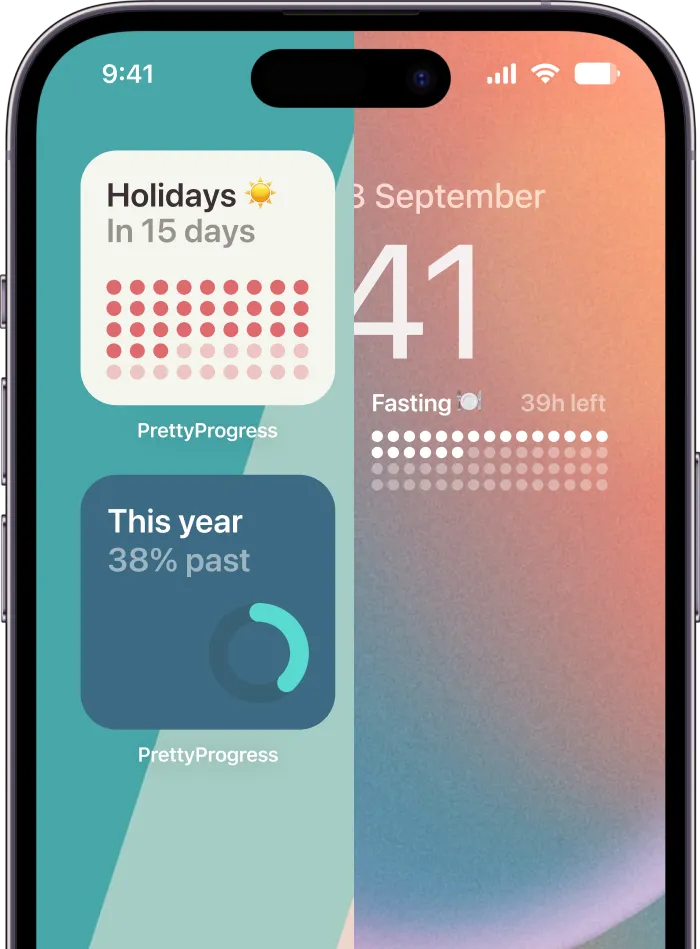
Pretty Progress is built around that kind of glanceable reminder, and its visual reminders for ADHD fit especially well on a lock screen or home screen that you see many times a day. The useful part isn’t just the widget, it’s the constant low-effort cue.
Practical rule: if a deadline only lives in a calendar you rarely open, it’s not a system, it’s a hope.
A calm visual theme matters too. Busy colors and cluttered layouts can feel like one more source of pressure, so a clean style is often easier to live with. Review the dates weekly, because an accurate countdown is calming and a stale one becomes visual noise.
2. Zone-Based Organization with Clear Boundaries
Shared homes get messy when every surface is a little bit of everything. Zone-based organization solves that by giving each area one job, which makes it easier to know where things belong and what should happen there.
Build around movement, not wishful thinking
The best zones follow how you already move through the house. A door-side intake spot for mail and keys works because that’s where items arrive. A laptop zone works because that’s where work happens. A craft corner works best when one active project lives there instead of three half-finished ones spread across the house.
Keep the boundaries physical. A rug, a shelf, a basket, or a small cart tells the brain that the area has a purpose. When boundaries are only conceptual, they disappear fast on tired days. That’s why a two-zone or three-zone setup is often more sustainable than trying to map the entire house at once.
A zone should have a clear entry point, a clear exit point, and a short list of item types that belong there.
If you want a maintenance cue, use a countdown to remind you when a zone needs a reset. That works well for spaces that drift, like an intake table or a hobby shelf. The point is not to make every room look staged, it’s to stop each room from becoming a dumping ground for unrelated stuff.
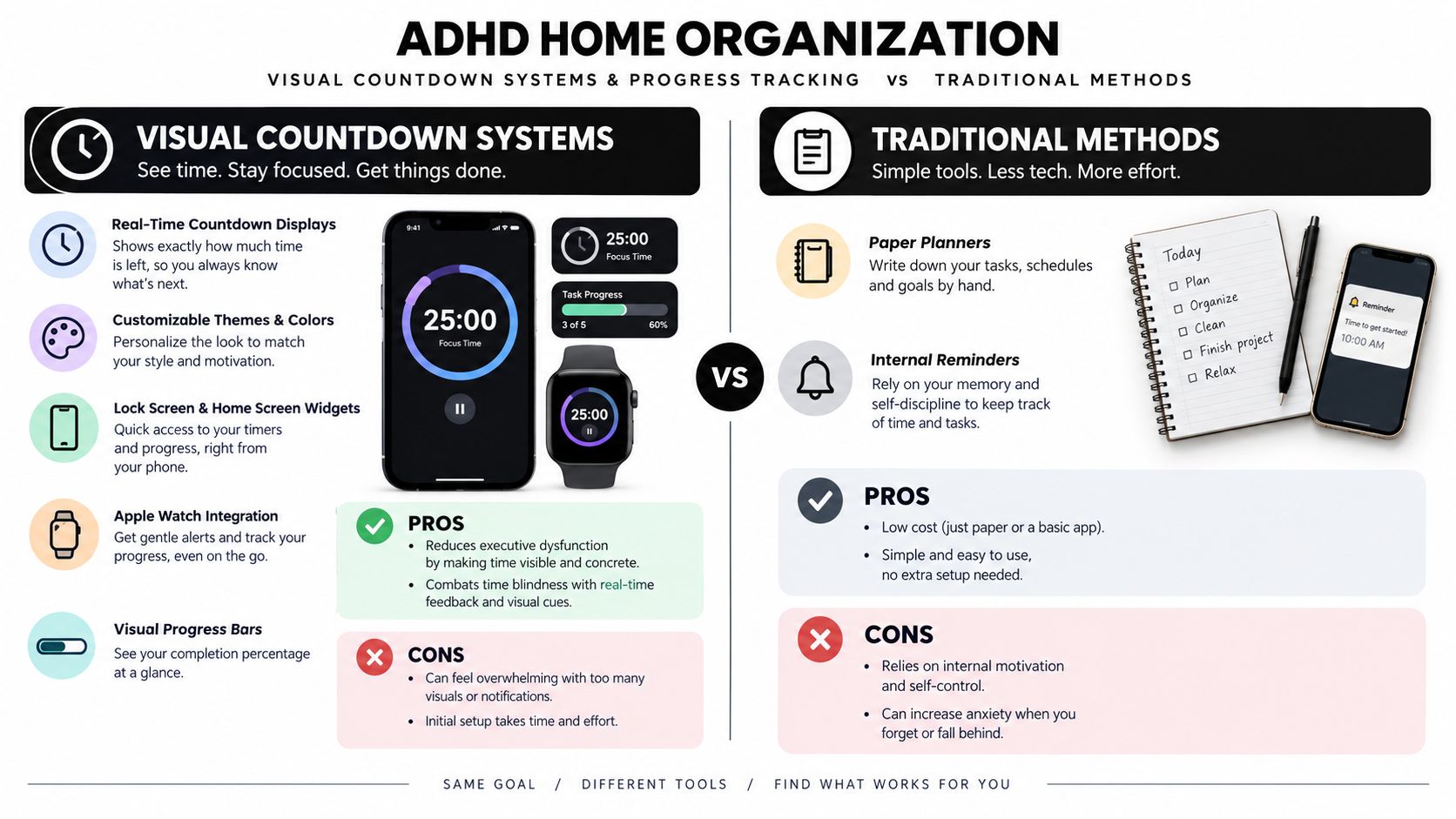
For a visual contrast between a structured reminder system and a traditional approach, the comparison infographic on visual countdowns and ADHD organization shows how much simpler glanceable cues can be. A short planning video can help too, especially if you think better by watching a setup unfold.
3. The Visibility Principle and Open Storage
Hidden storage often looks tidy and then slips past ADHD brains. If the item is out of sight, it tends to become out of mind, which leads to duplicate purchases, forgotten supplies, and frantic searching right when you need something.
Show the things you use most
Open shelving, clear bins, and visible labels reduce the amount of memory your home demands from you. A kitchen shelf with everyday dishes in view is easier to use than a deep cabinet you avoid opening. The same goes for hobby supplies, shoes, chargers, and bathroom basics.
This doesn’t mean every item should be on display. Seasonal items, backup stock, and rarely used tools can stay hidden. The rule is simpler, keep active-use items visible and make the visible field cohesive enough that it doesn’t turn into visual static.
- Use clear containers consistently: similar containers make the shelf look intentional instead of chaotic.
- Label with words and color cues: that helps other people in the house use the same system.
- Group related items together: one shelf for writing tools, one bin for yarn, one drawer for cables.
- Limit what stays visible: if something isn’t in regular use, it probably doesn’t need prime space.
A good visible system should answer two questions fast, what do I have, and where does it go back? That’s why the goal isn’t aesthetic perfection. It’s reducing search costs and decision points so maintenance becomes almost automatic. For a different take on visual organization, the idea of how icons and colors organize folders maps well to home storage too, because the brain likes consistent visual categories.
4. Simplified Sustainability Through Reduced Possessions
Reducing possessions isn’t about chasing a showroom look. It’s about lowering the number of decisions your home asks you to make every day. Fewer shirts, fewer tools, fewer duplicate gadgets, fewer “maybe someday” items, that all translates into less sorting and less stalling.
Keep fewer things in the category that burdens you most
Start with one category that creates repeated friction. Clothes are a common one, because too many options can turn morning routines into a low-grade decision marathon. Kitchen tools are another, especially when drawers are packed with specialty items that only get used once in a while.
The trade-off is real. Letting go of extras can trigger anxiety about future needs, and some people prefer a buffer of backups. The key is to be honest about whether that buffer supports life or just preserves clutter.
If a category keeps re-creating mess, the number of items in that category is part of the problem.
A practical method is to make a clear split between active and inactive items. Active items live where they’re used. Inactive items go into a marked backup zone, or they leave the home altogether. Photographing items before donating can help if letting go feels risky, because it gives you a record without keeping the object itself.
This works best as a slow experiment. Reduce one category, live with it for a bit, then decide whether the new level is comfortable or too lean. The goal is not to become a different person. It’s to make your current routines less expensive in time and attention.
5. Time-Based Reminders and Maintenance Scheduling
Most ADHD organizing plans fall apart at the maintenance stage. The system got built once, then no one reminded the household to keep it alive. That’s why scheduled reminders matter, they turn invisible upkeep into an actual appointment.
Put maintenance on the calendar like any other task
Weekly tidy-ups, monthly purges, and seasonal swaps work better when they’re attached to a time cue. A reminder before the task starts is useful because it gives your brain time to transition, instead of demanding instant action. That matters when task initiation is the hard part, not the work itself.
The strongest schedules are short and specific. “Sunday evening reset” is easier to follow than “clean the house.” “Mail sort” is clearer than “organize papers.” And if you pair the session with music, a podcast, or a small reward, it stops feeling like a punishment.
Pretty Progress can support that rhythm with a visual countdown to a maintenance session, and the planner-for-ADHD approach fits especially well when you want the reminder to stay visible instead of disappearing into a buried app. The point is not to track productivity for its own sake. It’s to make upkeep feel finite.
- Schedule at your best energy time: don’t fight your natural rhythm if you can avoid it.
- Set a reminder before the session: that helps with mental preparation.
- Keep the task bounded: a 15-minute reset is often more realistic than a full-hour overhaul.
- Use a visual finish line: progress bars make completion easier to feel.
The home doesn’t need constant perfection. It needs regular resets that are small enough to survive a busy week.
6. Category-Based Sorting and Closed-Loop Systems
Organizing by room sounds logical, but ADHD households usually do better when similar items live together. That’s the closed-loop idea, everything of one type has one home, so you’re not guessing where the next cable, pen, or battery belongs.
Group by item type, not by where you happened to drop it
A pen should live with other pens. All tech cords should live together. Medications should stay in one consistent spot. The logic is simple, if you need a thing, you know exactly which category to check.
This also helps with hyperfocus. Many people can sort one category for a short burst, but they stall when the project becomes too broad. One drawer of writing tools is manageable. The whole office is not. That’s why category-based sorting turns a big vague job into a series of finishable wins.
- Start with one high-impact category: medicine, tech, or hobby supplies usually creates the fastest payoff.
- Use transparent containers: inventory stays visible without extra effort.
- Label by category plus contents: that helps during restocking and when someone else uses the item.
- Keep consumables on a list: batteries, refills, and office supplies go stale fast when they live only in memory.
Closed-loop systems work because they reduce the number of places your brain has to search. They also make it easier to notice when something is missing. That’s a quiet but important form of organization, the home tells you what it needs before the problem gets big.
7. Accountability Partnerships and Organized Spaces as Motivation
Many ADHD homes need external accountability, not just better intentions. A buddy, a family check-in, or a visible progress photo can create enough social momentum to get a stalled project moving. That’s not a crutch, it’s a support structure.
Make the work visible to another person
Before-and-after photos are useful because they make progress tangible. What felt like a tiny fix in the moment can look much bigger when you compare the two images later. That feedback loop helps a lot when motivation is unreliable.
You don’t need a formal organizing partner if that feels like too much. A sibling, housemate, partner, or friend can be enough. The important part is that someone else knows what you’re trying to do and can ask about it later.
Visible progress often creates more momentum than private perfection ever will.
Pretty Progress can fit here too, because a countdown to an organizing session gives the task a start time and a finish line. The how to build accountability guide is relevant if you want that progress to stay in sight between check-ins. Just keep the expectations human. A shared photo, a short message, or a weekly reset is enough.
Public accountability can work if you like it and have privacy boundaries sorted out. Private accountability can work if you don’t. What matters is that the system reaches beyond internal willpower, because ADHD homes often need outside pressure to make follow-through easier.
8. One-Touch Rule and Immediate Processing Systems
Doom piles happen when items get touched, then set down to deal with later. Later never arrives, or it arrives with too much friction, and the pile grows into a problem that feels bigger than the original task.
Make the first contact the decision point
The one-touch rule asks you to process items when they arrive, or as close to arrival as possible. Mail gets sorted right away. Packages get opened, cardboard gets tossed, and the item gets put in its home. Laundry gets sorted into its category the moment it comes out, not after it has sat on a chair for three days.
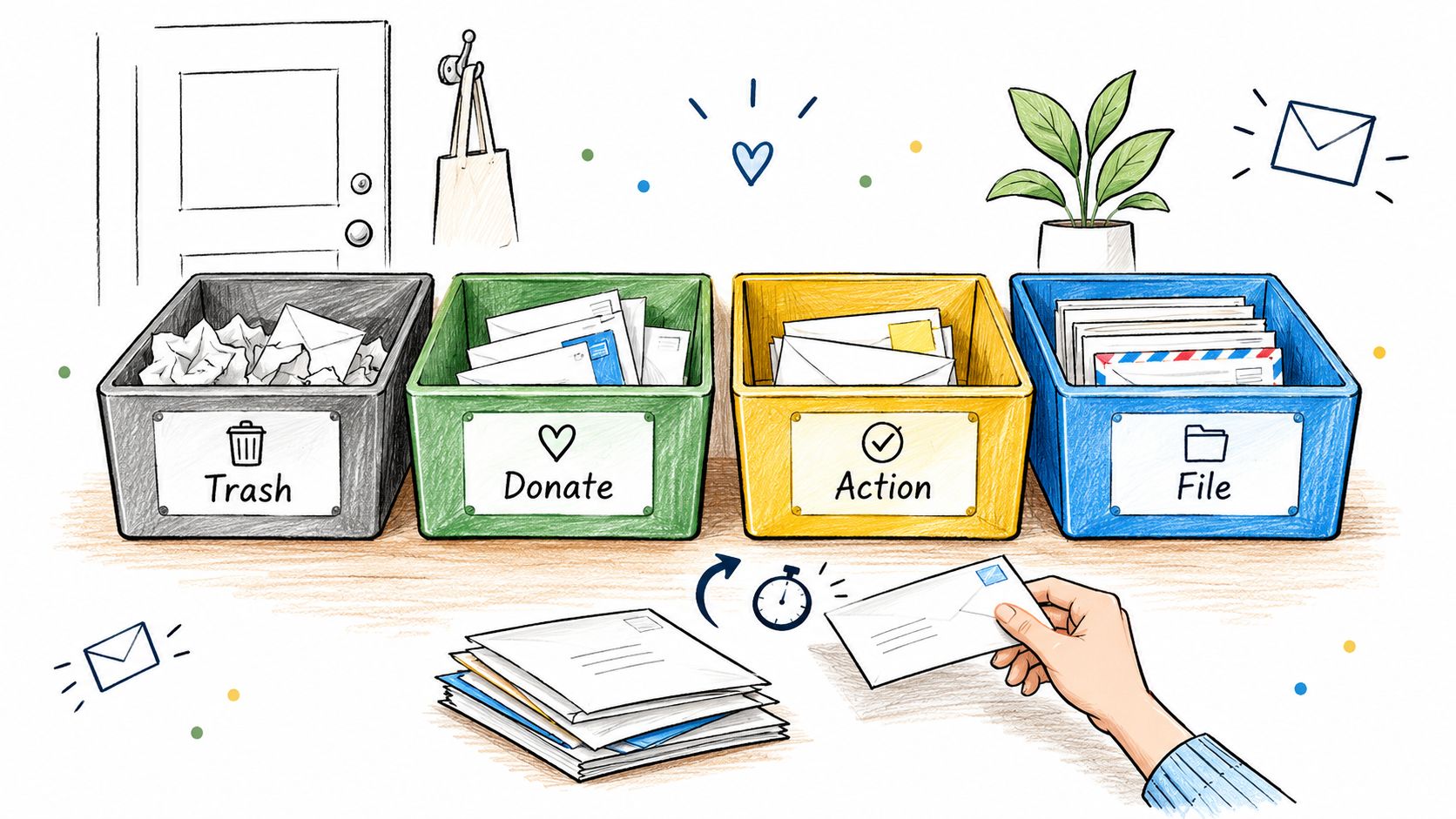
The trick is to make processing feel tiny. A front-door tray, a mail station, or a small bin system turns a vague job into a quick sequence. If the categories are simple, the system is more likely to stick. More than four bins at a station usually starts to feel like homework.
The best version of this is not intense. It’s routine. Fifteen minutes in the evening, one tray, one timer, and one pass through the incoming stuff. That’s enough to stop many clutter spirals before they start.
For a strong visual example, the mail sorting image shows how simple labeled bins can turn paperwork into a decision you make once instead of ten times. The same logic works for bills, school forms, and random items that tend to land on the nearest flat surface.
ADHD Home Organization, 8-Point Comparison
| System | Implementation Complexity 🔄 | Resource Requirements ⚡ | Expected Outcomes 📊 | Ideal Use Cases 💡 | Key Advantages ⭐ |
|---|---|---|---|---|---|
| Visual Countdown Systems and Progress Tracking | Medium setup & customization 🔄 | Smartphone/watch + app; low ongoing cost ⚡ | Better time awareness; fewer missed deadlines 📊 | Time-blind users, students, deadline-driven projects 💡 | Constant external cues & cross-device visibility ⭐ |
| Zone-Based Organization with Clear Boundaries | Medium–High: furniture/space changes & agreements 🔄 | Physical space, furniture, storage containers ⚡ | Reduced decision fatigue; easier room-by-room maintenance 📊 | Homes with sufficient space; those needing environmental structure 💡 | Creates natural stopping points; supports hyperfocus ⭐ |
| The Visibility Principle and Open Storage | Low–Medium: swap to open shelving & clear bins 🔄 | Clear containers, labels, shelving; moderate cost ⚡ | Fewer forgotten items; reduced duplicate purchases 📊 | Visual learners; households tolerant of visible items 💡 | Prevents “out of sight” forgetting; immediate inventory awareness ⭐ |
| Simplified Sustainability Through Reduced Possessions | Medium: ongoing discipline & decision work 🔄 | Time for purging & tracking; low material needs ⚡ | Less clutter; fewer daily decisions; simpler maintenance 📊 | Those overwhelmed by volume; capsule wardrobe or limited tools 💡 | Dramatically reduces decision fatigue; simplifies systems ⭐ |
| Time-Based Reminders and Maintenance Scheduling | Low: set recurring reminders & calendars 🔄 | Digital calendar/apps, notification setup; low cost ⚡ | Regular maintenance; fewer “doom piles” over time 📊 | People who need scheduled prompts for chores/seasonal tasks 💡 | Externalizes scheduling; creates accountability without shame ⭐ |
| Category-Based Sorting and Closed-Loop Systems | Medium: consolidate items and create category homes 🔄 | Consolidated storage space, labels, containers ⚡ | Clear inventory; easier restocking and focused sessions 📊 | Hyperfocus-friendly tasks; consumables and hobby supplies 💡 | Enables complete-category organization; simplifies restocking ⭐ |
| Accountability Partnerships and Organized Spaces as Motivation | Low–Medium: establish partners & sharing routines 🔄 | Time/people for check-ins, photo tracking tools ⚡ | Higher follow-through and sustained motivation 📊 | People responsive to social reinforcement; group projects 💡 | Leverages external motivation and social reward loops ⭐ |
| One-Touch Rule and Immediate Processing Systems | Medium: habit formation and station setup 🔄 | Entry-point trays/bins and simple sorting supplies ⚡ | Prevents pile accumulation; faster decision processing 📊 | High-influx entry points (mail, packages); busy households 💡 | Stops backlog growth; speeds everyday decisions ⭐ |
Make the System Easier Than the Mess
The right ADHD home setup usually looks less like a makeover and more like a series of small environmental edits. Choose one visible problem area, give it one physical home, add one cue that reminds you to act, and set one short maintenance appointment. That’s enough to test whether a system actually reduces friction or just creates a prettier version of the same stress.
If a setup keeps working, keep it. If it makes you hesitate every time you use it, change it. ADHD-friendly organization is supposed to lower the cost of everyday life, not raise the standard you have to maintain. That’s why visible storage, category-based homes, and countdowns are useful together, they reduce searching, simplify decisions, and make time easier to see.
The strongest systems also respect the actual household, shared spaces, kids, partners, mail, bills, and the fact that some days you’ll have more capacity than others. A basket by the door can be a smart system. So can a timer, a label, a clear bin, or a Sunday reset. What matters is whether the home helps you act without forcing you to remember everything first.
If you want a simple next step, pick one chore zone that keeps getting messy, add one fixed home for the items that pile up there, and use a countdown or progress bar to make the reset visible. A glanceable widget can be enough to turn “I’ll do it later” into “I can see exactly when and how to do it.” For many ADHD homes, that’s the difference between another abandoned cleanup and a system that sticks.
Pretty Progress gives you customizable countdown and progress widgets for the moments you need to keep in view. If you want a visual cue for cleaning sessions, maintenance days, or deadlines that affect your home routines, visit Pretty Progress and see whether a glanceable countdown fits the way you organize.