
July 14, 2026
Weight Loss Timeline: Realistic Expectations for 2026
Understand your weight loss timeline with our realistic 2026 guide. Discover weekly/monthly progress, beat plateaus, & track success for lasting results.
You started eating better. You walked every day this week. The scale dropped fast at first, then barely moved. Maybe your jeans feel a little different, but the mirror doesn’t seem impressed yet.
That’s the moment when many people decide their plan “stopped working.” Usually, it didn’t. They just hit the most confusing part of the weight loss timeline.
A realistic timeline isn’t a straight line. It has an early drop that feels exciting, a slower stretch that feels unfair, and a middle period where your body may be changing before anyone else can see it. That gap between effort and visible payoff frustrates a lot of people. So do the messy ups and downs on the scale.
This guide is built for that reality. Not the fantasy version where you lose the same amount every week and feel more motivated every day. The actual version, where biology, perception, water retention, and patience all matter.
Table of Contents
- Setting Realistic Expectations for Your Journey
- The Two Phases of Weight Loss Explained
- Your First Month A Week-by-Week Guide
- Mapping Your Milestones for the Next Six Months
- Factors That Influence Your Personal Timeline
- Staying Motivated Through Plateaus and Fluctuations
- Building a Sustainable Long-Term Plan
Setting Realistic Expectations for Your Journey
You start on Monday. By the end of the first week, the scale is down, your clothes might feel a little better, and you feel sure you finally found the plan that works. Then the second week shows almost nothing, or even a small uptick. That moment creates a lot of unnecessary panic.
That pattern is common because early progress and later progress are often measuring different things. The first drop can be loud. Real fat loss is usually quieter.
This is the first psychological hurdle in a weight loss timeline. I call it the perception gap. You can be doing the right things and still feel unsure because your body changes before the mirror catches up, and the scale can jump around before a trend becomes clear. A second hurdle follows close behind. Real weight loss is non-linear, which means progress rarely shows up as a straight, satisfying line from week to week.
A simple way to view the scale is to treat it like the weather, not your report card. One rainy day does not change the season. In the same way, one flat weigh-in does not cancel a week of solid habits.
Practical rule: Judge your plan by trends over several weeks, not by one exciting drop or one frustrating stall.
The early phase often includes shifts in stored carbohydrate and water, so the scale may move faster at first than it will later. That quick change feels encouraging, but it also sets a trap. Many people unconsciously expect week two to look like week one.
Your body has not adapted to the plan in just seven days. More often, the easy-to-see water changes happened first, while slower fat loss is still continuing in the background.
At the start, focus on consistency long enough to let the noisy early phase pass, not perfection. That mindset keeps normal fluctuation from feeling like failure.
A target date can help here. It gives your effort a realistic frame, so a slow week feels like part of the process instead of proof that nothing is working. If you want help setting a pace that matches your habits, you can calculate your ideal goal date and compare that timeline with what you can realistically sustain.
The Two Phases of Weight Loss Explained
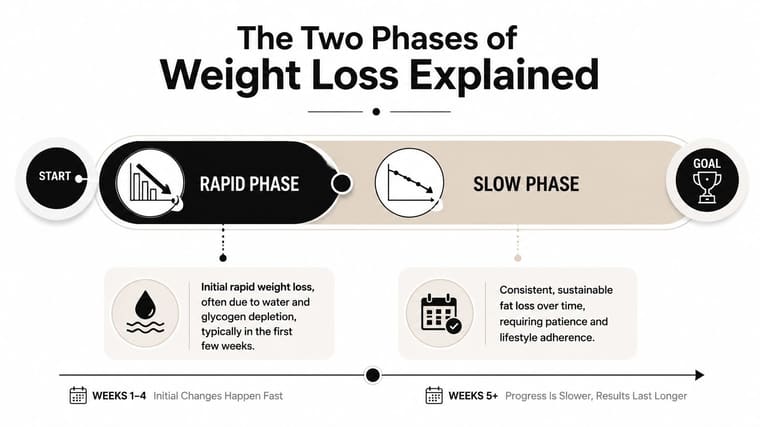
The body doesn’t lose weight in one smooth, uniform way. It tends to move through two phases.
The first phase is fast. The second phase is slower and steadier.
The rapid phase
During the first days to weeks, weight loss often happens quickly because the body is using glycogen, protein, and associated water stores, not just body fat, based on research on the two phases of body weight change. This is why your scale may drop faster at the beginning than it will later.
A simple way to think about it is a wet sponge. If you squeeze it, water comes out quickly. The sponge gets lighter fast, but it hasn’t really changed shape yet. Early weight loss can look like that.
This phase feels rewarding, but it can fool people. They assume the same speed should continue forever. When it doesn’t, they think something broke.
The slow phase
After that early drop, your body shifts into a slower fat-loss stage that can continue for a long time. In this phase, the energy cost of losing fat moves closer to 3,500 kcal per pound, which is why progress looks steadier and less dramatic in the same research article.
This is the phase where patience matters most.
Instead of big “whoosh” moments, you get smaller signs:
- Clothes fit better
- Waistbands feel less tight
- Energy feels steadier
- Your routine becomes easier to maintain
Early fast loss is often a water story. Later slow loss is more of a fat story.
That distinction matters because it protects your mindset. If your first month includes one exciting drop and then several calmer weeks, that’s not failure. It’s a normal transition.
Why slower can be more meaningful
People often want reassurance that slower progress still counts. It does. The later phase is usually less flashy, but it’s where the habits behind long-term change get built.
A good weight loss timeline isn’t one that looks dramatic on a chart. It’s one that you can keep living with. If your meals, movement, sleep, and stress levels support the plan, the slower phase is often the more important one.
Your First Month A Week-by-Week Guide
You start on a Monday, feel focused all week, and by Friday the scale is down. Then the next week it barely moves, or even bumps up a little, and suddenly your brain starts asking the wrong question: “Am I doing this wrong?”
For many new clients, that emotional swing is the hardest part of month one.
The first month is less like a straight slide down and more like watching the tide. The shoreline changes, but not in a perfectly smooth line. Some days the water pulls back. Some days it washes in. Your body weight behaves the same way, especially early on. That is normal biology, not a sign that progress stopped.
Week one
Week one often feels dramatic.
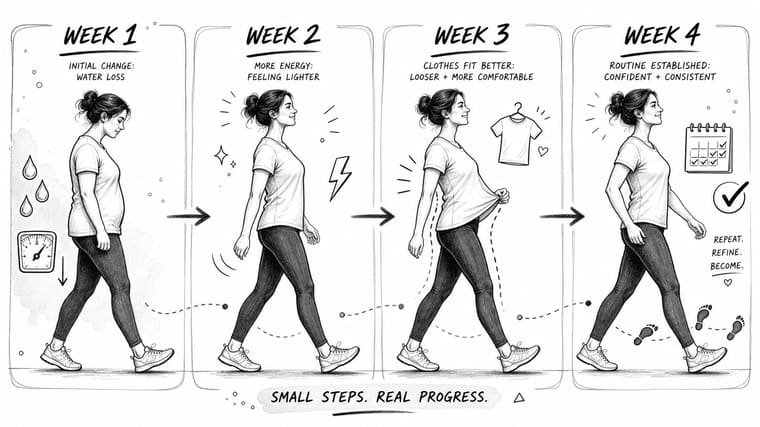
The scale can drop fast because your body is shedding some stored water along with the early shift in eating patterns. If you eat fewer processed foods, less sodium, or fewer carbohydrates than usual, your body may release extra water. That can create a quick reward, but it can also create a false expectation.
A better goal for this week is not “lose as much as possible.” It is “set up a routine I can repeat.”
Keep your attention on a few basics:
- Meals: Build a simple pattern you can follow on busy days, not just perfect days
- Movement: Pick activity that fits your real life
- Weigh-ins: Check under similar conditions so the number means something
- Notes: Record sleep, hunger, energy, and bloating so you can spot progress the scale misses
If you want a simple system, this guide on how to track fitness progress without relying only on the scale can help you collect better evidence.
Weeks two and three
The perception gap usually starts here.
You may be doing the right things and feel only subtle changes. Your digestion may feel calmer. Your energy may be steadier. You may feel less puffy in the morning. Yet the mirror still looks familiar, and the scale may not reward you every few days. That delay makes many people panic, even though nothing is wrong.
Fat loss is quiet at first. Real life is noisy.
A salty dinner, a hard workout, poor sleep, stress, your menstrual cycle, or constipation can all mask fat loss on the scale for a few days. That is the non-linear volatility people rarely get warned about. Progress is happening underneath those short-term swings, but the day-to-day number does not always show it clearly.
Your job in weeks two and three is to judge the trend, not the blips.
You may also notice that the routine still feels mentally expensive. That is normal too. Habits are still new here. Repeating the same simple actions matters more than searching for a more aggressive plan.
If you’re using a GLP-1 medication, the timeline can feel even stranger because appetite, digestion, and visible body changes may shift on different schedules. A useful companion resource is this Weight Method guide for GLP-1 users, which walks through the process month by month.
Week four
By week four, many people expect proof they can see.
Sometimes you have it. Sometimes you mostly have evidence you can feel.
Look for practical signs that your body and routine are changing:
- Clothes feel a little easier at the waist, chest, or thighs
- Hunger feels more predictable instead of urgent
- Energy stays steadier through the day
- Choices take less debate because the routine is getting familiar
That last point matters more than it seems. When healthy choices start feeling more automatic, you are building the part of weight loss that lasts.
A strong first month is not measured by a perfect downward line. It is measured by whether you kept going through normal fluctuations without treating every bounce as failure. That mindset protects you from quitting during the exact stage when real fat loss is starting to add up.
Mapping Your Milestones for the Next Six Months
You step on the scale in month two, see that you are down several pounds, and still feel disappointed when the mirror looks almost the same. That reaction is common. It is also one of the biggest reasons people quit too early.
This part of the timeline gets easier once you know two things. First, visible change usually lags behind real change. Second, progress over six months is rarely a straight line. Your body behaves more like the stock market than a ruler. The long-term trend can improve while daily numbers bounce around.
Why progress can feel invisible at first
A helpful rule of thumb is the 5 percent mark. For many people, that is the range where body changes become easier to notice in photos, clothing fit, or other people’s comments. Using the 5 to 10 percent range described in this explanation of when weight loss becomes noticeable, a person starting at 200 pounds may not see clearly visible changes until around 10 pounds or more are gone.
That delay creates a perception gap. You may be doing the work, feeling better, and building better habits before your reflection catches up. Nothing is broken. The outside often updates after the inside.
Your body also does not remove fat in a way that makes every pound easy to spot. Losing a few pounds is like taking books out of a packed backpack. The load gets lighter right away, but the shape of the bag may not look very different until more is gone.
To stay grounded during this phase, use more than memory. Photos, waist measurements, workout performance, and how your clothes fit often show progress before the mirror does. This guide on how to track fitness progress with better markers than the scale alone can help you set that up.
A sample six-month timeline
Here is a simple example for someone starting at 200 pounds. It is not a promise. It is a map for what normal, imperfect progress can look like.
| Month | Possible Trend | What You May Notice |
|---|---|---|
| Month 1 | Early drop, then some bouncing | Better routine, steadier hunger, small fit changes |
| Month 2 | Continued loss with noisy weigh-ins | Waistband feels different before the mirror does |
| Month 3 | Nearing or passing the 5% mark | Photos may show more than daily reflection |
| Month 4 | Slower pace or short plateau | Frustration often rises here, even with real progress |
| Month 5 | Another drop after a flat stretch | The scale may “catch up” after weeks of little movement |
| Month 6 | Noticeable total change, still with fluctuations | More visible shape changes, stronger habits, better consistency |
The point is not precision. The point is to prepare you for non-linear volatility.
Month four is where many people get discouraged. They assume a slower rate means they are failing, when often they are seeing a normal mix of water shifts, routine fatigue, and the body adapting to a smaller size. Fat loss can continue while scale loss slows. Those are not always the same speed.
A few milestones matter more than any single weigh-in:
- Months 2 to 3: You may feel better before you look different
- Months 3 to 4: Photos and clothing often show change before the mirror does
- Months 4 to 5: A plateau can be a normal pause, not proof that your plan stopped working
- By month 6: The habit side of progress often matters as much as the pounds lost
That last milestone deserves more respect. Six months is long enough for weight loss to become less about daily motivation and more about systems. If month one is about starting, months two through six are about staying steady long enough for biology to reveal the work you have already done.
You are not failing when progress looks messy. You are watching a real body change in real life.
Factors That Influence Your Personal Timeline
Two clients can start the same week, eat similar meals, walk a similar number of steps, and still see very different results by month three. One notices looser jeans before the scale changes. The other sees faster scale movement but fewer visible body changes. That gap is normal.
Your timeline is shaped by two layers at the same time. Biology sets the starting conditions. Daily habits shape how steadily progress shows up. Weight loss works less like a countdown clock and more like a road trip in changing weather. You control the route and the driving habits. You do not control every hill, headwind, or detour.
Your starting biology sets the pace
Some factors affect how quickly the scale tends to respond, even before habits enter the picture.
- Starting weight: People with more total weight to lose often see bigger early scale drops, partly because water shifts are larger at the beginning.
- Sex: Differences in body composition and hormones can change energy needs and the visible pace of change.
- Age: Energy needs and muscle mass often change over time, which can slow the rate of loss.
- Muscle mass: More muscle usually means higher energy use, but it can also make body recomposition harder to spot on the scale alone.
- Hormones and genetics: These influence hunger, fullness, energy use, and how strongly your body defends its current weight.
This helps explain the Perception Gap. You may be making real progress while your body reveals it slowly.
Your habits determine how consistent that pace feels
Biology loads the dice. Habits still matter a lot.
Sleep, stress, meal structure, food choices, and activity patterns affect appetite, recovery, and how easy it is to stay consistent long enough for fat loss to show itself. Poor sleep can make hunger louder. High stress can make every decision feel heavier. Meals that leave you unsatisfied often lead to more grazing later, even with good intentions.
A few habit areas deserve special attention:
- Sleep quality: Better sleep supports appetite control, energy, and follow-through.
- Stress load: Stress can increase cravings and make routines harder to repeat.
- Meal satisfaction: Protein, fiber, and a meal pattern you can live with usually work better than white-knuckling hunger.
- Daily movement: Walking, training, and general activity all help, but consistency matters more than intensity spikes.
If structured eating helps you stay organized, an intermittent fasting tracker can simplify the routine without turning your day into a constant calorie calculation.
Adaptation is real, and it is not a sign that your body is broken
As you lose weight, your body usually needs fewer calories than it did at a higher weight. You are carrying less mass, so the energy cost of daily life often drops. Hunger can rise too. That combination can make the same plan produce slower results later than it did at the start.
That is one reason personal timelines spread out over time. Early changes can be quick. Later changes often require more patience, tighter routines, or a small plan adjustment. For encouragement during those slower stretches, this article offers expert guidance on weight loss motivation.
The coaching takeaway is simple. Compare your results to your own repeatable behaviors, not to someone else’s graph. A personal timeline reflects your body, your routine, and how long you can stay steady while normal fluctuations come and go.
Staying Motivated Through Plateaus and Fluctuations
The middle of a weight loss timeline is rarely pretty on paper. Some weeks the scale drops. Some weeks it stalls. Some weeks it rises even when you did “everything right.”
That’s normal. Weight loss is not linear, weekly fluctuations happen, and many people hit an expected biological plateau between 6 and 12 months, based on WeightWatchers’ discussion of real-world weight loss patterns.
A plateau is not the same as a bad week
People often use the word plateau too early. A single flat weigh-in isn’t a plateau. Neither is one gain after a salty meal, poor sleep, hard workout, or stressful week.
A true plateau is more like a stretch where the trend stops changing for a while despite consistent behavior. That can happen as your body adapts.
Short-term fluctuations are different. Common causes include:
- Water retention
- Digestive changes
- Hormonal shifts
- Changes in workout recovery
- Normal day-to-day variation
The scale is a noisy instrument. It measures body weight, not your effort.
That’s why zooming out matters. If you need a practical system, this article on using a weight loss progress tracker gives a better framework than obsessing over isolated weigh-ins.
How to stay steady when progress looks messy
Your best defense against quitting is to expect the mess before it shows up.
Try these responses when motivation dips:
- Look at trends, not snapshots. A week of flat numbers doesn’t erase months of work.
- Keep your routine boring. People often sabotage themselves by changing everything at once.
- Use more than one marker. Photos, measurements, sleep, energy, and how clothes fit can show change the scale misses.
- Protect your mindset. Motivation comes and goes. Systems carry you further.
If you need a mental reset, this roundup of expert guidance on weight loss motivation has practical ideas for staying engaged when the novelty wears off.
This short video is also a good reminder that progress needs a longer lens than a single weigh-in.
The true win is not avoiding fluctuations. It’s refusing to misread them. When you stop treating normal volatility as failure, your timeline becomes much easier to live with.
Building a Sustainable Long-Term Plan
A lot of people reach a goal weight and assume the hard part is over. Then real life resumes, the scale becomes less predictable, old routines creep back in, and they wonder whether they did something wrong.
Usually, they did not.
Maintenance is a different phase with a different job. During weight loss, your plan is meant to create change. During maintenance, your plan is meant to hold that change steady while life keeps moving around it. That shift matters because the same body that resisted weight loss can also resist staying at a lower weight, especially if your earlier routine felt too strict to keep.
The perception gap shows up again. During active loss, progress feels obvious because you are chasing a moving number. In maintenance, success is quieter. You may be doing very well even when nothing dramatic is happening on the scale. That is the goal.
As noted earlier, long-term regain is common. That is not a character flaw. It is a sign that maintenance needs its own plan, not leftover willpower from the weight-loss phase.
A workable long-term plan usually rests on three pieces:
- Repeatable eating habits: meals and portions you can follow on busy Tuesdays, not just on highly motivated Mondays
- Regular movement: exercise that fits your actual schedule and helps support appetite, mood, and weight stability
- Consistent sleep: enough rest to make hunger, cravings, and decision-making easier to manage
Maintenance works like setting a thermostat, not winning a race. You are not trying to keep pushing lower forever. You are trying to keep your habits in a range your body and your schedule can live with.
That often means keeping some structure after you hit your goal. You might still plan meals, weigh yourself on a simple schedule, or notice early signs that routines are slipping. Small corrections are easier than waiting for a major regain and trying to reverse it all at once.
The people who keep weight off long term usually build a routine that still looks familiar months later. It is less exciting, but much more reliable.
If you want a simple way to keep your goal visible without overthinking it, Pretty Progress can help. It turns your timeline into a clean visual countdown or progress widget on your phone, tablet, watch, or desktop, so you can focus on the bigger trend instead of getting pulled into every daily fluctuation.