
July 24, 2026
Top Productivity Apps iPhone: Best Picks for 2026
Discover the top productivity apps iPhone users love in 2026. Our expert picks help you stay organized and focused every day.
Your iPhone is probably already running your workday. Emails land there, deadlines live there, and the same device that’s supposed to keep you organized can turn into a constant stream of pings, half-finished lists, and forgotten follow-ups. The best top productivity apps iphone users rely on don’t try to do everything, they solve one job well, then fit cleanly into the rest of your Apple setup. That’s the standard that matters if you want a system you’ll keep using.
This guide skips the endless feature dump and gets straight to the tools that work in real life, whether you’re a visual thinker, a student, a calendar-heavy planner, or someone who just wants fewer excuses to drift. It also reflects the current shape of the category. In June 2024, ChatGPT was the most downloaded productivity app on iPhone worldwide with over 7.38 million downloads, while Gmail followed with about 5.7 million and Doubao with around 3.5 million (Statista). That gap says a lot about where iPhone productivity is heading, toward AI, communication, and glanceable workflows, not just old-school task lists.
If you’re also comparing hardware for note-taking and planning, this Best iPad pen guide can help, but the app choices below are the faster win.
Table of Contents
- 1. Pretty Progress
- 1. Pretty Progress
- 2. Things
- 3. Todoist
- 4. Notion
- 5. Fantastical
- 6. Structured
- 7. TickTick
- 8. Forest
- 9. Obsidian
- 10. Microsoft To Do
- Top 10 iPhone Productivity Apps Comparison
- Build Your Ultimate Productivity System Today
1. Pretty Progress
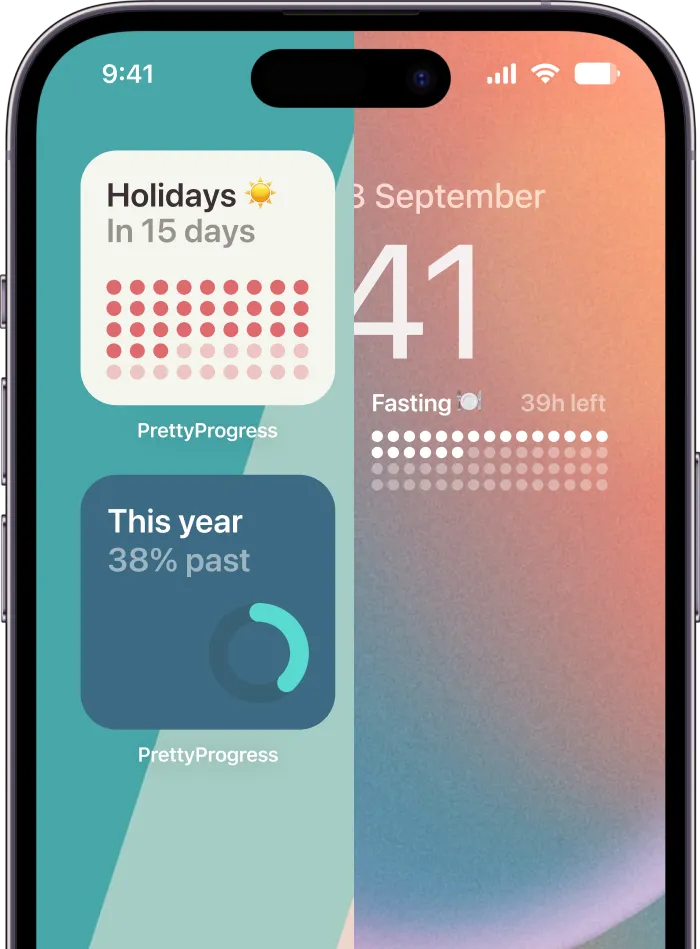
Pretty Progress is the right fit if your problem is not another empty task list, it is keeping a deadline, habit, fasting window, launch, or countdown visible throughout the day. It turns those dates into always-on widgets across iPhone, iPad, Apple Watch, Mac, and Android, which is useful in a category that still gives too much attention to lists. The app centers on progress bars and countdowns, so it suits people who track time remaining more naturally than they track tasks completed.
Setup is straightforward. Choose a start and end date, pick a theme, then place the widget on your Home Screen or Lock Screen. The built-in tools, including date calculator, business-days calculator, exact age, and intermittent-fasting timer, add value before you customize anything else.
Why it fits visual thinkers
This app works well for students, project leads, and anyone who wants a reminder without opening an app every time. The design is calm, and the lack of ads keeps it from feeling noisy or performative. If you want your phone to behave more like a quiet dashboard than a command center, Pretty Progress handles that job well.
Practical rule: use Pretty Progress for the one thing you keep checking in your head, like a launch date, exam window, or habit streak. If you open it constantly, it is probably doing the wrong job.
The app also gives you styling range without making setup complicated. That matters if you care about how the widget looks on your Home Screen, but you still want the information to stay readable at a glance.
Where it falls short
Pretty Progress is not built to manage a full to-do system. If your main problem is remembering what to do next, you’ll still need a task manager. It works best as a visibility layer, not as the place where you store every responsibility.
That trade-off is what makes it practical. On an iPhone, the most useful setup is often a small system, one app for tasks, one for calendar pressure, and one widget that keeps the most important countdown in front of you. Pretty Progress fits that role without getting in the way.
1. Pretty Progress
Pretty Progress is the easiest recommendation for anyone who doesn’t need another task inbox, they need a visual reminder that stays in front of them. It turns deadlines, habits, fasting windows, launches, and countdowns into always-on widgets across iPhone, iPad, Apple Watch, Mac, and Android, which is exactly why it stands out in a category that still over-focuses on lists. The app is built around progress bars and countdowns, so it works best for people who think in time remaining, not just tasks completed.
The setup is refreshingly direct. You pick a start and end date, choose a theme, then drop the widget onto your Home Screen or Lock Screen. The built-in tools, including date calculator, business-days calculator, exact age, and intermittent-fasting timer, make it useful before you’ve customized anything at all.
Why it fits visual thinkers
This is the app for students, project leads, and anyone who needs a daily reminder without opening an app. The design language is calm, and the lack of ads keeps it from feeling noisy or performative. If you like your phone to feel like a quiet dashboard instead of a command center, Pretty Progress is unusually good at that job.
Practical rule: use Pretty Progress for the one thing you keep checking mentally, like a launch date, exam window, or habit streak. If you open it constantly, it’s probably doing the wrong job.
The app also gives you styling range without making setup complicated. Curated themes like Swiss Style, Minimal, Aqua, Retro OS, and Grid give it personality, while deeper controls for colors, gradients, bar shape, layout, and icons let power users tune the widget to match the rest of the phone.
Where it falls short
Pretty Progress is not a replacement for Things, Todoist, or Notion. It’s a visibility tool, not a task system, and that’s its strength. If your real problem is remembering what to do next, you’ll still need a task manager.
The app’s free version is enough to get started, while the PRO upgrade gives you more styling controls and extra templates. Users consistently praise its polish and simplicity, and the developer’s support reputation is strong. If you want a glanceable system that lives in your ecosystem and keeps you motivated without clutter, this is the cleanest pick in the group. Pretty Progress
2. Things
Things is still one of the best choices for people who want a serious task manager without turning their iPhone into a project-management cockpit. It feels native to Apple because it behaves like Apple software should, fast, restrained, and hard to clutter. That matters if you’re the kind of person who wants structure but gets irritated by dashboards, team noise, or too many moving parts.
The app’s core workflow is simple to trust. You capture tasks quickly, sort them into Today, Upcoming, or Anytime, then refine with tags and checklists. On iPhone, that makes it ideal for personal planning, not group coordination.
Best for Apple-first personal workflows
Things is a strong fit for people who live in the Apple ecosystem and want their task app to disappear into the background. Widgets, Share Sheet support, Shortcuts, and Apple Watch integration all help it stay close to the places you already work. If your habit is to process tasks in short bursts between calls or classes, Things feels less like software and more like a well-designed note card system.
The downside is equally clear. It’s Apple-only, so there’s no Windows or web client, and that can be a dealbreaker for mixed-device households or teams with broader tool stacks. Collaboration is limited, too, so it’s not the right answer if you need shared task ownership or client visibility.
Use it when: your work is personal, your phone is the main capture device, and you care more about focus than features.
Things earns its reputation by reducing friction, not by adding shiny extras. If your current to-do app feels heavy, this is the cleanest reset you can make. Things
3. Todoist
Todoist is the most balanced pick for people who need speed, flexibility, and cross-platform coverage without building a complicated system from scratch. It’s especially useful on iPhone because Quick Add feels fast enough to catch thoughts before they vanish. That’s a real advantage when you’re on the move and don’t want to spend time figuring out where a task belongs.
Its strengths are in organization and automation. Labels, filters, sections, and priority levels make it easy to separate personal, school, and work tasks, while integrations and Shortcuts help it fit into a broader iPhone workflow. If you use more than one device, Todoist is usually easier to live with than Apple-only options because it moves cleanly across iOS, macOS, web, Windows, and Android.
Where Todoist makes sense
Todoist works best for users who want one system for both solo planning and light collaboration. Shared workspaces are straightforward, and the app handles recurring responsibilities better than many minimalist competitors. The mobile app is mature, so you’re not stuck waiting until you get back to a desktop.
The trade-off is cost. The more useful advanced features sit behind paid plans, and that can frustrate users who just want a strong everyday list manager. It’s also a little less elegant than Things if your priority is a calm visual experience.
- Choose Todoist if you want strong cross-device sync and a flexible list system.
- Choose something simpler if you only need a personal inbox and a short daily plan.
- Choose it for teams if you need basic coordination without moving to a full project suite.
Todoist remains one of the safest recommendations because it solves a broad set of problems well, even if it’s not the prettiest app in the category. Todoist
4. Notion
Notion is the right answer when your productivity problem is an organization problem. If tasks, notes, reference docs, meeting notes, and project trackers are scattered across different apps, Notion can centralize them into one workspace. That’s why it’s popular with creators, students, and small teams who want one place to build a system instead of juggling half a dozen tools.
The iPhone app gives you access to pages, databases, templates, and multiple views, so you can manage almost anything if you’re willing to design the structure yourself. Board views, tables, and timelines are especially useful when you’re tracking content calendars, coursework, or ongoing projects.
Best for builders and knowledge workers
Notion rewards people who like customization. You can create a very lightweight personal dashboard or a deep knowledge base with linked docs and database views. That flexibility is powerful, but it also means the app can feel like too much if all you need is a basic to-do list.
For iPhone use, the biggest limitation is that mobile performance and offline behavior can be less predictable than simpler apps, especially on large pages. That doesn’t make Notion bad, but it does mean you should avoid loading your phone with huge, complex workspaces if you expect fast, frictionless access.
If you want one app to hold your process, notes, and project context, Notion is hard to beat. If you want something that disappears into the background, it’s probably too much.
Notion is best treated as a system builder, not a simple task manager. Notion
5. Fantastical
Fantastical fits people whose day is organized around the calendar. If scheduling is the main bottleneck, it gives you one of the strongest calendar experiences on iPhone. Natural-language entry gets attention first, but the core value is how well it handles meetings, reminders, and the follow-through that keeps time-sensitive work from slipping.
It also brings tasks into the same space, which helps if you want your to-dos close to your schedule instead of split across separate apps. Widgets, Apple Watch support, and StandBy compatibility make it useful for people who keep their iPhone visible on a desk or nightstand, where quick checks matter more than opening a full app.
Best for schedule-heavy users
Fantastical works well when your work depends on seeing the shape of the day at a glance. That makes it a strong fit for consultants, managers, parents, and anyone moving between meetings and focused work blocks. Meeting link detection is a practical bonus because it cuts down on manual searching when a video call invite lands in your inbox.
The subscription model is the main trade-off. Light users may find Apple Calendar enough, especially if they do not need advanced scheduling logic or integrated task support. If you spend a lot of time planning around events and deadlines, Fantastical usually justifies the extra layer.
For reminder-heavy users, the stronger companion read is this internal guide to best reminder apps for iPhone, especially if you are deciding whether reminders should live inside your calendar or in a dedicated system.
Fantastical makes the most sense when your iPhone is the center of your time management, not just a place to store tasks. Fantastical
6. Structured
Structured is the app I’d hand to someone who says, “I need my day to feel visible.” It takes tasks and events, lays them out on a vertical timeline, and makes time blocking feel simple instead of intimidating. That’s a huge win for people who get overwhelmed by long lists, especially students and ADHD-prone planners who do better when the day has shape.
The app imports calendar data, supports reminders, and gives you Home Screen, Lock Screen, and Apple Watch access. On iPhone, that means your plan is always a glance away instead of buried in an app you forget to open.
Why time blocking works here
Structured succeeds because it stays focused. You aren’t asked to build a complex database or manage team layers. You just arrange the day, adjust the blocks, and move on.
Plain truth: if your schedule changes constantly, a visual planner is only useful when it stays fast to edit. Structured gets that part right better than most apps in this category.
The trade-off is that it’s not built for collaboration or long-term project management. More advanced features also sit behind Structured Pro, so it’s best for users who want a clean daily planner rather than a forever-free power tool.
If your biggest productivity win comes from seeing what happens next, this app makes that habit much easier to keep. Structured
7. TickTick
TickTick is for people who want one app to cover tasks, calendar awareness, focus sessions, and habit tracking. That breadth is exactly why it can become a daily driver on iPhone. You don’t need to jump between separate apps when you want to plan, focus, and repeat a routine.
The app includes natural-language date parsing, calendar views, a Pomodoro timer, and habit features like streaks and the Eisenhower Matrix. That makes it appealing to users who like structure but don’t want to assemble a system from several separate tools.
Best for all-in-one users
TickTick is strongest when you want breadth without immediately moving into a heavier workspace like Notion. It works well for solo users who like a little bit of everything, tasks, calendar, focus, and habit tracking, in one place. On iPhone, widgets, Apple Watch support, and Siri integration help it stay quick to access.
The downside is that breadth can feel busy. Some users love having everything together, others find the interface more crowded than necessary. Collaboration also isn’t as deep as in dedicated team tools, so it’s better for personal productivity than project coordination.
For people who want a middle ground between a pure to-do app and a full planner, TickTick is often the sweet spot. It’s not the simplest choice, but it’s one of the most complete. TickTick
8. Forest
Forest is the best pick if your real problem is phone distraction, not task capture. It uses a simple focus timer that grows a virtual tree during a work session, which sounds playful because it is, but that’s also the point. The app creates a small consequence for touching your phone when you should be working.
It’s especially useful alongside a separate task manager. Set the task elsewhere, start a focus session in Forest, and let the app handle the pressure to stay put. Apple Watch support and widgets make it easy to keep the focus timer close without opening more than necessary.
Best for study and sprint work
Forest works well for students, writers, and anyone who benefits from short, repeated work blocks. The optional app-blocking allow lists add structure on iOS, but the value is psychological. You’re more likely to finish a sprint when you’ve made the session visible and slightly game-like.
The limitation is obvious. Forest is not a task system, and it shouldn’t pretend to be one. It also depends on iOS capabilities for blocking, so it helps, but it’s not absolute.
For readers who want focus tools tuned to attention challenges, this internal guide to best apps for people with ADHD is a useful companion. Forest fits that workflow well because it lowers the barrier to starting.
Use Forest to protect work time, not to plan your life. Forest
9. Obsidian
Obsidian is for people who care about long-term thinking, private notes, and linked ideas. It’s a local-first Markdown system, which means your notes live in files you control instead of being locked into a closed workspace. For researchers, writers, and knowledge workers, that portability matters more than flashy design.
The graph view and backlinks are the features people talk about most, but the strength of Obsidian is how naturally it scales. You can start with simple notes and grow into a serious personal knowledge system without changing platforms. The plugin and theme ecosystem also gives it a lot of range on iPhone and desktop.
Best for note-heavy users
Obsidian is a strong fit if you treat notes as raw material. Capture an idea, link it to related notes, and build a web of reference over time. That approach is great for writing projects, research, and personal reference libraries.
The learning curve is real, though. New users often expect a traditional note app and get a much more open system instead. Collaboration also takes extra work, so it’s not the best choice for teams that need shared editing out of the box.
Obsidian is powerful when you want ownership and flexibility. It’s frustrating when you want instant simplicity.
If you’re willing to invest time in setup, it can become the deepest note system on this list. Obsidian
10. Microsoft To Do
Microsoft To Do is the best no-fuss option for people already living in Microsoft 365. It’s free, simple, and reliable, which is exactly what many users want from a task app on iPhone. The app keeps the interface clean, and that makes adoption easy for people who don’t want to spend a weekend configuring workflows.
The My Day view is the key feature because it gives you a daily planning space without overwhelming you with every task at once. Shared lists and task assignments also make it useful for home coordination, group errands, and light work collaboration.
Best for Microsoft users
If your calendar and email already live in Outlook or Exchange, Microsoft To Do usually feels like the path of least resistance. Sync is available across iPhone, macOS, Windows, Android, and web, so it works well for mixed-device environments. That broad compatibility is a big practical advantage when your workflow doesn’t stay inside Apple-only tools.
The trade-off is limited customization and fewer power-user features than Things or Todoist. That’s not necessarily a flaw, it’s a design choice. If you want a simple list app that won’t get in your way, this is one of the easiest to recommend.
Microsoft To Do is the app you choose when you want clear, modest task management without paying for complexity. Microsoft To Do
Top 10 iPhone Productivity Apps Comparison
| App | Core features & unique ✨ | UX / Quality ★ | Price / Value 💰 | Best for 👥 |
|---|---|---|---|---|
| Pretty Progress 🏆 | ✨ Always‑on countdown & progress widgets (iPhone, iPad, Watch, Mac, Android); rich themes, color/gradient/bar controls; built‑in date/fasting calculators | ★★★★★ Polished, minimalist, zero‑ad | 💰 Free; PRO upgrade for advanced styling | 👥 Visual trackers, habits, milestones |
| Things (Cultured Code) | ✨ Today/Upcoming views, tagging, checklists, deep Apple integrations | ★★★★★ Refined, low cognitive load | 💰 Paid (premium Apple app) | 👥 Apple users who want simple, elegant task planning |
| Todoist | ✨ Quick Add (natural language), filters, labels, broad integrations | ★★★★☆ Fast, powerful, cross‑platform | 💰 Freemium; Pro/Business subscriptions | 👥 Individuals & teams needing flexible to‑dos |
| Notion | ✨ Pages, databases, multiple views & templates; collaboration & docs | ★★★★☆ Highly customizable; can be heavyweight | 💰 Freemium; paid team tiers | 👥 Knowledge workers, teams, builders of custom systems |
| Fantastical (Flexibits) | ✨ Natural‑language scheduling, rich calendar views, meeting link detection | ★★★★☆ Top‑tier calendar UX (Apple ecosystem) | 💰 Subscription for full features | 👥 Calendar‑heavy users & Apple power users |
| Structured, Daily Planner | ✨ Drag‑and‑drop time blocking, visual timeline, widgets | ★★★★☆ Fast, approachable, ADHD‑friendly | 💰 Freemium; Pro subscription | 👥 Time blockers, routine builders |
| TickTick | ✨ Tasks + calendar, Pomodoro timer, habit tracker, Eisenhower support | ★★★★☆ Broad feature set (all‑in‑one) | 💰 Freemium; Premium subscription | 👥 Users wanting integrated task, focus & habit tools |
| Forest: Focus for Productivity | ✨ Gamified focus timer, tree growing, co‑plant sessions | ★★★☆☆ Simple, motivating for sprints | 💰 Paid / IAP; optional planting partnerships | 👥 Students & focus‑session users |
| Obsidian | ✨ Local markdown notes, graph/backlinks, extensive plugin ecosystem | ★★★★☆ Powerful PKM; steeper learning curve | 💰 Free core; paid sync/publish options | 👥 Privacy‑minded note takers & researchers |
| Microsoft To Do | ✨ My Day suggestions, shared lists, Outlook/365 integration | ★★★☆☆ Simple, reliable across platforms | 💰 Free with Microsoft account | 👥 Microsoft ecosystem users, household & work lists |
Build Your Ultimate Productivity System Today
The perfect productivity system isn’t about hoarding apps, it’s about matching the tool to the job. A visual thinker may do better with Pretty Progress or Structured, a calendar-heavy planner may prefer Fantastical, and a student trying to stay focused may get more from Forest plus a task manager than from one giant all-in-one app. That’s the pattern across the top productivity apps iphone users keep coming back to, each app wins by solving a specific problem cleanly.
The market also explains why the category looks this way. Productivity software generated $32.5 billion in revenue in 2024, up 17.3% from the year before, with office-suite apps contributing $19 billion and AI apps adding $4.5 billion (Business of Apps). The same source says AI apps had almost one billion users in 2025, and that the majority used ChatGPT. On iPhone, that scale shows up in the app-store rankings and in the way people now expect productivity tools to combine communication, planning, and AI support.
That doesn’t mean you need to install everything. Start with one app that fits your weakest point, then add a second only if the first one leaves a real gap. If you miss deadlines, choose a countdown or task tool. If you drown in details, choose a note system. If your day feels invisible, choose a visual planner or calendar-first app.
Keep the setup small enough that you’ll use it on your iPhone when life gets messy. Widgets help. Shortcuts help. But the biggest gain comes from choosing an app that matches how you already think, not how a productivity guru thinks you should work.
If you’re ready to make your iPhone feel calmer and more useful, start with one download tonight, put the widget on your Home Screen, and use it tomorrow morning before you touch anything else. That first week will tell you more than hours of comparing screenshots ever could.
A CTA for Pretty Progress.