
September 19, 2026
Sign Tracking vs Goal Tracking
Sign tracking vs goal tracking explained in plain English. Learn the difference, when each approach works, and how to set up widgets in Pretty Progress.
You sit down to work, open the app you always use, and start checking little signals that feel productive. Your streak is alive. Your timer is running. Your checklist has neat empty boxes. Two hours later, the task still hasn’t moved.
Or the opposite happens. You open a project with a giant progress bar that’s still embarrassingly low, notice the deadline is close, and feel your motivation drop on contact.
Those look like different problems, but they often come from the same choice. You’re deciding whether your planning system should pull your attention toward the cue that predicts progress or toward the outcome that proves progress. That’s the practical heart of sign tracking vs goal tracking.
This isn’t a personality verdict. It’s a setup decision. If you understand it, you can make your widgets, trackers, and reminders work with your attention instead of against it.
Table of Contents
- Why This Distinction Changes How You Plan
- What Sign Tracking and Goal Tracking Actually Mean
- Side by Side on the Criteria That Matter
- Why Most People Are Not Purely One or the Other
- Which Mode Fits Students Professionals Habit Builders and ADHD Users
- Setting Up Pretty Progress Widgets for Each Mode
- A Short Decision Rule and Common Questions
Why This Distinction Changes How You Plan
A student spends the afternoon refreshing a writing app, reorganizing notes, and protecting a study streak. It feels organized. It even feels disciplined. But the essay draft stays blank.
A project manager has the opposite problem. She opens a dashboard the night before a deadline, sees a lot of unfinished work represented by one harsh red bar, and avoids the project because the outcome looks too far away to fix.
Two failures with one root
In both cases, the person isn’t lazy. The planning surface is pulling attention in a certain direction.
The student is locked onto signals. The routine, the streak, the setup, the cue that says work is about to happen. The manager is locked onto outcomes. The final number, the delivery date, the visible shortfall.
Both approaches can help. Both can also backfire.
Practical rule: If your tracker creates motion but not completion, you may be over-weighting cues. If it creates pressure but not action, you may be over-weighting outcomes.
This is a design choice, not a diagnosis
The neuroscience behind sign tracking vs goal tracking comes from conditioning research in animals and gaze research in humans. In plain language, one mode leans toward the thing that signals reward, and the other leans toward the reward location or end result itself.
For daily planning, that matters less as a lab label and more as a widget-design choice.
You can build a home screen around:
- Cue-led tracking: streaks, check-ins, timers, recurring rituals, visual prompts
- Outcome-led tracking: progress bars, deadlines, milestone completion, shipped deliverables
People need both during a normal week. The useful question isn’t “Which one am I?” It’s “Which one should this task use?”
What Sign Tracking and Goal Tracking Actually Mean
In research, sign tracking means attention gets pulled toward the cue that predicts a reward. Goal tracking means attention gets pulled toward the place or outcome tied to the reward itself.
That sounds abstract until you bring it into ordinary work.
Sign tracking in everyday life
Sign tracking shows up when the trigger becomes the anchor for action. You notice the cue and move toward it.
That can look like:
- A fixed start ritual: opening your laptop at the same hour each day
- A visible streak: wanting to keep a reading or workout chain alive
- A checklist prompt: checking off a box because the box itself keeps the task alive
- A recurring timer: responding to the cue that says, “Start now”
If you’ve ever done better with a lock screen reminder than with a quarterly target, you’ve felt this mode.
Goal tracking in everyday life
Goal tracking points attention at the finished state. You care most about the result becoming real.
That can look like:
- A word-count target: finishing the draft, not just sitting down to write
- A deadline bar: seeing how far a project has moved from start to finish
- A milestone list: submitting the report, shipping the feature, passing the exam
- A final metric: the number that tells you whether the effort landed
A lot of classic goal-setting advice fits here. If you want a clean refresher on building specific outcomes, these revision notes on SMART goals are useful because they force vague intentions into observable targets.
The research version, translated into plain English
Researchers don’t treat this difference as a vague vibe. In the sign-tracking and goal-tracking literature, behavior is often measured with numerical indices. One common animal measure is a PCA index ranging from -1.0 to +1.0, where more positive values indicate stronger sign tracking and more negative values indicate stronger goal tracking, and parallel human work uses a gaze index based on attention to the cue versus the reward location during the cue period (overview of the measurement approach).
That matters because it reminds us this isn’t motivational fluff. It’s an attempt to measure where attention goes.
If you want a broader visual framing for turning goals into something glanceable, this guide to visual goals is a helpful companion.
The useful translation is simple. Sign tracking asks, “What cue gets me moving?” Goal tracking asks, “What result tells me this mattered?”
Side by Side on the Criteria That Matter
Not everyone needs a theory debate. They need to know which mode will make a widget feel usable on a Tuesday afternoon.
Sign Tracking vs Goal Tracking Across Five Criteria
| Criterion | Sign Tracking | Goal Tracking |
|---|---|---|
| Attention focus | Pulls attention toward the cue, prompt, ritual, or signal that predicts progress | Pulls attention toward the end state, deadline, or finished output |
| Motivation source | Momentum, routine, and the satisfaction of starting | Completion, payoff, and the satisfaction of closing the loop |
| Adaptability to changing conditions | Can be sticky when the cue keeps firing even if the target should change | Better when the outcome changes and you need to update behavior around the new result |
| Strength of evidence base | Strong as a measurable behavioral phenotype in conditioning and attention research | Strong in applied goal-setting and progress-monitoring work tied to attainment |
| Behavior-change fit | Good for consistency, initiation, and low-friction starts | Good for finish lines, accountability, and measurable completion |
What the evidence suggests for everyday use
One of the most practical findings for this comparison is about adaptability. In outcome-devaluation work, sign-tracking stayed resistant to reward devaluation, while goal-tracking decreased when reward value changed, which suggests goal-tracking is more outcome-sensitive when conditions shift (Frontiers overview).
That maps surprisingly well to planning. If the target changes often, outcome-focused tracking usually adjusts better. If the challenge is getting yourself to start at all, cue-focused tracking often has the edge.
The strongest practical takeaway for widget design
The biggest applied evidence base here comes from progress monitoring. A major meta-analysis in American Psychologist synthesized 138 studies with 19,951 participants and found that interventions designed to increase progress monitoring raised monitoring frequency by a very large margin (d+ = 1.98, 95% CI [1.71, 2.24]) and also improved goal attainment (d+ = 0.40, 95% CI [0.32, 0.48]). The review also found stronger effects when progress was made public and physically recorded (meta-analysis summary).
For planning tools, that means visible tracking isn’t just decorative. It changes behavior.
If you’re comparing planning interfaces and want to see how different layouts support different working styles, it helps to review lesson planning apps because the contrasts in visual structure are easy to spot even outside teaching.
Use this table as a buying guide for your tracking style, not as a label for your identity.
Why Most People Are Not Purely One or the Other
A lot of content treats sign tracking vs goal tracking like a quiz result. You’re this kind of person. Your coworker is that kind. The research picture is messier.

The spectrum is the point
The PCA approach was built as a continuous measure, not just a pair of personality boxes. That alone should make you cautious about rigid self-labels.
Human work has pushed that caution further. A proof-of-concept study found a third group of intermediate responders, with latent profile analysis identifying 36 intermediate responders, 10 sign-trackers, and 4 goal-trackers. The same line of research also notes that classification reliability is still a live issue, including later work focused on test-retest questions around the gaze index (human classification findings).
Why your mode changes by context
Context doesn’t lock you into one stable type every day. It pushes you around.
You may lean cue-first when:
- The task is new: novelty makes prompts more powerful
- The work is boring: a small ritual gets you over the start line
- Your energy is low: signals beat abstract ambition
You may lean outcome-first when:
- The stakes are clear: a deadline sharpens selection
- The project is long: milestones matter more than mood
- The target can change: you need to update effort based on results
Don’t ask, “Am I a sign-tracker or a goal-tracker?” Ask, “Where does my attention need help right now?”
That question leads to better setups than any personality label will.
Which Mode Fits Students Professionals Habit Builders and ADHD Users
Different people usually need different default settings. The key word is default. Not destiny.
Recommended Tracking Mode by Persona
| Persona | Primary Mode | Why It Fits | Watch Out For |
|---|---|---|---|
| Student | Hybrid, sign first then goal | Cues help with starting, outcomes help with exam dates and submissions | Too many streaks can replace actual assignment progress |
| Professional | Goal tracking | Long projects often require delayed reward and milestone clarity | A harsh progress bar can create avoidance if the project feels too big |
| Habit builder | Sign tracking | Repetition grows better from visible prompts and low-friction check-ins | You can protect the ritual without improving the outcome |
| ADHD user | Sign-heavy hybrid | Salient cues, quick feedback, and visible momentum help sustain engagement | Too much visual noise can become distraction instead of support |
Students and professionals
Students often need a two-part system. Use cues to start, then switch quickly to an outcome anchor. For example, a study timer or streak gets the session going, but the session still needs a visible endpoint such as pages reviewed, problems completed, or a submission date.
Professionals usually benefit from stronger goal tracking, especially for work that spans weeks or months. If your job involves deliverables, dependencies, and shifting priorities, outcome visibility keeps the project honest.
Habit builders and ADHD users
Habit builders often do best by ignoring the grand result at first. The early win is repetition. Did you show up? Did you do the tiny version? Cue-led design helps more than a distant transformation metric.
For ADHD users, sign-heavy setups are often more practical because they reduce the energy needed to re-enter the task. Short loops, visual prompts, and frequent check-ins can hold attention better than one abstract finish line. If that’s your world, this guide to a habit tracker for ADHD is worth reading because it focuses on friction, visibility, and re-entry.
A simple way to choose
If a person mainly struggles with starting, lean sign-heavy. If they mainly struggle with finishing, lean goal-heavy. If they struggle with both, split the system in two.
That’s why hybrid setups work so often.
Setting Up Pretty Progress Widgets for Each Mode
Once you see the difference, the setup gets easier. You’re not decorating a screen. You’re choosing what your screen should pull you toward.
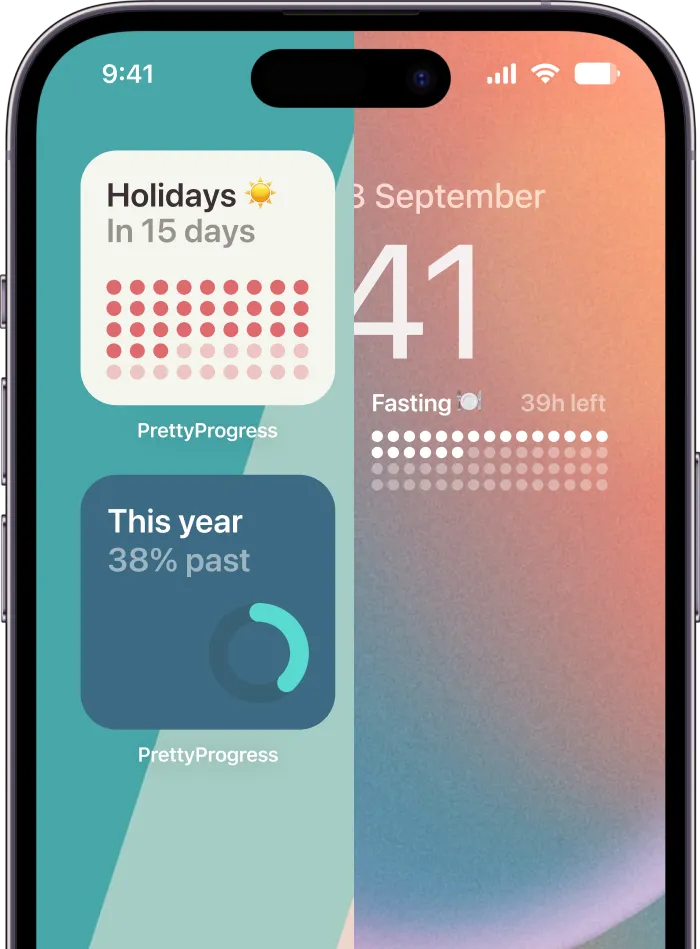
A tool like Pretty Progress can handle both modes because it supports countdowns and progress-bar widgets with custom themes, dates, and layouts. The trick is setting it up to match the job.
A sign-tracking setup
Use this when initiation is the bottleneck. The widget should act like a prompt, not a verdict.

Try a setup like this:
- Widget type: daily reset habit or short countdown
- Example name: 7-Day Reading Streak
- Start and end: start today, end in 7 days
- Style: ring or compact card
- Theme: lighter palette or bright accent so the cue stands out
- Placement: lock screen or first home screen page
This works because the widget keeps asking one question. Did you show up today?
A goal-tracking setup
Use this when completion, pacing, and milestone awareness matter more than daily ritual.
Try a setup like this:
- Widget type: multi-week progress bar
- Example name: 12-Week Thesis Draft
- Start and end: fixed project window across the full draft period
- Style: bar with visible movement across the full range
- Theme: deeper tones, cleaner contrast, less playful visual noise
- Milestones: add labels for 25 percent, 50 percent, and 75 percent if your workflow allows it
This setup works because the bar reflects whether the project is converging on done, not whether you merely touched it.
A hybrid setup that avoids both traps
Many people need one cue widget and one outcome widget, each doing a different job.
For example:
- Top widget: short daily check-in for starting
- Second widget: long-range project bar for completion
- Rule: never let the cue widget count as success unless the outcome widget moved too
If you want one more practical example of keeping a visual countdown in view all day, this guide to a home screen timer gives a useful template.
A good widget doesn’t just look motivating. It points your attention at the thing you most often neglect.
A Short Decision Rule and Common Questions
You don’t need to overthink every new tracker. Use a short rule.

Five-line decision rule
- If progress is invisible, add a cue.
- If starting is hard, use sign-heavy tracking.
- If finishing is hard, use goal-heavy tracking.
- If the target changes often, favor outcome visibility.
- If motivation collapses under pressure, pair one cue widget with one outcome widget.
Common questions
Where do intermediate responders fit?
They’re probably closer to normal than the extremes. People shift across tasks and situations, so build for the task in front of you.
Does sign tracking matter outside the lab?
It may. A 2025 study linked sign- versus goal-tracking patterns with greater adiposity and a more severe adiposity phenotype, which suggests cue attraction can matter in real-world health contexts (health relevance discussion).
How can I test my own bias in under a week?
Run two parallel trackers on one project. Use a cue-led widget for a few days, then an outcome-led one. Notice which version gets you to start and which one gets you to finish.
What if the mode stops working?
Switch the lever. If your streak is alive but the work is stale, move toward outcome tracking. If the progress bar is honest but demoralizing, add a cue that lowers the cost of starting.
Pretty Progress lets you build both kinds of visual tracker, from quick cue-led countdowns to longer progress bars that keep the finish line in view. If this article helped you spot the difference between starting support and completion support, visit Pretty Progress and try building one widget for each mode on your home or lock screen.