
July 16, 2026
Quit Smoking Timeline: What Happens When You Stop?
Explore the complete quit smoking timeline, from the first 20 minutes to 15 years of recovery. Learn about withdrawal, coping tips, and how to stay motivated.
You might be reading this with a cigarette pack nearby, or with your last cigarette already smoked and a strange mix of relief, doubt, and nerves settling in. That moment is more common than people admit. You want out, but you also want to know what happens next.
The good news is that quitting doesn’t begin with loss. It begins with repair. Your body starts responding almost right away, and the quit smoking timeline gives you a way to see that change as a chain of wins instead of one long test of willpower.
A lot of people think quitting is one giant leap. It usually feels more like a series of small shifts. One hour, one craving, one better breath, one smoke-free morning. If you’ve ever looked into the stages of addiction recovery, you’ve seen that change tends to happen in steps, not all at once. Quitting smoking works the same way. Your body has a timeline, and your habits have one too.
Table of Contents
- Your Journey to a Smoke-Free Life Begins Now
- The First 72 Hours Your Body Begins to Heal
- From One Week to Nine Months The Path to Recovery
- Managing Withdrawal and The Psychological Timeline
- Long-Term Health Gains After You Quit Smoking
- Visualize Your Progress with Pretty Progress
- Frequently Asked Questions About Quitting
Your Journey to a Smoke-Free Life Begins Now
A common quitting story starts unremarkably. Someone finishes a cigarette outside before work and thinks, “I’m tired of planning my day around this.” Not dramatic. Just clear. That kind of moment matters because it turns quitting from a vague wish into a real decision.
The quit smoking timeline helps because it gives that decision shape. Instead of wondering whether anything good is happening, you can look for specific signs that your body is doing exactly what it’s supposed to do. Lower stress on your heart. Better oxygen flow. Easier breathing. Stronger lungs over time.
That matters on hard days. If you wake up feeling restless or irritated, it’s easy to assume something is wrong. Often, the opposite is true. Your body is adjusting, clearing smoke-related chemicals, and switching back to healthier patterns.
You are not “just resisting cigarettes.” You are moving through a recovery process with visible milestones.
It also helps to separate two tracks that happen at the same time:
- Body repair: Your heart, blood, lungs, and nerve endings start changing soon after you stop.
- Habit repair: Your routines around coffee, stress, driving, or breaks take longer to untangle.
- Identity repair: You begin to see yourself as someone who doesn’t need smoking to get through the day.
People often get discouraged because these tracks don’t move at the same speed. That’s normal. The body can improve quickly, while old routines may still tug at you. Keeping both in view makes quitting feel less confusing and more manageable.
The First 72 Hours Your Body Begins to Heal
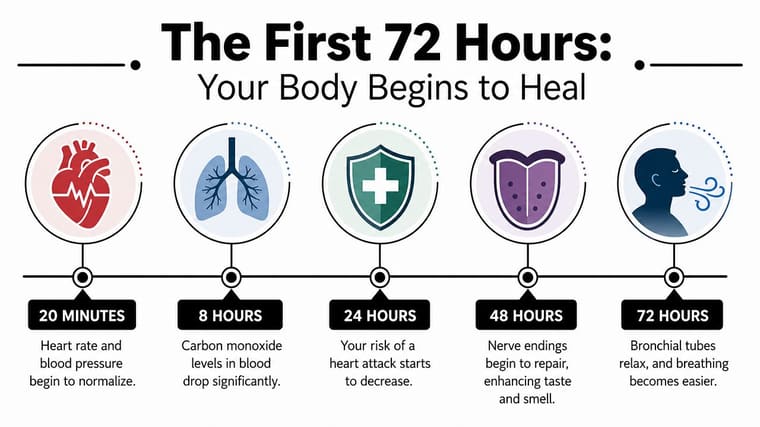
A few hours after your last cigarette, repair is already underway. You may not feel dramatic relief yet, but your body has started reclaiming normal function in ways that are real, measurable, and worth noticing.
The early quit smoking timeline helps to view these changes like a progress bar instead of a test of willpower. Your heart is getting a break. Your blood is carrying oxygen more effectively. Your airways are beginning to loosen. If you use a tracker like Pretty Progress, these first milestones can become visible proof that something good is happening, even on a day that feels messy.
Here is the short version of what the first 72 hours often look like:
| Time after your last cigarette | What your body is doing |
|---|---|
| 20 minutes | Heart rate and blood pressure begin moving toward normal |
| 12 hours | Carbon monoxide drops, so oxygen can do its job better |
| 48 hours | Nerve endings begin repairing, which can improve taste and smell |
| 3 days | Bronchial tubes relax, and breathing may feel easier |
Your body works a lot like a house with the windows finally opened after smoke has built up inside. The air does not turn fresh all at once. It clears in stages. First the pressure changes. Then the stale air leaves. Then you start noticing details you could not detect before.
That is why many people notice small wins before they feel broadly “better.” Coffee may smell stronger. Food may taste more distinct. A walk may feel a little less tight in the chest. These are not random changes. They are signs that your system is readjusting.
If you like seeing recovery in phases, this overview of a realistic detox recovery timeline can help frame why the body often improves step by step rather than in a straight line.
Why days two and three can feel intense
This part confuses people. You can be healing and uncomfortable at the same time.
Nicotine levels are dropping. Your brain is adapting to that change. Old cue patterns around coffee, driving, meals, and stress are still firing. So while your heart and lungs are getting a win, your nervous system may be asking for the routine it expects.
You might notice:
- Stronger cravings at the times you used to smoke
- Irritability or restlessness as your brain adjusts
- Sharper taste and smell as sensory function starts to recover
- Coughing or throat sensations as the airways begin readjusting
None of that means quitting is going badly. It usually means your body is doing exactly what early recovery requires.
A helpful way to track this is to record both sides of the experience. In Pretty Progress, for example, you could mark “12 hours smoke-free” as a body win, then note “craving after lunch” as a habit cue to work on. That turns a blurry day into useful information. You are not guessing whether progress counts. You can see it.
Keep the first 72 hours simple. Drink water. Rest when you can. Change small routines that are tightly linked to smoking, such as where you stand during breaks or what you do right after meals. When a craving hits, interrupt the pattern quickly. Walk to another room, brush your teeth, hold a cold drink, or step outside without a cigarette.
Small actions help because cravings are often attached to moments, not just nicotine itself.
These first three days are full of quiet victories. Even if your mood is uneven, your body is already putting distance between you and smoking.
From One Week to Nine Months The Path to Recovery
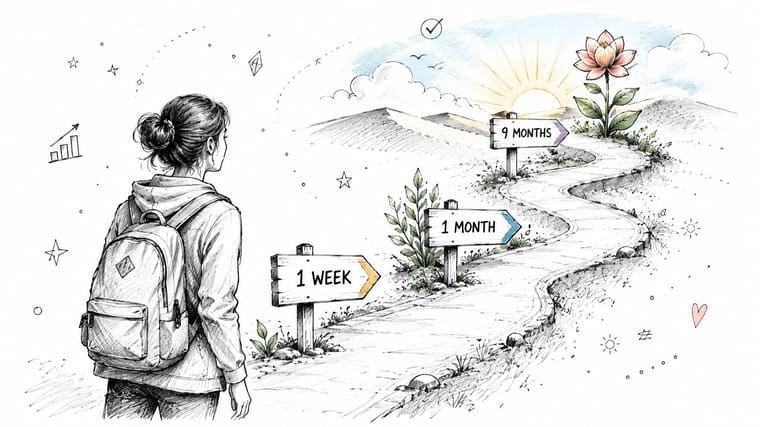
A week into quitting can feel surprisingly ordinary. You might realize you climbed the stairs without pausing, or that your morning feels a little less heavy. Those quiet changes matter because they show your body is shifting from emergency response into rebuilding.
By this point, as noted earlier, carbon monoxide has dropped back to a normal level. That gives your blood a cleaner job to do. Oxygen can move where it needs to go more efficiently, a bit like opening lanes on a crowded highway so traffic starts flowing again.
Your body keeps repairing the airways
The next stage is less flashy, but it is full of gains. Inside the lungs, tiny hair-like structures called cilia start recovering. Their job is to sweep mucus, particles, and germs out of the airways. Smoking slows and damages that cleanup crew. After quitting, the crew gradually gets back to work.
According to Pelago Health’s quit smoking timeline, lung function improves between 3–9 months after quitting. As cilia recover and irritation in the airways settles down, many people notice less coughing, less congestion, and fewer respiratory flare-ups.
That repair often shows up in everyday life before it shows up in a medical chart:
- Walking may feel easier. Daily tasks can require less effort.
- Mornings may feel clearer. Less mucus can mean less coughing and throat clearing.
- Exercise may feel more doable. Your body is getting better at using oxygen.
- Cold season may feel different. Healthier airways can clear irritants more effectively.
For readers who like broader behavior-change models, these Maverick Treatment recovery insights are useful because they describe recovery as a process that strengthens with time and repetition.
The middle months build staying power
Around the three-month mark, many former smokers notice that being smoke-free is starting to feel more like their normal life and less like a daily interruption. That matters. Repetition teaches the brain a new script.
A practical way to understand this phase is to treat it like visible progress, not just absence. Each smoke-free week gives your lungs more time to heal, your circulation more time to improve, and your routines more time to detach from cigarettes. If motivation tends to rise when progress is concrete, this guide to the ADHD reward system and visual progress tracking helps explain why small, visible milestones can keep effort going.
Pretty Progress fits well here because this stretch can otherwise feel hard to measure. The first few days are intense, but weeks two through twelve often improve subtly. Logging milestones such as one week, one month, three months, and six months turns invisible healing into something you can see. Instead of asking, “Why am I still thinking about smoking sometimes?” you can also ask, “What has improved since last month?” That second question usually reveals real gains.
A simple tracking approach works well:
- Mark body wins. Note easier breathing, fewer coughing spells, or better stamina.
- Track routine shifts. Record situations that feel easier now than they did in week one.
- Celebrate medium milestones. One month and three months deserve attention because they reflect repeated repair.
- Leave room for uneven days. One hard afternoon does not erase months of healing.
From one week to nine months, the pattern is steady improvement. Your body is clearing, repairing, and practicing a healthier normal, one measurable win at a time.
Managing Withdrawal and The Psychological Timeline
Many people prepare for nicotine withdrawal but get blindsided by something else. Weeks later, they pass the place where they used to smoke, have an argument, or sit with a drink, and the urge returns fast. That doesn’t mean they’re back at the beginning. It means the psychological side follows its own timeline.
According to Ikon Recovery’s nicotine withdrawal timeline, physical withdrawal symptoms typically ease within 2–4 weeks, but cue-induced cravings can persist for nearly a year. That longer “relapse timeline” is one of the most important parts of quitting to understand.
Physical withdrawal versus cue based cravings
Physical withdrawal is about your body reacting to the absence of nicotine. Cue-based cravings are different. They’re learned links between smoking and specific situations.
A simple comparison helps:
| Type of challenge | What sets it off | How it often feels |
|---|---|---|
| Physical withdrawal | Nicotine leaving the body | Restlessness, irritability, tension, discomfort |
| Cue-based craving | Stress, coffee, alcohol, driving, certain people or places | A sudden urge that feels tied to a moment or ritual |
This second category is why someone can feel mostly fine for days, then suddenly want a cigarette during a familiar routine. The brain remembers patterns. It doesn’t care that your body has already done a lot of repair.
If you’ve noticed that reward-seeking tends to intensify around habits and stimulation, this piece on the ADHD reward system can help explain why repetitive cues can feel so sticky.
How to respond when a trigger hits
The best response is specific. “I’ll just be strong” usually isn’t enough because cravings are often automatic and fast.
Try a plan like this:
- Name the trigger: Say what just happened. “This is my after-dinner craving.”
- Change the setting: Stand up, go outside, brush your teeth, or get water.
- Delay the urge: Tell yourself you’ll reassess after a short pause.
- Keep your hands busy: Hold a pen, peel fruit, fold laundry, use a straw, or make tea.
- Break the old chain: If smoking went with coffee, change the cup, seat, or time.
A craving is not an instruction. It is a signal passing through.
It also helps to stop treating every craving like a crisis. Some are loud. Some are strange and fleeting. Many lose force when you stop arguing with them and start outlasting them.
One more thing confuses people. They think, “If I still get cravings, quitting must not be working.” That’s backward. The presence of a trigger doesn’t erase the progress you’ve made. It shows which associations still need more repetition without smoking.
Long-Term Health Gains After You Quit Smoking
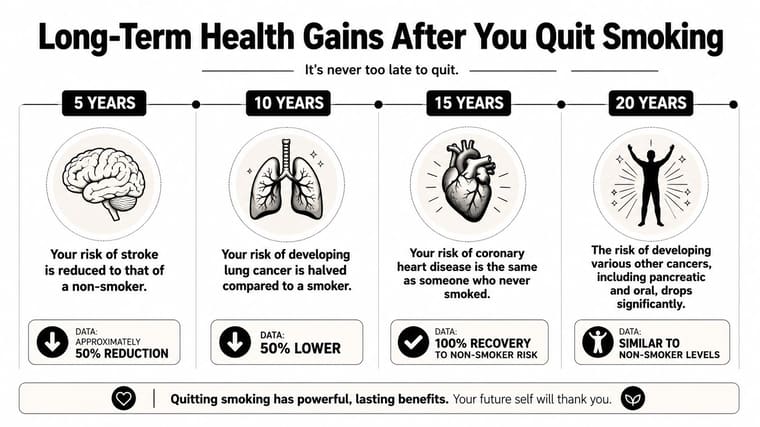
A few months from now, you might look back and realize something important. Quitting did not just help you get through cravings or breathe a little easier. It started changing your long-term health trajectory, one milestone at a time.
That is why the quit smoking timeline matters so much. Your body is not standing still after the early recovery phase. It keeps repairing, recalibrating, and lowering risk in ways that continue for years.
As noted earlier, by 1 year after quitting, heart disease risk drops sharply compared with continuing to smoke. At 5 years, stroke risk can fall to the level of a non-smoker, and the risk of cancers of the mouth, throat, and voice box is cut in half. By 10 years, lung cancer risk is cut by 50%, and by 15 years, heart attack risk matches that of someone who never smoked.
Your future health improves in layers
These changes help to picture quitting as a series of wins instead of one distant goal. The body works like a house being repaired room by room. First the air clears. Then the wiring gets safer. Then the structure itself becomes stronger.
Here is the long-term pattern:
- At 1 year: Your cardiovascular system is already under less strain.
- At 5 years: Major blood vessel risks continue to fall.
- At 10 years: Lung cancer risk is far lower than it was if smoking had continued.
- At 15 years: Heart attack risk reaches the level of someone who never smoked.
Each milestone gives you something real to mark.
That matters psychologically too. Quitting can feel abstract if the reward seems far away, but a visible timeline turns future health into progress you can track. Instead of telling yourself, “I’m giving something up,” you can say, “My body has reached another repair checkpoint.”
Quitting helps at every age
One point often surprises people. There is no age at which quitting stops helping.
The source cited earlier also notes that quitting can add years to life compared with continuing to smoke, including for people who stop later in adulthood. Earlier quitting usually leads to bigger gains, but later quitting still improves the outlook. That is a hopeful message, especially for anyone who feels they waited too long.
If you want a practical way to connect today’s choice with your future years, this life expectancy calculator for healthy habit changes can make the payoff feel more concrete.
The bigger idea is simple. Your body responds to better conditions for as long as you provide them. Every smoke-free month is not just time passed. It is progress gained.
Visualize Your Progress with Pretty Progress
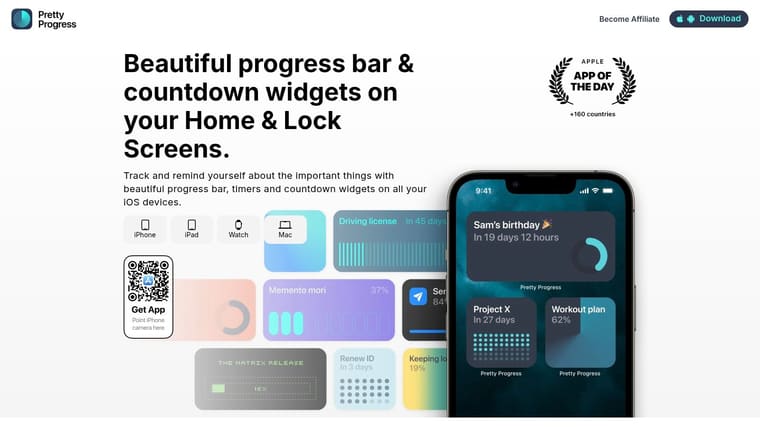
Knowing the timeline is helpful. Seeing your place on it every day is often better. Quitting tends to go more smoothly when the process feels visible, because visible progress gives your brain something concrete to hold onto.
Why a planned quit date helps
A lot of people wait to “feel fully ready.” That can keep the quit attempt floating in the future. Recent clinical data reported in this PMC article on quit date timing shows that setting a specific, calendar-based quit date is a stronger predictor of sustained abstinence at 6 and 12 months than traditional readiness-to-quit metrics.
That finding matters because a date turns intention into structure. Instead of vaguely hoping to quit soon, you create a visible starting line.
A planned quit date can help you:
- Prepare your environment: Remove cigarettes, lighters, and routine cues.
- Warn your routines: If mornings are hard, redesign that slot before quit day.
- Recruit support: Tell one or two people what day matters.
- Create a countdown: Anticipation can strengthen commitment when it’s specific.
How to turn milestones into visible progress
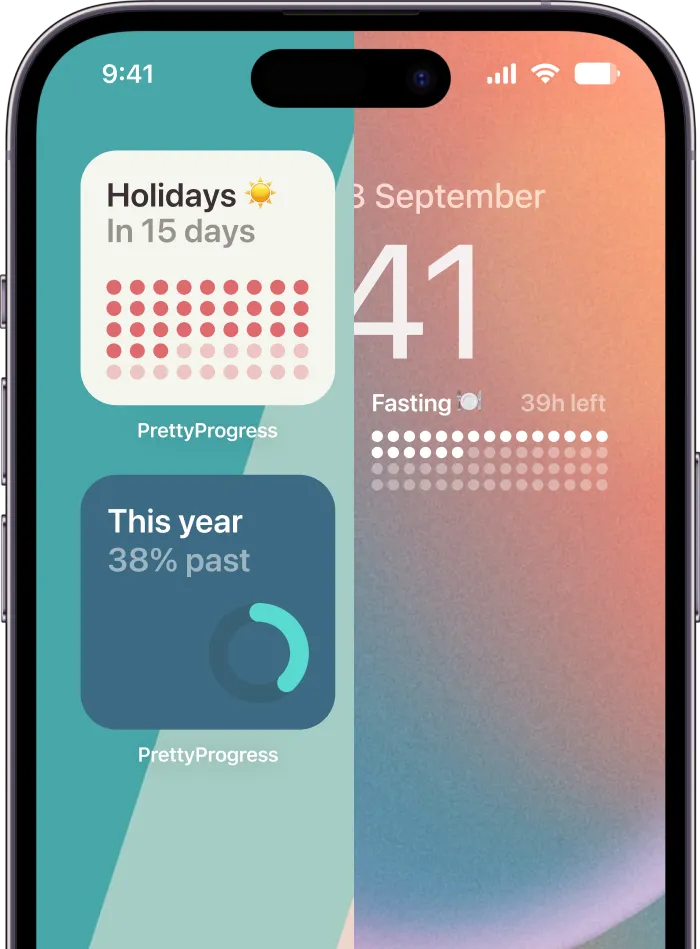
At this point, progress tracking becomes practical. Pretty Progress is built for countdowns, count-ups, widgets, and visual milestones, which makes it a natural fit for a quitting journey. You can explore more ideas in this guide to a goal progress tracker app.
A simple setup could look like this:
- Start with a countdown to quit day. Put the date on your Home Screen so it stays real.
- Flip to a count-up once you quit. Track smoke-free time in minutes, hours, days, and weeks.
- Create milestone bars. Examples include “72 Hours,” “1 Week,” “3 Months,” and “1 Year.”
- Use labels that feel rewarding. “Better breathing,” “First big turning point,” or “Heart recovery year.”
- Keep it glanceable. A widget works best when you can understand it in a second.
The deeper reason this helps is simple. Smoking used to give frequent signals. A break. A ritual. A small reward. Visual tracking replaces that with healthier signals. Instead of seeing what you’re missing, you see what you’re building.
Frequently Asked Questions About Quitting
A common question near the end of a quit plan is, “What if real life gets messy?” That question makes sense. Quitting is a biological reset and a behavior change happening at the same time, so a few bumps do not mean the process is broken. They usually mean you found a spot that needs a better plan.
What if I slip and smoke one cigarette
One cigarette is a data point, not the end of your quit.
Your body does not forget the smoke-free hours you already built. Heart rate, oxygen levels, circulation, and lung recovery do not vanish because of one moment. The useful response is simple: stop the slip from becoming a return to the old routine.
Ask three short questions while the moment is still fresh. What was happening just before it. Who were you with. What feeling were you trying to change. Stress, alcohol, social cues, boredom, and autopilot are common patterns. Once you spot the pattern, you can replace it with something more specific next time, like a five-minute walk, gum, texting a support person, or leaving the situation earlier.
Pretty Progress can help here in a practical way. Keep your count-up running if the slip was brief and your plan is continuing, or restart with a clear note about what triggered it. Either way, you turn a vague setback into something visible and useful.
Does nicotine replacement change the timeline
It can change how withdrawal feels, but it does not erase the health gains of stopping cigarettes.
That difference matters. Cigarette smoke exposes the body to far more than nicotine. When you stop smoking, your lungs, blood vessels, and heart are no longer dealing with that constant stream of toxic chemicals. Nicotine replacement may soften cravings while your routines change, which can make the early phase easier to handle.
The timeline may feel less intense for some people, but the recovery process is still moving in the right direction. If you want to use nicotine replacement, a clinician or pharmacist can help you choose a method and dose that fit your smoking pattern.
How can I avoid replacing smoking with constant snacking
Start by separating hunger from habit.
Many urges after quitting are really requests for a pause, a hand-to-mouth motion, or a familiar reward. The brain used smoking as a quick punctuation mark in the day. Food can slide into that space if nothing else is ready to take its place.
A little structure helps:
- Eat regular meals. Skipping meals can make cravings feel louder than they are.
- Keep simple substitutes nearby. Water, tea, gum, mints, cut fruit, and crunchy vegetables work well because they answer different kinds of urges.
- Add short movement breaks. A brief walk after meals or during a craving can reset your body faster than sitting with the urge.
- Use your hands on purpose. Hold a straw, pen, or water bottle during high-risk moments if the missing ritual is physical, not nutritional.
- Track the win you want. In Pretty Progress, a milestone like “3 days without a smoke break after lunch” can be more motivating than focusing on what not to eat.
That last point matters because visible progress changes the story. You are not just resisting cigarettes. You are building a new pattern your brain can recognize and repeat.
If your quit feels uneven, it can still be a strong quit. Recovery rarely looks perfectly straight when viewed up close. Over time, the trend that matters is fewer cigarettes, more awareness, and more smoke-free time collected day by day.
If you want a clearer, more motivating way to stay on track, Pretty Progress can turn your quit date and smoke-free milestones into visible countdowns, count-ups, and Home Screen widgets. That makes the quit smoking timeline easier to see, easier to stick with, and far more satisfying to celebrate day by day.