
July 21, 2026
How to Build Accountability: A Practical Framework
Learn how to build accountability with a step-by-step framework. Define goals, track progress with visual tools, handle setbacks, and succeed.
You can have a clear goal and still miss it for weeks. The task looked simple on Monday, then messages piled up, the deadline drifted, and by Friday you were telling yourself you’d start again next week. That pattern usually isn’t a character flaw, it’s a system problem.
How to build accountability starts with that honest reset. The goal isn’t to pressure yourself harder, it’s to make follow-through easier to see, easier to measure, and harder to ignore. When accountability is built well, people and teams don’t need constant nudges, because the work itself keeps pointing them back to what matters.
Table of Contents
- Beyond Willpower The Real Anatomy of Accountability
- Define Your Destination and Set Goals Worth Pursuing
- Design Your System A Framework for Tracking Progress
- Use Your Environment for Social and Tech Support
- Navigate Setbacks and Rebuild When You Stumble
- Customize Your Approach for Your Brain and Your Life
Beyond Willpower The Real Anatomy of Accountability
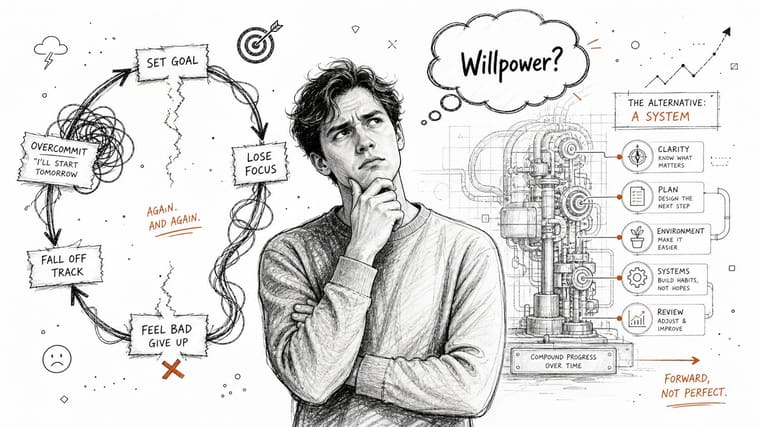
The most frustrating accountability failure is usually very ordinary. You make a promise, feel motivated for a few days, then reality gets busy and the promise loses momentum. That’s when people start blaming discipline, but discipline alone doesn’t hold up against vague goals, invisible progress, and no review cadence.
Accountability is a structure, not a personality trait. If the structure is weak, even a motivated person slips. If the structure is strong, ordinary effort becomes more reliable because the next action is obvious and the cost of drift is easier to spot.
Gallup’s workplace research shows why this matters beyond motivation talk. Organizations with high levels of workplace accountability see a 21% increase in profitability and a 17% increase in productivity compared with low-accountability organizations, based on analysis of more than 10,000 business units. In practice, that means accountability changes outcomes because leaders clarify expectations, match people to strengths, and create feedback loops that keep issues from hiding for weeks. Read more in Gallup’s analysis of accountability in the workplace.
What usually breaks first
The first break is often ambiguity. People think they know what “done” means, then discover that the finish line was never specific enough to guide action. The second break is silence, because no one checks in until the problem is already expensive.
Practical rule: If a goal can’t survive a busy week, it isn’t accountable enough yet.
That’s why this topic belongs in productivity, leadership, and personal development at the same time. A student, a manager, and a solo creator all fail in the same ways when the system is vague. The fix is not more self-criticism, it’s better design.
Define Your Destination and Set Goals Worth Pursuing
A goal that doesn’t connect to a real value becomes easy to postpone. You can still write it down, track it, and talk about it, but the effort won’t feel anchored when other demands show up. That’s why the strongest goals are not just measurable, they’re meaningful.
Start by asking what this goal changes in your life. A student finishing a thesis may care about closure, credibility, or grad-school options. A product lead may care about shipping a launch that protects the team’s reputation. Someone working on health may care less about a number on a scale and more about energy, confidence, or being available for family.
To build a solid accountability system, use SMART goals with real numbers and dates linked to tracked metrics. That part matters because accountability needs a target that can be reviewed, not just a wish that feels good on paper. A precise goal gives your future self fewer chances to negotiate the meaning.
Connect the target to purpose
The fastest way to lose momentum is to choose a goal you admire but don’t want. The safer move is to translate the ambition into a smaller promise that has emotional weight. If the value is stability, the goal should sound like stability. If the value is progress, the goal should sound like progress.
For example, a thesis goal might become, “Finish the literature review draft by Friday and send it to my supervisor.” A launch goal might become, “Confirm final copy, assign owners, and post the launch checklist in the team channel.” A health goal might become, “Walk after lunch on weekdays and log it before dinner.” Each version is clear, short, and reviewable.
Choose goals that can be understood in one sentence, and then make the next action even smaller.
For a deeper breakdown of practical goal design, the guide on goal-setting best practices is useful as a companion read. In sport settings, the same principle shows up in strategies for sports mental health, where performance usually improves when people understand both the target and the pressure around it.
Split the goal into milestones
Big goals need intermediate wins or they become abstract. Break the destination into checkpoints that tell you whether you’re still on course. Then define the next physical action, not just the next intention.
A strong goal stack looks like this:
- Outcome: The final result you want.
- Milestone: A meaningful midpoint that proves the work is moving.
- Next action: The smallest task you can do today.
That structure keeps accountability grounded in reality. You’re not asking, “Did I become the kind of person who finishes things?” You’re asking, “Did I do the next visible step that moves the work forward?”
Design Your System A Framework for Tracking Progress
A good accountability system has to do three jobs at once. It has to make the work clear, make the work visible, and make the work recur often enough that drift gets caught early. If one of those pieces is missing, the system turns into either a spreadsheet nobody checks or a meeting everybody dreads.
Clarity comes first
Clarity means one owner per task, one definition of done, and one place where the status lives. If two people think they’re responsible, nobody is. If “done” means different things to different people, the review is just a debate. A simple RACI matrix helps here, because it separates who is responsible, accountable, consulted, and informed.
The strongest systems also define what gets reviewed. A few leading indicators and lagging indicators typically suffice. Too many metrics create noise, and noisy systems hide the very patterns accountability is supposed to expose.
Practical rule: Track the few signals that change behavior, not every number you can find.
Structured check-ins matter. A short weekly check-in should end with decisions, action items, owners, and due dates. Monthly reviews can zoom out to patterns and development, while a quarterly review can confirm whether the goal still deserves the same shape. A smart system gets revisited every few weeks, because averages can hide what’s happening inside a subgroup or a specific project.
Visibility makes drift obvious
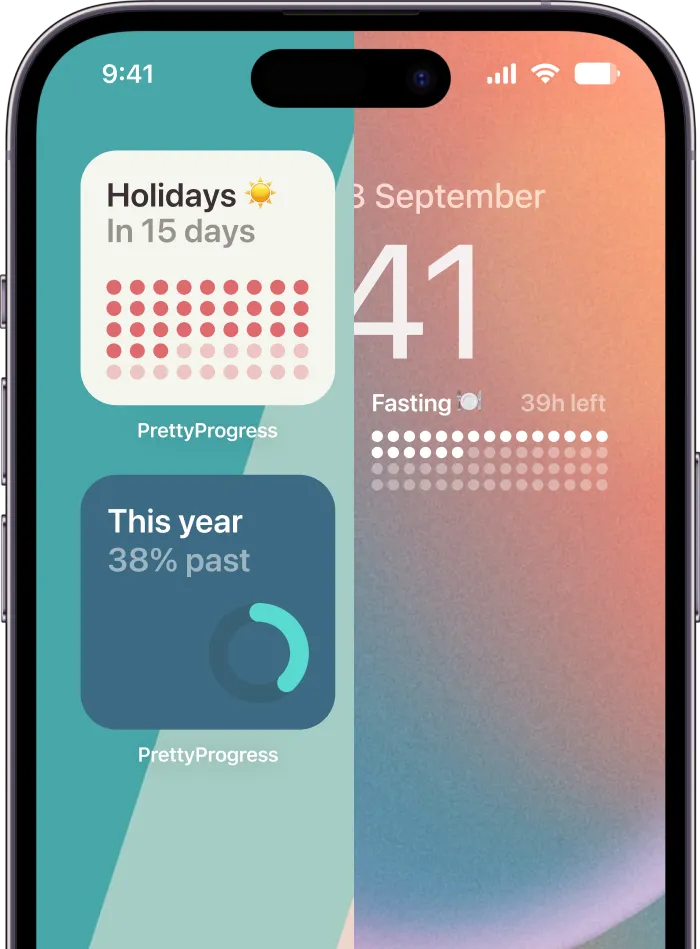
Visibility is what transforms accountability from memory into something you can directly observe. That can be a dashboard, a shared document, a project board, or a progress widget sitting on your phone’s home screen. The point is not decoration, it’s friction reduction. If progress is visible the moment your screen becomes active, you don’t have to remember to check it.
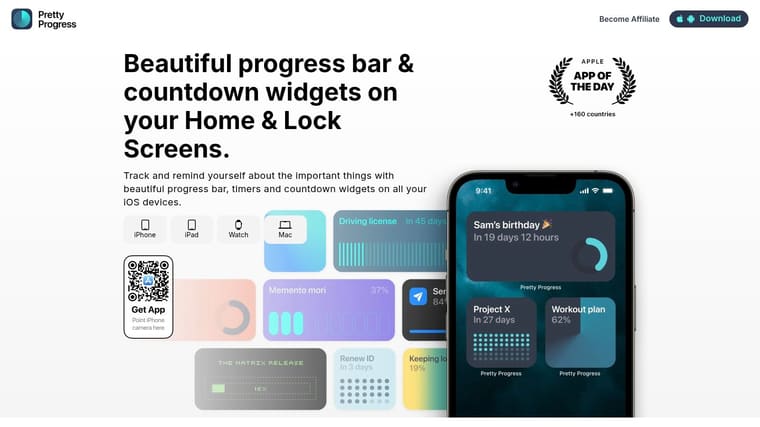
Pretty Progress is one option for this kind of glanceable accountability, because it creates countdown and progress widgets for home and lock screens. That kind of visibility is valuable when a task needs a low-effort reminder rather than a new app habit.
The strongest visual systems don’t wait for perfect motivation. They make the status impossible to miss. That’s why progress bars, visible deadlines, and shared boards work better than vague intentions stored in a notes app.
Regularity keeps the system alive
Regularity is what makes the structure trustworthy. If the cadence is random, the system loses teeth. If the cadence is fixed, people know when problems will surface and when they’ll be expected to respond.
A simple rhythm works well for many teams and solo projects. Weekly check-ins catch slippage early. Monthly reviews adjust the approach. Quarterly reviews decide whether the target, the timing, or the scope needs to change. For teams that need a tighter rhythm on meeting follow-through, ensure meeting follow-through is easier when the notes always end with named owners and deadlines.
If you want a deeper look at setup options and interfaces, the guide on goal progress tracker app shows how tracking can stay simple enough to keep using. The best system is the one people open, not the one they admire once and forget.
Use Your Environment for Social and Tech Support
A lonely accountability system usually weakens under stress. People follow through more often when other humans can see the commitment, and when the tools around them make progress visible without much effort. That does not mean turning daily work into surveillance. It means choosing supports that make hiding harder and next steps easier to spot.
I have seen this work in a weekly team review where each project owner posted one blocker, one next step, and one date before the call ended. The tone changed quickly. No one wanted to show up with a blank update twice in a row, but nobody felt shamed when a task needed help either.
BetterUp says that managers who give regular, timely, and constructive feedback instead of waiting for annual reviews see stronger engagement, and people are more willing to admit mistakes without fearing blame. That matters because accountability gets stronger when people can tell the truth early, not when they are waiting for punishment. The practical lesson is simple. Timely feedback makes ownership safer and more useful, as BetterUp explains in its guide to creating a culture of accountability in the workplace.
Pick support that fits the person, not the fantasy
A good accountability partner asks specific questions and follows a schedule. A weak one just says, “How’s it going?” and disappears. The right support depends on what you need, whether that is structure, encouragement, or a little external pressure to start.
Teams can use Slack, Microsoft Teams, or Asana for more than task assignment. These tools work best when they give people real-time visibility into what is moving and what is stuck, which helps when someone freezes on a task and needs a clear next prompt instead of a vague reminder. The same logic applies in personal work, where calendar holds, shared notes, and recurring check-ins can replace a lot of memory stress.
For people who want to compare software options, productivity tools are worth scanning before adding another app. The mistake is not using tools. It is adding ones that do not change behavior.
Use the environment as a reminder system
Your environment can do a lot of the heavy lifting if it is designed well. A progress widget on a lock screen, a recurring calendar invite, a shared board in a team channel, or a text check-in with a friend can all serve as cues to act. The point is to make the commitment visible before your attention moves elsewhere.
Useful standard: If the reminder requires effort to find, it is too weak to count as accountability support.
Collaboration tools help most when they make obstacles visible early. A task board that shows stalled work is better than a clean board nobody updates. A check-in channel with clear response expectations is better than a group chat full of emojis and no next step.
Navigate Setbacks and Rebuild When You Stumble
Setbacks are part of the system, not evidence that you’re incapable. The mistake is turning a missed deadline into a story about identity. Once that happens, people stop troubleshooting and start withdrawing.
Emerging 2024 to 2025 research points to a real pattern here. 42% of people in that research reported quitting goal-tracking apps after three weeks because they felt they weren’t making enough progress, and the broader pattern of accountability fatigue is rising among remote workers and students. That doesn’t mean people are lazy. It means the reset process is usually too harsh, too vague, or too slow to feel usable. See the discussion of accountability fatigue and goal abandonment for the underlying trend.
Use a reset ritual, not a guilt spiral
A reset ritual is a short review that answers four questions. What happened? What was under your control? What needs to change in the system? What is the next smaller action? That sequence keeps the focus on execution instead of self-judgment.
If a deadline was missed because the task was too large, the fix is scope. If it was missed because no one checked in, the fix is cadence. If it was missed because the goal no longer matters, the fix is honesty, not force. Each answer leads to a different intervention.
Don’t reopen the whole plan every time you slip. Reopen the part that failed.
Shame is noisy and data is useful. Shame tells you to hide. Data tells you what to change. Accountability only gets stronger when the system can absorb a miss without collapsing into blame.
Rebuild with a smaller commitment
After a stumble, lower the next step until it feels almost too easy. Micro-commitments help rebuild trust because they create proof that follow-through still exists. Once the smaller step is working, the system can expand again.
That approach also helps separate a temporary slip from a real mismatch. If you keep missing the same kind of task, the issue may be the timing, the format, or the goal itself. If a smaller version works immediately, the problem probably wasn’t character, it was scale.
A reset that keeps the work moving might look like this:
- Name the miss: State the failed commitment plainly.
- Diagnose the cause: Look for scope, clarity, timing, or overload.
- Shrink the next action: Make the next step easy to start.
- Set the review date: Put the next check-in on the calendar immediately.
The point is to restart fast. The longer a miss sits unaddressed, the more it starts to feel like identity instead of data.
Customize Your Approach for Your Brain and Your Life
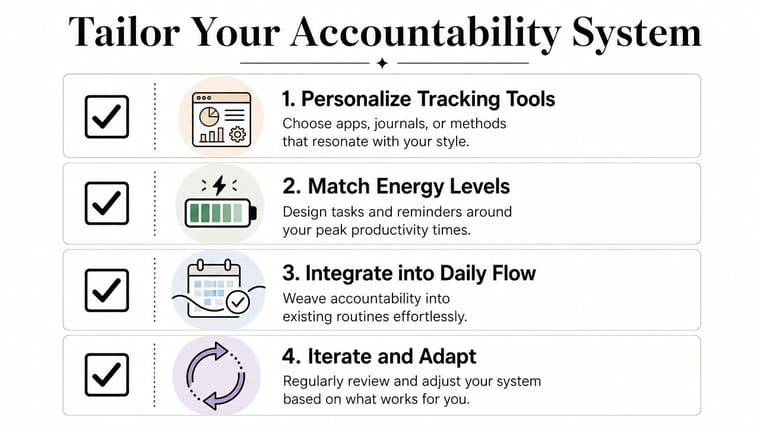
A good accountability system fails fast if it assumes every person works the same way. A student juggling a thesis, a manager coordinating a launch, and a neurodivergent person managing executive function need different kinds of support, different cues, and different review rhythms. The principle stays the same, but the delivery has to fit the person.
Students need visible milestones
Long academic projects stall when the finish line feels abstract. Break the work into chapters, drafts, feedback rounds, and submission dates. Put those dates where they are hard to miss, then treat them as real commitments instead of loose intentions.
A weekly accountability call with one person can help if that person asks for evidence, not reassurance. A shared doc, calendar reminders, and a visible checklist are usually enough when they are used. The system should make progress feel concrete before motivation fades.
Professionals need ownership tied to outcomes
Work accountability gets stronger when each task connects clearly to team objectives. That means fewer vague priorities and more named deliverables. A project board, a short standup, and a visible owner for every task work better than a long list of items marked “important.”
The trade-off is simple. More visibility can feel slower at first, but it reduces the confusion that causes work to stall later. People tend to follow through better when they know exactly what they own and how their work will be reviewed.
Neurodivergent users need lower cognitive load
Analysts at AIHR noted in its discussion of accountability in the workplace that 30% to 60% of adults with ADHD struggle with task initiation and follow-through even when they know what to do, and many accountability guides still ignore the supports that help. Those supports include dopamine-driven cues, visual progress bars, and glanceable reminders that reduce cognitive load. That gap matters because a shame-based approach adds pressure without increasing clarity or making the next step easier to start.
For neurodivergent users, the best supports are often visual, immediate, and forgiving. Use widgets, timers, sticky prompts, and short checklists. Keep the next step visible and small enough to start without negotiation. A system built this way reduces the number of decisions a person has to make before getting started, which is often where the process breaks down.
If the system relies on memory, it will punish the people who need support most.
The right approach is not to copy someone else’s setup. It is to keep the same accountability principles and adjust the delivery. Match the tool to the brain, the cadence to the workload, and the review style to the kind of follow-through you need. That can mean a paper tracker for one person, a digital dashboard for another, or a visual widget paired with a short check-in. For people who need a more personalized structure, AI-guided fitness for women over 40 shows how tailoring the system to the user can make consistency easier to maintain.