
October 29, 2026
Group Project Timeline: Templates and Steps
Build a group project timeline with week, month, and semester templates, named owners, buffers, and a check-in rhythm that catches slips early.
Only 38% of organizations surveyed in the 2025 State of Project Management report said they mostly or always completed projects on time, according to Xergy’s account of the report. For a student team or small professional group, the practical question isn’t whether everyone knows the deadline. It’s whether everyone knows what they owe the next person before that deadline.
Table of Contents
- Why a Shared Final Deadline Fails the Group
- Timeline Templates for Short Medium and Long Work
- Balance Dependencies Without Unfair Load
- How to Build the Group Project Timeline
- Set the Cadence and Lock the Next Milestone
- Fix a Slip Before It Hits the Deadline
Why a Shared Final Deadline Fails the Group
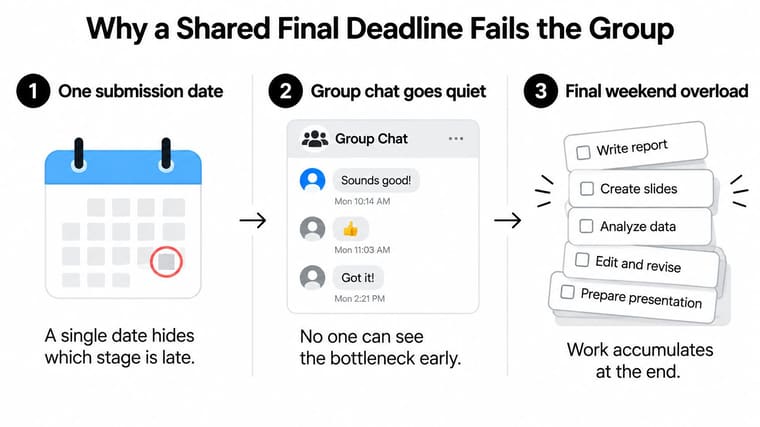
A submission date is set. The group chat goes quiet, and most of the work happens on the final weekend. Until someone opens the shared folder, nobody knows whether the team has usable research, disconnected notes, or nothing ready to review.
Historical software projects illustrate the stakes of poor project control: in the Standish Group’s early CHAOS report, only 16.2% of US software projects finished on time, within budget, and with the originally specified features. That isn’t a forecast for your class assignment. It’s a reason not to confuse a promised finish date with a workable delivery plan.
The difference becomes visible when you separate the stages.
Replace the promise with handoffs
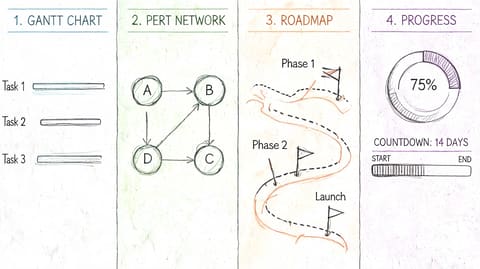
A group project timeline is a sequence of dated checkpoints with a lead, a backup reviewer, and an agreed handoff. Most groups need these checkpoints:
- Scope lock: Agree on the deliverable and its boundaries.
- Inputs or research: Make evidence available to the writers.
- First draft: Include an agreed outline before full drafting.
- Review: Check the combined work against the brief.
- Revision: Resolve comments and repair gaps.
- Submission: Deliver the checked final file.
Use collaborative goal setting to settle what completion means before assigning work. For workplace groups coordinating information across departments, SIX ERP’s explanation of what ERP means for manufacturers provides useful context for shared information and connected workflows.
Choose a calendar shape that matches the time you have, not the time you wish everyone could contribute.
Timeline Templates for Short Medium and Long Work
Group project timeline templates by length
These are illustrative planning templates, not research-derived timing rules. Replace the sample spans with your actual calendar, and reserve recovery time before allocating the remaining days to production.
| Project length | Typical span | Phase split | Buffer before submit | Check-in rhythm |
|---|---|---|---|---|
| One-week sprint | Example working week | Scope and inputs early; draft midweek; review before the final day | Keep the final working session for fixes and submission, with no new scope | Brief daily check |
| Two-to-four-week assignment | Example fortnight or month | Research, visible outline, full draft, review, revision | Reserve a recovery window after planned revision | Midweek and end-of-week checks |
| Semester or quarter project | Example teaching term | Proposal, research, initial draft, peer review, revision, polish, submission | Leave an unassigned window after polish | Weekly meeting plus a check after each milestone |
Put the short templates on a calendar
Say a class sprint begins Monday and ends Friday. Lock scope on Monday, gather inputs through Tuesday, draft on Wednesday, and review on Thursday. Friday is for correcting the reviewed version and submitting it, not discovering that someone interpreted the question differently.
That schedule needs a small deliverable. If the assignment includes interviews, unfamiliar software, or outside approval, either narrow the scope or move those dependencies earlier. A compact calendar doesn’t make a large task smaller.
For a hypothetical fortnight-long report due Friday the 27th, a workable sequence could be scope approval on Monday the 16th, sources by Wednesday the 18th, and an agreed outline on Thursday the 19th. Set the combined draft for Wednesday the 25th and review for Thursday the 26th. Protect Friday the 27th for recovery and upload.
A buffer is time you haven’t promised to another task. If you fill it with planned writing, it’s no longer a buffer.
Calendar time also isn’t effort. A writer may need a short working session but wait several days for an interview transcript. Put both the work and the waiting period on the timeline.
Give long projects visible intermediate outcomes
For a hypothetical semester project running from September into December, use September for proposal approval and early evidence gathering. Put an outline and sample section in October, a complete draft and peer review in November, and revision and submission preparation in December. Replace those month labels with actual course dates before anyone starts.
Long projects need intermediate outputs that another person can inspect. A literature map, working chart, or rough argument is more useful than a status message saying research is underway.
The academic procrastination study supports using staged sub-goals for students who struggle with self-regulation, while also showing why interdependent work shouldn’t be treated as an automatic cure for procrastination. Some people respond to being needed by teammates; others still need an earlier, concrete commitment.
Copy the matching template into Google Docs, Notion, or a shared spreadsheet. Replace phase labels with deliverables and real dates before naming owners, so people accept a defined commitment rather than an open-ended responsibility.
Balance Dependencies Without Unfair Load
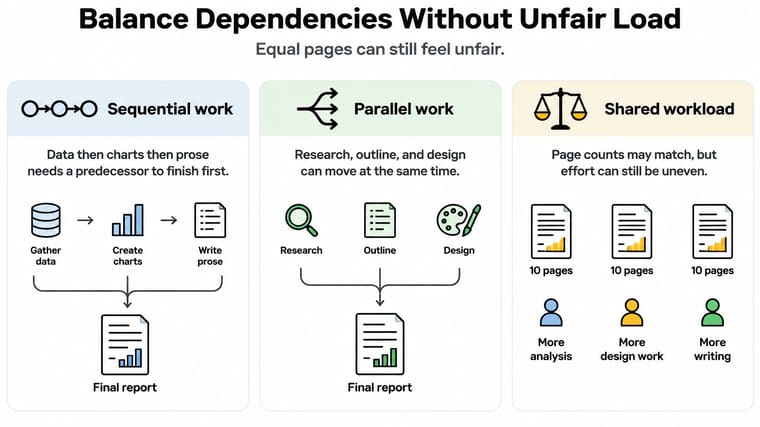
Equal page counts can still produce an unfair workload. The person writing a straightforward summary may finish quickly, while the person cleaning data and reconciling contradictory sections spends much longer on work nobody sees.
This comparison shows why counting outputs alone misses the problem.
Diagnose the work before dividing it
Use the same report to distinguish the task structures:
- Sequential work: Someone collects data, another person creates charts, and a writer interprets those charts. The chart maker needs a predecessor deadline for the data and recovery time before the prose handoff.
- Additive work: Members draft separate chapters in parallel. Schedule an integration checkpoint to compare terminology, evidence, and argument before anyone polishes their chapter.
- Independent work: Someone checks submission instructions or prepares the reference template without waiting for the report’s findings. Give that work an owner even though it doesn’t block drafting.
Ask whether the next person can start without the output. If they can’t, you have a sequential dependency. If separately produced pieces must merge, you also have additive work; a single task can participate in both structures.
Student accounts in the Information Research study of group work distinguish unequal participation, communication, procrastination, and coordination problems. Don’t treat every delay as laziness when the actual problem may be an unclear handoff or an overloaded editor.
Effort and dependency check for the four-person report
| Task | Dependency type | Dependency risk |
|---|---|---|
| Data collection | Sequential | High |
| Charts | Sequential | Medium |
| Three chapter drafts | Additive | Low |
| Merge and final prose | Sequential | High |
Treat those risk labels as starting judgments for this example. Add each owner’s estimated effort, available working sessions, and conflicting deadlines to your shared version.
Count the work people usually overlook
Give merging, citation checking, meeting notes, and revision their own task entries. The editor shouldn’t receive a full writing allocation plus an unacknowledged obligation to repair everyone else’s work.
MakeAutomation’s capacity planning guidance for SaaS founders offers a useful workplace perspective on matching commitments to availability. For a student team, the equivalent is checking exam dates, shifts, caring responsibilities, and access to required software.
Use a shared workload management system to make those commitments visible without demanding private explanations. For cross-time-zone teams, specify the time zone and choose a handoff during agreed overlap hours rather than somebody’s midnight.
Use this video as a prompt for discussing how your group will organize the work.
Fairness check: Redistribute work before drafting if someone’s remaining commitments clearly exceed their available time. Don’t wait for that person to fail before acknowledging the mismatch.
How to Build the Group Project Timeline
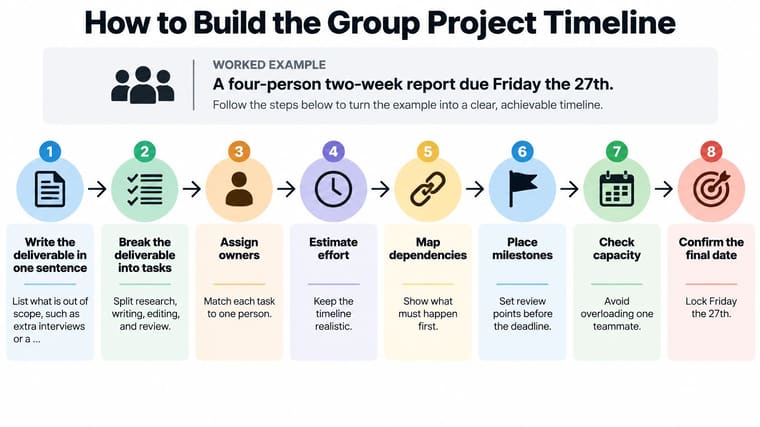
Say a four-person team has a report due Friday the 27th, with work beginning Monday the 16th. Use a shared spreadsheet for dates and dependencies, a shared folder for files, and the assignment brief as the acceptance checklist.
The process should produce something teammates can act on, not just a tidy chart.
Define the work and its boundaries
-
Write the deliverable in a sentence.
For this example, the team will submit a report that answers the assigned question, supports its conclusion with cited evidence, and follows the required format. Put extra interviews and a redesigned cover outside scope unless needed. -
Freeze requirements at the kickoff.
On Monday the 16th, agree on the audience, required sections, file format, and submission method. Record unresolved questions and give someone responsibility for obtaining answers. Don’t let an unanswered formatting question hold up evidence gathering. -
Break phases into finishable tasks.
Replace research the topic with actions such as find evidence for the main claim, check the source’s relevance, and add a citation to the evidence sheet. A task should end with a visible output, not time spent reading. Stop splitting when someone can understand and complete it in a focused sitting. -
Mark the task structure.
Label evidence gathering as a predecessor to chart production. Mark chapter drafts as additive and create a merge task that requires all chapter files. Write the required input beside each dependent task so nobody has to reconstruct the sequence from chat messages.
Turn the task list into commitments
-
Estimate effort and check availability.
Ask owners to estimate working sessions, then compare those estimates with their calendars. For unfamiliar work, include a trial task before committing to the full schedule. Testing whether the dataset opens correctly is more informative than confidently estimating an analysis nobody has attempted. -
Place dates backward from submission.
Keep Friday the 27th free for recovery and upload, with review on Thursday the 26th and a combined draft on Wednesday the 25th. Work backward to the agreed outline on Thursday the 19th and sources on Wednesday the 18th. If the available sessions don’t fit, reduce optional scope before accepting the dates. -
Assign a lead and backup reviewer.
For example, Maya owns the evidence sheet, with Leo checking that each claim has a usable citation. Their handoff is Wednesday the 18th in the shared folder. A backup reviewer checks readiness and can help arrange recovery; they aren’t responsible for doing the lead’s entire task. -
Publish the working version.
Put the timeline beside the files people already use. Make the kickoff message’s subject line identify the next deliverable and its due date. If you use Trello, attach the file location and acceptance checklist to the task card rather than scattering them across messages.
For professional teams that struggle with too much work in progress, Ekipa’s Kanban training for operations leaders provides context for making workflow and blocked work visible. A student group can apply the simpler principle: finish and hand over usable work before starting optional additions.
The timeline is ready when every task has a date, a lead, a reviewer, and a predecessor or the word none. Check that each handoff also says what the recipient should be able to open and use.
Set the Cadence and Lock the Next Milestone
A progress meeting should produce a decision, not a performance of busyness. Reading task names aloud doesn’t help if nobody checks whether the files exist or whether the next person can use them.
In 2024, Boston Consulting Group reported that effective early-warning systems could increase project success rates by up to 16 percentage points. For a small group, early warning can be straightforward: an owner flags uncertainty while teammates still have choices.
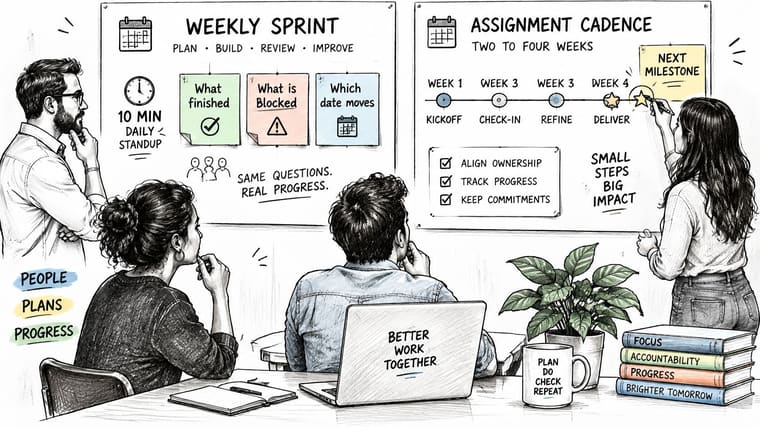
Keep the conversation centered on outputs, blocked work, and decisions.
Match the check to the project
For a short sprint, use a brief daily check. A longer assignment can use scheduled midweek and end-of-week checks, while a semester project can combine a weekly meeting with a review after major submissions.
Use the same prompts without turning every check into a co-writing session:
- Finished work: What file is ready, and where is it?
- Blocked work: What input, decision, or access is missing?
- Next commitment: Who owns the next deliverable, and does its date still hold?
If someone needs help developing an argument, arrange a separate working session with the relevant teammate. Don’t keep the whole group in a meeting that only requires the writer and reviewer.
A check should end with an updated commitment. If the date hasn’t changed, confirm it; if it has, record the replacement date and tell the person waiting for that output. Silent calendar edits create a different kind of coordination problem.
Make the next action visible without monitoring people
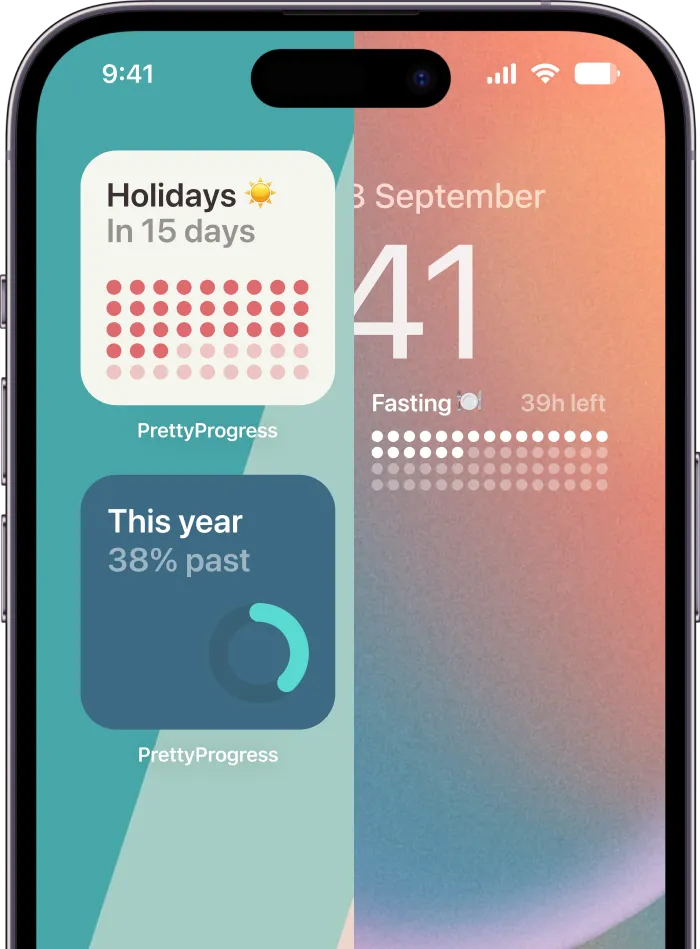
Keep the complete schedule in Google Calendar, Notion, or the shared spreadsheet. For a personal visual reminder, Pretty Progress is another option: its countdown and progress widgets can display the next draft, review, or handoff on a Home Screen or Lock Screen.
Use the widget for your own next commitment rather than tracking teammates’ activity. A countdown can remind you that a review is approaching, but it can’t establish whether the draft meets the brief. That still requires opening the file.
The useful question isn’t how long someone appeared online. It’s whether the agreed output is ready for the person who needs it.
Before leaving the kickoff, write these lines in the shared document:
- Calendar choice: The project-length template and actual submission date.
- Next milestone: A nearby deliverable with an explicit due date.
- Responsibility: Its lead and backup reviewer.
- File location: The folder or document where the output will appear.
Then set a widget for that next handoff, not only the final submission. At the next check, open the required file before discussing progress. That small habit keeps the timeline connected to work rather than promises.
Fix a Slip Before It Hits the Deadline
A construction schedule review published in Sustainability, covering 31 publications across 17 countries, found that approximately 72% of projects experienced schedule delays, with delayed projects averaging a 38% increase over their original contracted duration. The useful planning lesson is to act while recovery choices remain, particularly when another task is waiting.
Diagnose before changing dates
Milestone slips and the move to make
| What you see | What it means | Move to make |
|---|---|---|
| Task visibly running beyond its estimate | Optimistic duration or a hidden dependency | Spend buffer on that task and ban new scope |
| No file on the handoff morning | Ownership or handoff failure | Confirm a lead and backup that day and shrink the next deliverable |
| New requests after the first draft | Scope creep | Freeze additions and cut an optional section |
| A member has gone quiet | Possible late start or an undisclosed blocker | Ask about the blocker and agree on a small visible file |
Don’t diagnose a quiet teammate’s ability or motivation from silence alone. Ask what prevents the next output, then agree on something inspectable, such as an annotated outline instead of a polished chapter.
If a handoff is missing, reduce the immediate requirement without abandoning the essential one. A chart maker may be able to start from a checked subset of the dataset while the collector resolves the remaining entries.
Change only what the slip affects
Avoid restarting the whole plan, distributing a late task among everyone without a new owner, or waiting for the next scheduled meeting. Those responses either discard useful work or leave responsibility unclear.
Update the downstream dates and notify the people affected. Keep the original submission date unless the instructor or client has approved a change, and record which optional work you’ve removed to protect it.
Use project deadline management to keep recovery decisions tied to the deliverable rather than to general pressure to work faster. Once the immediate risk is contained, review why the estimate or handoff failed so the next commitment is more realistic.
Pretty Progress offers customizable countdown and progress widgets for keeping upcoming milestones visible on your devices. Visit Pretty Progress and set a countdown for your next concrete handoff, such as an outline, combined draft, or review-ready file.