
June 16, 2026
Build a Visual Weight Loss Progress Tracker with Widgets
Ditch spreadsheets. Learn to build a visual weight loss progress tracker with custom widgets on your phone. Track metrics that matter and stay motivated.
You open your phone to check the weather, your calendar, maybe your messages. Your weight loss plan is nowhere in sight.
That’s a big reason many people stop tracking. The paper log stays in a drawer. The spreadsheet lives in a tab you never reopen. Even a good health app can become invisible if it asks you to go looking for it instead of putting your progress in front of you.
A better weight loss progress tracker fits into the way you already use your phone. It should be quick to update, easy to read in a glance, and visual enough to keep the goal feeling real. That’s where a widget-based setup changes the experience. Instead of treating tracking like homework, you turn it into a small, visible prompt that shows up every day on your Home Screen or Lock Screen.
Table of Contents
- Why Your Old Progress Tracker Is Failing You
- Designing Your Tracker and Setting Realistic Goals
- Choosing Metrics That Tell the Whole Story
- How to Build Your Widget with Pretty Progress
- Interpreting Trends and Staying Consistent
- Avoiding Common Weight Loss Tracking Pitfalls
- Frequently Asked Questions
Why Your Old Progress Tracker Is Failing You
Most failed tracking systems have the same problem. They create friction.
A notebook can work, but only if you remember where it is, open it, and write in it. A spreadsheet can work, but only if you’re willing to type into a grid that feels more like admin than self-care. Many people blame themselves when they stop using these tools, but the actual issue is often design. If the tracker is easy to ignore, you probably will.
The old-school version of tracking still matters, though. The CDC’s public Weight Log handout exists for a simple reason. Frequent logging creates a dated record that helps you track progress over time. That tells you something important. Tracking isn’t a trendy app habit. It’s a long-established behavior tool.
Out of sight becomes out of mind
If your weight loss progress tracker only appears when you remember to go find it, consistency drops fast. You don’t need more guilt. You need fewer steps between noticing your goal and engaging with it.
That’s why a visual system works better for many people than a hidden log. A widget on your phone turns tracking into a glanceable cue. You see it when you check the time, swipe through your apps, or access your screen for something unrelated.
Practical rule: If your tracker takes more effort to open than your social apps, it’s set up to lose.
The problem isn’t motivation alone
People often assume they need more discipline. Usually, they need a setup that respects normal human behavior.
What works:
- Visible reminders that stay on screen
- Simple inputs you can update quickly
- Visual progress that feels satisfying to check
What usually fails:
- Perfect-only systems that punish missed days
- Buried data hidden in notes, files, or forgotten apps
- Scale obsession without context
A modern weight loss progress tracker should do one job well. It should make progress visible often enough that you keep coming back.
Designing Your Tracker and Setting Realistic Goals
Before you build anything on your phone, decide what the widget is tracking. A lot of people skip this step, then end up with a progress bar that looks clean but means nothing.
A useful tracker needs a start point, an end point, and a pace that makes sense in real life. That’s what turns a vague goal into a measurable project.

Vertex42’s printable charts are a good model because they anchor progress to a real trajectory. Their templates include trend lines for 1 pound per week and 2 pounds per week, which would equal about 52 pounds or 104 pounds across a full 52-week year if maintained consistently, as shown on the Vertex42 weight loss chart page.
Start with a pace, not just a target
“Lose weight” is not a tracker. “Lose 20 pounds” is better, but it still leaves out timing.
A better setup looks like this:
| Part of the tracker | What to decide |
|---|---|
| Starting point | Your current weight or current waist measurement |
| Goal point | Your target weight or target measurement |
| Pace | A planned weekly rate of change |
| Review rhythm | When you’ll update and assess it |
Once you set the pace, the progress bar becomes useful. It stops being decoration and starts showing whether your trend is roughly on track.
Keep the goal realistic enough to survive real life
A weight loss progress tracker should reduce panic, not create it. If your timeline assumes flawless eating, no travel, no stress, and no normal fluctuations, the widget will become a daily reminder that you’re “behind.”
Try this planning filter:
- Choose one main outcome metric. Usually body weight or waist.
- Pick one pace you can live with. Slow and repeatable beats aggressive and fragile.
- Add one review day. Same day each week is easier to maintain.
- Leave room for noise. The trend matters more than a single entry.
A good tracker doesn’t ask, “Did you do this perfectly?” It asks, “Are you still moving in the right direction?”
When you build the widget later, those choices will shape everything. The cleanest designs are built on clear numbers.
Choosing Metrics That Tell the Whole Story
The scale gives useful information. It just doesn’t give enough information by itself.
If you’ve ever done “everything right” for a week and then seen almost no change on the scale, you already know the problem. Weight responds to more than fat loss. Food volume, hydration, bowel changes, and training stress can all blur the picture. That’s why a stronger weight loss progress tracker uses a small set of metrics instead of one noisy number.

Behavioral guidance summarized by RippedBody’s tracking guide points toward a multi-metric approach: track nutrition, physical activity, sleep, and stress alongside weight, focus on 2 to 3 goals at a time, and review them weekly rather than trying to overhaul everything at once.
Pick a short list with high signal
Individuals generally do better with one primary metric and a few supporting ones.
A practical setup looks like this:
- Primary metric: scale weight
- Best body-change metric: waist circumference
- Best daily-behavior metric: nutrition consistency
- Best recovery metric: sleep quality or general energy
- Best reality check: how clothes fit
That combination catches progress the scale can miss. It also gives you something useful to look at when body weight is temporarily messy.
For a more medication-specific example of what people choose to log, this roundup of Blue Haven RX GLP-1 tracker advice is helpful because it shows how symptoms, habits, and progress markers often need to sit together in one tracking system.
What not to overvalue
Some measurements create more confusion than clarity.
I’m cautious with:
- Mirror checks, because lighting and posture change everything
- Wearable calorie-burn numbers, because they can look precise without being dependable
- Body-fat estimates from consumer devices, because they often swing around in ways that don’t help decision-making
If you want a deeper breakdown of which signs matter most beyond the scale, Pretty Progress also published a useful guide on how to track fitness progress.
Better question: Instead of asking “Did my weight drop today?” ask “What does the full pattern say this week?”
Non-scale progress matters more than people think
Reputable health sources keep making the same point. People often need non-scale signals such as energy, clothing fit, waist circumference, strength, mobility, mood, and lab markers to judge whether a plan is working, as outlined in HealthCentral’s guide to tracking progress without the scale.
That matters most when the scale stalls. If your waist is shrinking, your workouts feel better, and your clothes fit differently, your plan may still be working. A scale-only mindset misses that.
How to Build Your Widget with Pretty Progress
Once your metrics are clear, the actual build should take only a few minutes. The key is choosing a widget format that matches the kind of progress you want to see at a glance.
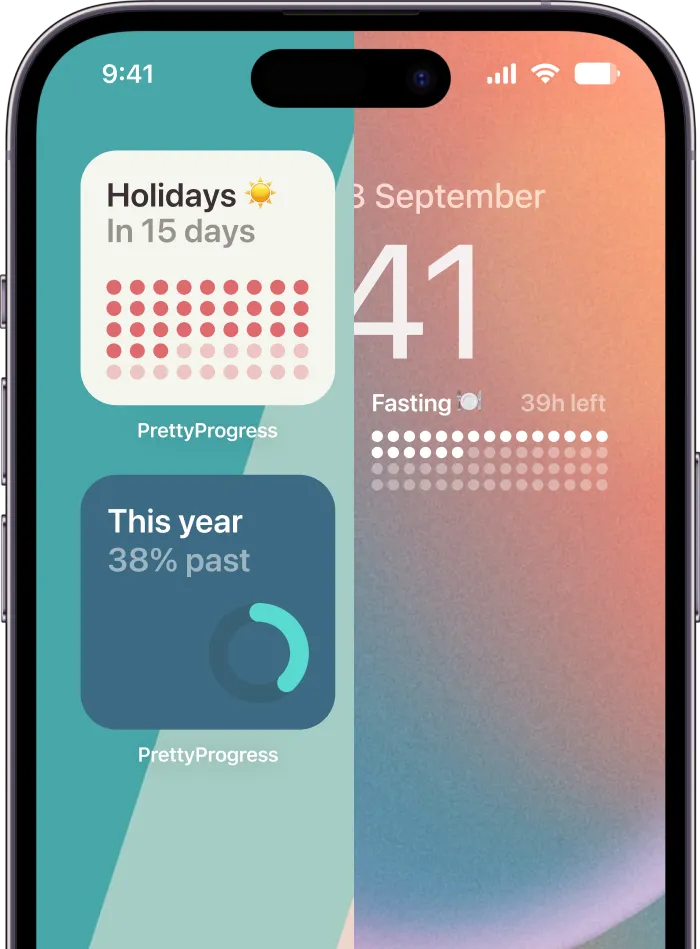
One option is Pretty Progress, which lets you create countdowns and progress widgets for Home and Lock Screens on Apple devices and Android. For weight loss, that means you can turn a goal into a visible bar, countdown, or percentage that stays in front of you during the day instead of hiding inside an app menu.

Choose the widget format that fits the metric
Different goals look better in different visual formats. Don’t force everything into one bar.
Here are three setups that work well:
-
Pounds-to-go countdown
Good when your main focus is total weight remaining to your target. This keeps the number simple. -
Percentage-complete bar
Better if you want to see the whole journey as one long project. It’s often more motivating for long timelines. -
Waist-change tracker
Useful when the scale tends to mess with your head. This can be a separate widget if body composition changes matter more right now.
Build it in a way you’ll want to look at
The practical build process is straightforward:
- Set the start value. This is your current number when you create the tracker.
- Set the target value. Use the realistic endpoint you planned earlier.
- Pick a visual theme. Minimal themes usually work best for daily visibility.
- Choose a label you’ll understand instantly. “Pounds to Goal” is better than something vague.
- Place it where your eyes already go. First Home Screen, Lock Screen, or a widget stack you regularly use.
The design part matters more than some people expect. If the widget feels cluttered or unattractive, you’ll mentally tune it out. Aesthetic motivation is real. People engage more with tools that feel clean, personal, and pleasant to open.
Keep the inputs simple
Don’t turn your widget into a dashboard with too many moving parts. Only one visible widget and one hidden log behind it are typically needed.
A simple structure:
- one widget for the outcome
- one weekly check-in routine
- one notes app or health app for supporting detail
If you like the idea of pairing a goal widget with a behavior cue, this article on a habit tracker with widget gives a clean way to think about that setup.
The best widget is the one you can understand in one second.
Good examples for real life
These work particularly well on a phone:
| Widget idea | What it tracks | Why it works |
|---|---|---|
| Goal weight progress bar | Total weight lost toward target | Clear long-range view |
| Waist countdown | Inches or centimeters remaining | Useful during scale stalls |
| Weekly consistency widget | Check-in streak or routine cadence | Keeps behavior visible |
| Photo reminder countdown | Days until next progress photo | Prevents random, emotional comparisons |
When a weight loss progress tracker becomes part of your daily screen, it stops being a project you “should” manage and starts acting like a gentle prompt you naturally respond to.
Interpreting Trends and Staying Consistent
The hardest part of tracking isn’t entering the data. It’s reading it without overreacting.
Daily body weight can bounce around for reasons that have nothing to do with actual fat gain or fat loss. A salty meal, a harder workout, a late dinner, poor sleep, or simple digestion can shift the scale enough to mess with your mood. That’s why you should treat single weigh-ins as data points, not verdicts.

Read the direction, not the drama
A good review process is calm and repetitive. You log, then you zoom out.
Use this approach:
- Weigh under similar conditions. Same general time and routine gives cleaner comparisons.
- Review weekly, not emotionally. One rough day doesn’t deserve a strategy overhaul.
- Compare with another signal. Waist, performance, or clothing fit can confirm what’s happening.
UCLA Health notes that body fat, performance, and how clothes fit can improve even when scale weight changes slowly, especially when someone starts exercising. Their guidance on measuring progress beyond pounds is useful because it frames the question correctly: learn which metric to trust when weight and body composition diverge.
If the scale is flat but your waist is down and training is up, I’d trust the waist and performance first.
Use weekly reviews to stay objective
Your weekly check-in should be short. Five minutes is enough.
A solid review asks:
- What did weight do across the week?
- What did waist, clothes, or photos suggest?
- Were nutrition, activity, sleep, or stress noticeably off?
- Do I need an adjustment, or just another steady week?
That last question matters. Many people change the plan too early. They react to noise instead of patterns.
When readers want extra help handling a stall without turning it into a crisis, I often point them to practical plateau resources like Maximum Health Products’ guide, because it encourages adjustment rather than panic.
Consistency beats intensity
A tracker should lower emotional swings, not amplify them. One useful habit is tying your review to a standing appointment with yourself, like Sunday morning or Monday after your usual weigh-in.
If consistency is a significant challenge, this guide on how to stay consistent with goals pairs well with a widget-based system because the phone becomes part reminder, part scoreboard.
The people who stick with tracking longest usually don’t stare at it all day. They glance at it, update it, and keep moving.
Avoiding Common Weight Loss Tracking Pitfalls
The most common tracking mistake is quitting after a break.
People miss a few logs, feel like the record is ruined, and stop entirely. That reaction makes sense emotionally, but it’s not supported by the data. Reporting from UConn on a 6-month study found that people who tracked food on only about 30% of days still lost more than 3% of body weight. Higher tracking frequency was associated with larger losses, while the group that dropped to zero tracking lost less, as summarized in UConn’s review of how much tracking is enough.
The all-or-nothing mindset is the real trap
Tracking works best when you treat it as a returnable habit.
Bad script:
- “I missed days, so this week doesn’t count.”
- “I went off plan, so I’ll restart next month.”
Better script:
- “Log what happened.”
- “Update the tracker.”
- “Resume at the next meal or next day.”
Missing entries don’t erase progress. Quitting the system does.
Pitfalls worth catching early
- Overchecking the scale: More data isn’t always better if you can’t interpret fluctuation calmly.
- Tracking too many things: If your app asks for everything, you’ll eventually avoid opening it.
- Using the tracker as punishment: A tracker should give feedback, not shame.
- Changing goals too often: Constant edits make the data hard to trust.
An effective weight loss progress tracker makes room for imperfect weeks. That’s not lowering the standard. It’s building a system people can keep using.
Frequently Asked Questions
What should I do if my weight loss progress tracker shows a plateau
Don’t assume the plan has failed. First, check your other signals. Waist, clothing fit, energy, strength, and routine consistency often tell you more than a flat scale week. If those are moving in the right direction, stay steady before making major changes.
How often should I weigh myself
Use a schedule you can repeat calmly. Many people do well with a consistent weigh-in routine under similar conditions, then review the weekly pattern instead of reacting to single readings. The more important part is consistency in method, not obsessing over any one day.
Should I track only weight or also habits
Track both, but keep it light. Weight is an outcome. Habits such as nutrition consistency, activity, sleep, and stress give you context for why the outcome is moving or stalling. That context is what helps you make smart adjustments.
Can I use the same widget idea for other health goals
Yes. The same visual setup works for workout streaks, hydration routines, fasting windows, step goals, sleep schedules, or a countdown to your next progress-photo check-in. The principle stays the same. Put the goal somewhere visible and make updates easy.
If you want your tracking system to live where it will be consistently visible, Pretty Progress gives you a simple way to turn a weight loss goal into a visual widget on your Home or Lock Screen. That kind of glanceable reminder won’t do the work for you, but it can make consistency much easier to keep.