
July 1, 2026
Goal Setting for Students: A Practical Success Framework
Master goal setting for students with this step-by-step guide. Learn to set SMART goals, track progress with apps, and build habits for academic success.
You might be in that point of the semester where everything feels important at once. A quiz is coming up, a paper is half-started, your inbox is full, and you keep telling yourself you’ll “get organized this weekend.” Then the weekend goes by, and somehow you’re still busy but not fully moving forward.
That feeling usually isn’t a character flaw. It’s often a system problem. Most students don’t need more pressure. They need a clearer way to decide what matters, why it matters, and what to do next when motivation drops.
Good goal setting for students does exactly that. It turns vague hopes like “do better this term” into something you can see, plan, and follow. It also has real academic value. A Michigan State University study of 328 students found that a structured goal-setting process increased academic performance, with 69% of participants making adequate growth compared with 60% before implementation, as reported in the Michigan State University study summary.
Table of Contents
- From Overwhelmed to On-Track
- Find Your ‘So That’ Before You Set Your Goal
- Build an ‘Informed’ SMART Goal Blueprint
- Deconstruct Your Goal into Weekly Actions
- Make Your Progress Impossible to Ignore
- Navigate Common Goal-Setting Pitfalls
- Your Journey Starts with a Single Step
From Overwhelmed to On-Track
A student I’ve advised many times in different forms goes like this. She starts the term with good intentions, writes due dates in three different places, and promises herself she’ll stay ahead. By week four, she’s reacting to whatever feels loudest. A discussion post gets done at midnight, a reading gets skimmed, and a larger project sits untouched because it feels too big to begin.
That spiral is common in high school and college. You’re not lazy if you keep bouncing between tasks. You may be trying to manage a full academic life without a reliable framework.
A workable system starts with two questions. What am I trying to accomplish, and what will I do this week that proves I’m moving toward it? When students can answer both, school feels less like chaos and more like navigation.
Practical rule: If your goal only exists in your head, it’s easy for stress to rearrange your priorities.
If you want a simple outside example of age-appropriate student goal-setting strategies, it helps to see how other educators frame reflection, commitment, and follow-through. Sometimes one fresh prompt is enough to turn “I should” into “I will.”
Many students also discover that weak goals are really weak schedules. If that’s you, pair your goal work with a few practical time management tips for students. The combination matters. A meaningful goal without time blocked for it usually turns into guilt.
Find Your ‘So That’ Before You Set Your Goal
Some students write perfectly clear goals and still don’t follow through. “Get an A in biology.” “Study every night.” “Finish my transfer application.” These sound fine on paper. But they often fall apart because the student never connected the goal to personal meaning.
Why clear goals still fail
Research on goal acceptance points to this gap. Students can understand a goal and still feel no real drive to pursue it if they don’t have a strong WIIFM, or “What’s In It For Me?” connection. The “so that” framework helps by linking the task to personal utility and engagement, as discussed in this research on goal acceptance and motivation.

Here’s what that looks like in real student life:
- Without meaning: I’m going to improve my math grade.
- With a “so that”: I’m going to improve my math grade so that I can qualify for the course I need next term.
- Without meaning: I’ll attend office hours.
- With a “so that”: I’ll attend office hours so that I stop losing points on the same type of problem.
- Without meaning: I’ll finish my essay early.
- With a “so that”: I’ll finish my essay early so that I have time for feedback before the deadline.
The difference is subtle, but powerful. The second version gives your brain a reason to care.
How to write a goal that means something
Start with a goal you’ve been avoiding. Then finish this sentence: “I want to do this so that…” Keep going until the answer feels personal, not performative.
A few useful prompts:
- What changes if I succeed? Think beyond the grade. Confidence, options, less panic, better habits.
- What frustration am I trying to stop repeating? Maybe you’re tired of rushing, forgetting, or feeling behind.
- What future door does this open? A class, internship, major, scholarship, portfolio piece, or skill.
- Who benefits besides me? Sometimes motivation grows when a goal connects to family, team work, or a long-term purpose.
A goal becomes easier to protect when it means more than “because I’m supposed to.”
If consistency is hard for you, build this reflection into your routine instead of treating it like a one-time journal exercise. A simple weekly review can help you reconnect with the reason behind the work. This kind of reset is especially useful if you tend to start strong and drift later, which is why many students benefit from practical guidance on how to stay consistent with goals.
Try these examples:
| Basic goal | Better goal with a so that |
|---|---|
| I’ll read two chapters this week | I’ll read two chapters this week so that class discussion stops feeling confusing |
| I’ll apply for three internships | I’ll apply for three internships so that I can test what field actually fits me |
| I’ll practice Spanish for 15 minutes a day | I’ll practice Spanish for 15 minutes a day so that I can participate instead of staying quiet |
When students skip this step, they often choose goals that sound impressive but don’t feel real. That’s when procrastination sneaks in. Not because they don’t care about their future, but because the next action still feels disconnected from their life right now.
Build an ‘Informed’ SMART Goal Blueprint
SMART goals still help, but students often get stuck on one question. How do I know what’s realistic for me? That’s where many goal-setting guides are too thin. They tell you to be specific and measurable, but they don’t show you how to choose a target that fits your actual starting point.
Use evidence from your own school life
Research highlights a lack of informed student goal setting processes as a major barrier to achievement. Students need guidance that breaks larger objectives into specific skill gaps and realistic targets based on past performance, as noted in this dissertation on informed goal setting in education.
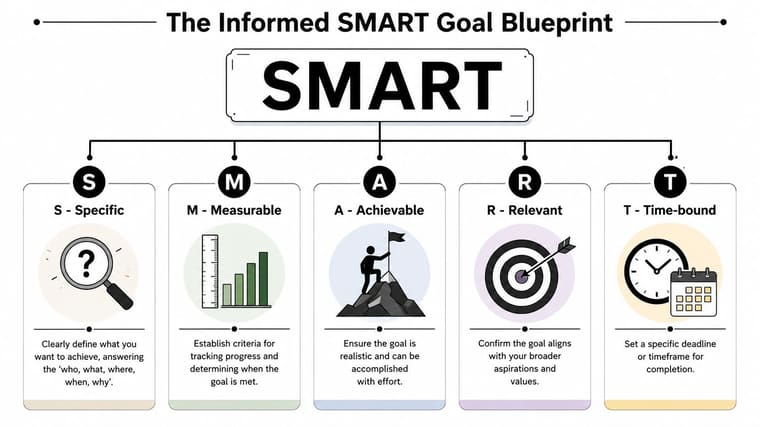
That means your goal shouldn’t come from wishful thinking alone. It should come from information you already have, such as:
- Recent grades: Which assignments went well, and which ones dropped your average?
- Teacher feedback: Are you losing points for weak evidence, rushed work, missed directions, or inconsistent attendance?
- Your patterns: Do you do better in the morning, under structure, with a study group, or after practice problems?
- Available support: Tutoring, office hours, peer notes, writing centers, review sheets, or online practice tools.
A student who scored poorly because they misunderstood the exam format needs a different goal than a student who understood the format but never studied consistently. “Do better” is too vague for both.
A student version of SMART
Here’s a plain-language way to make SMART work.
S is for Specific.
Name the class, skill, or task. Not “get better at science.” Try “improve my lab report conclusions in chemistry.”
M is for Measurable.
Choose a sign that tells you whether you’re improving. That might be completing all assigned problem sets, turning in every draft on time, or raising scores on one type of quiz.
A is for Achievable. Here, honesty matters. If you haven’t studied outside class at all, don’t set a goal that assumes a sudden perfect routine. Stretch yourself, but stay grounded.
R is for Relevant.
Your goal should connect to the “so that” you wrote earlier. If it doesn’t matter to you, it won’t hold up under stress.
T is for Time-bound.
Set a deadline and a review point. A goal with no date becomes a wish.
Reality check: A goal should challenge you, but it should also match the time, energy, and support you actually have.
Here’s a simple comparison:
| Weak goal | Informed SMART goal |
|---|---|
| I want to do better in English | I will raise the quality of my essay evidence in English by meeting my teacher once before the next paper and finishing my outline two days early |
| I’ll stop procrastinating | I will start homework by 7 p.m. on school nights and complete my first work block before checking social media |
| I want to improve in math | I will practice the problem type I missed on the last test for four study sessions before the next quiz |
If you want help shaping your wording, a practical guide to SMART objectives and goals can make this step less abstract.
Use this fill-in template:
- I want to improve ___
- Based on my past work, my main issue is ___
- I will work on it by ___
- I’ll know I’m improving when ___
- My deadline is ___
- This matters to me so that ___
That’s the blueprint. It gives your goal structure without pretending you’re starting from zero context.
Deconstruct Your Goal into Weekly Actions
A strong goal still won’t help if it stays too large. Students often fail here, not because they picked the wrong goal, but because the goal never got translated into a weekly workload.
Turn one big outcome into parts
Evidence from Michigan State University Extension emphasizes that students do better when they write down goals, commit to specific action steps, and create a support network. It also warns that a major failure point is skipping the planning phase where activities, resources, and timelines are identified, as explained in this evidence-based goal achievement guide.
Take a common example: a long research paper.
“Write my paper” is not a task. It’s a stack of tasks hiding under one label. Break it apart:
- Choose and narrow the topic
- Find and save sources
- Read and annotate
- Draft the thesis
- Build the outline
- Write the first section
- Write the middle sections
- Write the introduction and conclusion
- Revise for argument and clarity
- Proofread and format citations
Now the project has shape. You can schedule shape. You can’t schedule dread.
Put the work where your week can hold it
Once you know the pieces, assign them to actual days. Don’t stop at “work on paper Thursday.” Name the action.
A workable weekly plan might look like this:
- Monday: Find three sources and save quotes
- Tuesday: Read one source and write notes
- Wednesday: Draft thesis and bullet outline
- Thursday: Write body paragraph one
- Friday: Meet with teacher or writing center
- Saturday: Revise paragraph and plan next section
Notice what’s missing. There’s no giant five-hour rescue block. Students love to imagine heroic catch-up sessions. Real progress usually comes from smaller sessions you’ll do.
A few methods help:
- Time blocking: Reserve a fixed window for one kind of work. Example: 4:00 to 4:45 p.m. for math review only.
- The Ivy Lee method: Choose the most important tasks for tomorrow and do them in order, one at a time.
- Task pairing: Put a hard task beside a stable routine. Example: review flashcards right after dinner.
If you’re learning a language or another skill that improves through steady practice, it helps to look at examples of structured routines. A daily format like Gaeilgeoir AI shows how small, repeatable sessions can turn a broad learning goal into a plan you can follow.
Here’s the key test for any weekly action list:
| Good weekly action | Weak weekly action |
|---|---|
| Review class notes for 20 minutes and write two questions | Study chemistry |
| Draft the introduction before 6 p.m. | Work on essay |
| Email professor about citation confusion | Fix paper |
The smaller action is not “less serious.” It’s more usable. Students stay on track when the next step is obvious.
Make Your Progress Impossible to Ignore
Students often assume motivation should come first. In real life, motivation usually follows evidence of movement. If you can see progress, you’re more likely to keep going. If your goal disappears into a notebook or a forgotten app folder, your brain starts treating it like optional background noise.

Why visible progress changes behavior
Students do better with cues that stay in sight. A checklist on your desk, a wall calendar, a progress bar on your phone, or a countdown to exam day all serve the same purpose. They reduce the mental effort needed to remember what matters.
This is one reason monitoring matters in school and beyond it. If you want a helpful way to think about tracking outcomes instead of relying on vague intentions, Model Diplomat’s M&E insights offer a useful lens. The language comes from program evaluation, but the core idea applies well to student goals. Decide what you’re tracking, how you’ll notice change, and when you’ll review it.
A simple student tracking system can include:
- One visible target: next exam, draft, portfolio submission, or attendance goal
- One progress measure: sessions completed, pages drafted, chapters reviewed, or practice sets finished
- One review moment: every Sunday evening or every Friday after class
If progress is visible, it’s easier to restart after a bad day.
Use your phone as a cue not a distraction
Your phone can pull attention away from your goals, but it can also bring them back into view. The tool matters less than the placement. What you want is a reminder that appears without requiring effort.
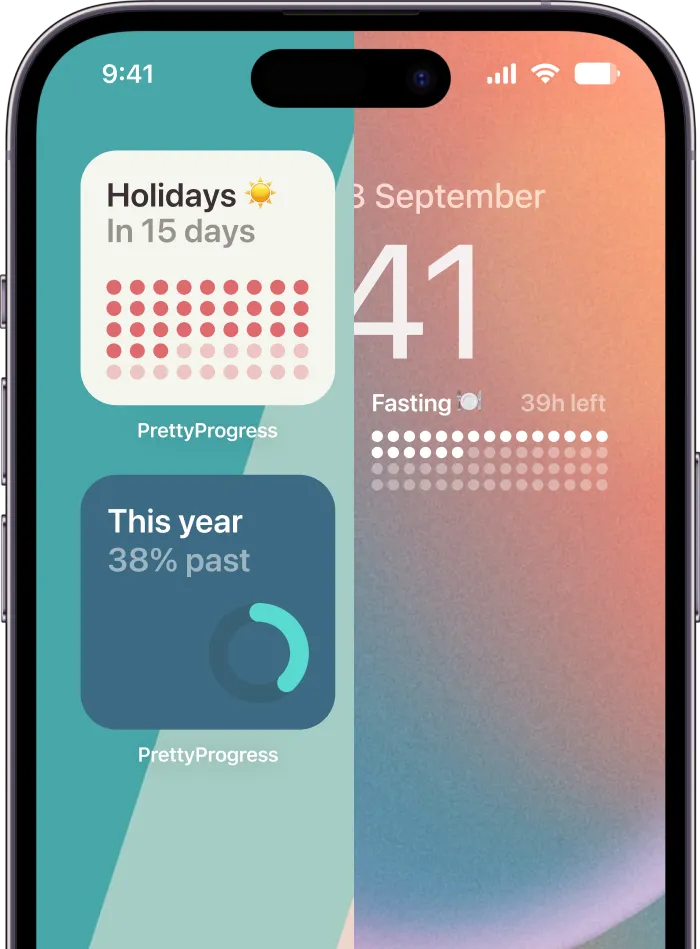
Some students use a paper planner. Some use Apple Calendar or Google Calendar. Some use widgets that keep a deadline or progress bar on the Home Screen or Lock Screen. Pretty Progress is one option for this. It lets students create countdown and progress widgets for deadlines, exams, and longer-term goals across devices, so the timeline stays visible during everyday phone use.
A short demo makes the idea concrete:
The best visible tracker is the one you’ll glance at. If you always check your phone before class, put the reminder there. If you always sit at a laptop, put the deadline where it shares your screen space. Don’t hide your goal in a place you only visit when you’re already behind.
Navigate Common Goal-Setting Pitfalls
Students often think the problem is discipline. Sometimes it is. More often, the problem is that the goal was built in a way that made follow-through unlikely from the start.
When the goal is too big
A common pitfall is choosing goals that are too lofty, which can lead to discouragement. A better approach is to break large goals into smaller milestones and measure success as progress, not perfection, as advised in this Harvard Summer School article on student goals.
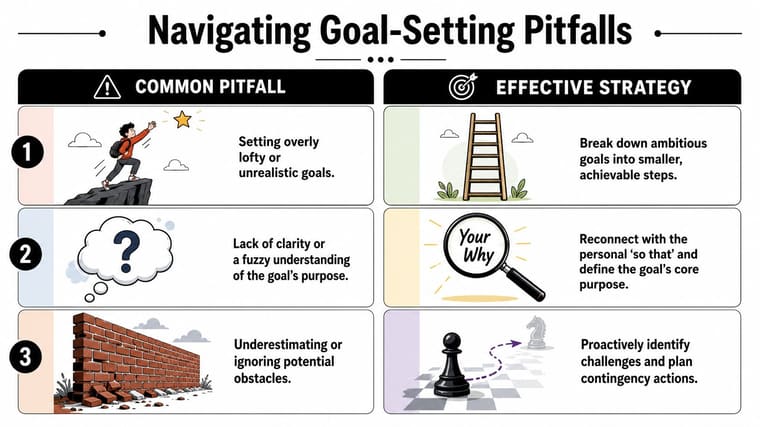
If your goal sounds like a complete identity transformation, it’s probably too big for a starting point.
Compare these:
-
Too big: I’m going to become a straight-A student this term.
-
More workable: I’m going to submit every history assignment on time this month.
-
Too big: I’ll never procrastinate again.
-
More workable: I’ll start my hardest task before dinner on weekdays.
-
Too big: I’m going to master calculus.
-
More workable: I’m going to fix the three problem types I missed on the last quiz.
When life interrupts the plan
You will fall behind sometimes. Students get sick, work extra hours, lose focus, misjudge how long assignments take, or hit an emotionally rough week. Falling behind does not mean the goal was fake.
When that happens, ask three questions:
- What still matters most? Keep the core outcome in view.
- What can I shrink? Reduce the size of the next step, not the seriousness of the goal.
- Who can help? A teacher, advisor, classmate, tutor, or family member can often help you restart faster.
Here’s a quick recovery table:
| Problem | Better response |
|---|---|
| Missed two study sessions | Reschedule one short session today and one tomorrow |
| Bombed a quiz | Review the error pattern before deciding you’re “bad” at the subject |
| Lost motivation | Re-read your “so that” and choose one small action that fits today |
| Got overwhelmed | Turn the goal back into the next visible step |
Missing a step is normal. Quitting the system after one miss is what creates the bigger setback.
A resilient student isn’t someone who never struggles. It’s someone who knows how to adjust without turning one bad week into a bad semester.
Your Journey Starts with a Single Step
Goal setting for students works when it becomes a living system, not a motivational speech you gave yourself once. Start with a goal that matters to you. Add the “so that” so your effort has a reason. Build the goal from real information about your current performance. Turn it into weekly actions. Keep the progress where you can see it. Adjust when life gets messy.
That’s enough. You don’t need a brand-new personality. You need a repeatable process.
If you’re unsure where to begin, choose one goal for the next two weeks. Not five goals. One. Maybe it’s attending every class, finishing one essay early, or reviewing notes after each lecture. Write it down today. Add your “so that.” Put the first action on your calendar. Then start before you feel fully ready.
If you want a simple visual way to keep deadlines and progress in front of you, Pretty Progress can help by turning your phone, tablet, watch, or computer into an always-visible countdown or progress tracker for exams, assignments, and personal goals.