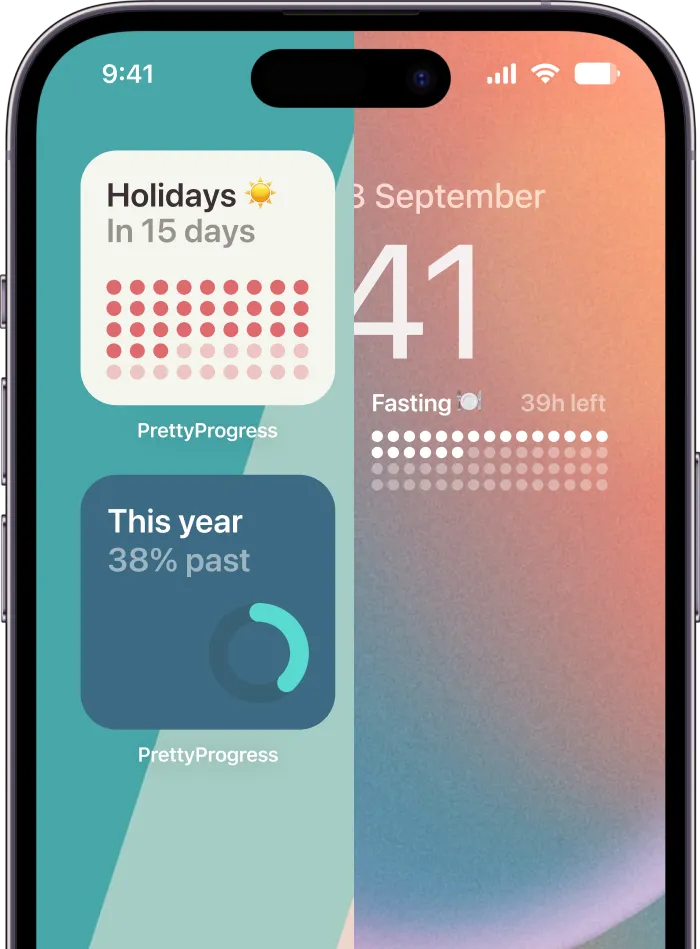

July 8, 2026
Collaborative Goal Setting: A Practical Team Framework
Master collaborative goal setting with our step-by-step framework. Learn to align stakeholders, create shared goals, track progress, and drive team success.
You probably know the pattern. A team leaves a planning meeting with a polished set of goals, everyone nods, the doc gets shared, and then real work starts. By the third week, delivery pressure takes over, updates get skipped, priorities drift, and nobody is fully sure which goal still matters most.
That failure usually isn’t about bad intent or weak ambition. It’s operational. Teams spend too much time on wording and not enough on the mechanics that keep a shared goal alive: alignment before drafting, ownership after drafting, a weekly rhythm, visible progress, and a way to handle conflict when people want different things.
Most advice on collaborative goal setting stops at frameworks like SMART goals or OKRs. Those are useful. They’re not enough. Teams need working rituals, clear escalation rules, and constant visibility so goals stay present inside daily work instead of living in a forgotten planning file.
Table of Contents
- Why Most Team Goals Quietly Fail
- Phase 1 Aligning Stakeholders and Priorities
- Phase 2 Co-Creating Meaningful Goals
- Phase 3 Defining Ownership and Measurable KPIs
- Phase 4 Building Cadence and Visualizing Progress
- Conclusion From Plan to Persistent Practice
Why Most Team Goals Quietly Fail
Teams rarely fail because they didn’t care. They fail because the goal was agreed to on paper, not in practice. One function thought the goal meant speed, another thought it meant quality, and a third assumed the actual priority would surface later.
That gap between intended collaboration and actual collaboration shows up well outside business. In a BMJ Open study of 341 patient-provider dyads, only 26.4% agreed their appointment involved high-quality shared decision-making. The lesson transfers cleanly to team planning: people can sit in the same conversation and still leave with very different views of what was decided.
When I look at failed team goals, the pattern is usually simple:
- Planning was representational: Leaders asked for input, but the final choice had already been made.
- Goals were too abstract: People heard “improve onboarding” or “increase quality,” but nobody knew what trade-offs those phrases required.
- No operating rhythm existed: The team had a kickoff, not a system.
- Conflict stayed underground: People avoided hard priority calls because they wanted harmony in the room.
Practical rule: If a team can’t name the trade-off behind a goal, the goal isn’t ready.
This is why so many goal systems decay. The wording might look solid, but execution falls apart because ownership, visibility, and escalation were never built in. If you’re working through addressing common OKR pitfalls, you’ll recognize the same failure mode: teams often don’t need better slogans, they need better operating rules.
A lot of the damage also starts earlier than people think. Teams make avoidable errors in scope, ownership, and measurement before they even begin tracking. This breakdown shows up in many of the most common mistakes in goal setting, especially when goals are drafted in isolation and revealed later.
Collaborative goal setting works when the process creates real commitment, not ceremonial agreement. That means surfacing hidden priorities early, translating ambition into concrete language, and building a rhythm that survives a busy week.
Phase 1 Aligning Stakeholders and Priorities
The strongest goal-setting sessions start before anyone writes a draft objective. First, get the right people in the room and make priorities visible. Otherwise, the team will argue about wording when the underlying issue is competing mandates.
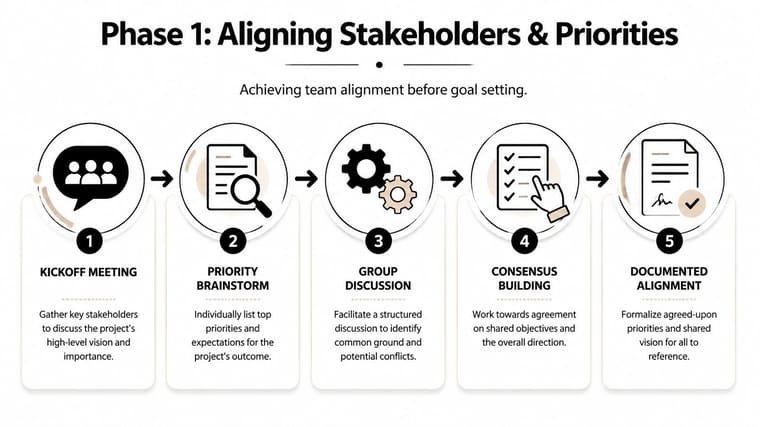
Start before the goal draft exists
A good alignment pass is small and direct. Bring in the decision-maker, the people doing the work, the teams affected by the outcome, and any stakeholder who can block progress later. If someone can veto the plan, they belong in the alignment step, not in a surprise review two weeks later.
Ask each person to answer four questions in writing before the meeting:
- What outcome matters most to your team
- What risk are you trying to avoid
- What would make this initiative feel successful
- Which existing commitment could conflict with it
Written pre-work matters because it stops the loudest voice from setting the frame too early. It also gives you a way to compare priorities before the discussion turns political.
Use a conflict-first workshop
Teams often waste time trying to sound aligned. A better approach is to surface friction immediately. One useful way to run the workshop is:
- Open with business context: State the decision window, the constraint, and what this initiative can’t do.
- List mandatory considerations: Compliance, launch timing, staffing realities, customer commitments.
- Map competing priorities: Put speed, quality, revenue impact, technical debt, and stakeholder risk on the board.
- Force ranking: Ask each stakeholder to rank top priorities individually before discussing them.
- Document the trade-off: Write down what the team is choosing and what it is intentionally not optimizing.
That last step is where alignment becomes real. A team might decide, for example, that the current cycle prioritizes adoption over polish, or retention over net-new features. Once that’s written down, later debates get easier because the strategic context is already visible.
A future-dated meta-analysis cited in the brief notes that 41% of collaborative goal-setting sessions resulted in unresolved priority conflicts, and those conflicts were tied to three times higher project abandonment rates. The exact takeaway isn’t that conflict is bad. It’s that unresolved conflict is expensive.
“If two leaders leave the room with different assumptions about what comes first, the team inherits the argument.”
I’ve found that a simple priority conflict matrix helps. Put each proposed priority against three filters: strategic importance, team capacity, and dependency risk. Then discuss where scores diverge. The matrix doesn’t remove disagreement, but it stops people from disguising preference as fact.
Use this checkpoint before moving on:
| Decision check | What good looks like |
|---|---|
| Shared outcome | Everyone can describe the same end state in plain language |
| Known trade-off | The team has named what it will deprioritize |
| Stakeholder coverage | No critical approver is missing |
| Conflict handling | Disagreements are written down, not buried |
| Working constraint | Time, scope, or resource limits are explicit |
If this phase feels slow, that’s normal. It’s still faster than discovering in week five that product, sales, and operations were each pulling toward a different result.
Phase 2 Co-Creating Meaningful Goals
Once priorities are aligned, the team can write goals together. At this stage, many groups slip back into bad habits. They brainstorm broadly, produce vague language, and then call it collaboration because everyone got to add sticky notes.
That isn’t enough. The goal has to be precise enough to guide decisions under pressure.

A meta-analysis on group goal setting found that specific, difficult goals lead to significantly increased group performance compared with nonspecific or easy goals, and that effect was not significantly changed by task complexity or participation level. That matches what strong teams already know. Stretch matters, but fuzziness kills execution.
Turn broad intent into a sharp objective
Start with the broad theme from Phase 1, then tighten it. Don’t ask, “What should our goal be?” Ask, “What result would prove this priority moved?”
Here’s the difference in practice:
-
Weak: Improve marketing
-
Better: Improve lead quality from the website
-
Useful: Increase lead-to-customer conversion rate
-
Weak: Make onboarding better
-
Better: Reduce friction in first-week setup
-
Useful: Increase the share of new users who complete setup milestones
The exact target number depends on your team’s real baseline and constraints. If you don’t have reliable baseline data yet, don’t invent precision. Write the outcome clearly first, then add the metric once the team confirms it can measure it.
Write goals the whole team can actually use
A collaborative writing session works best when it separates divergence from convergence.
Use this sequence:
- Silent drafting first: Give everyone a few minutes to write one proposed objective and a few candidate measures.
- Read drafts aloud without debate: This keeps early discussion from collapsing around the first senior opinion.
- Cluster similar ideas: Group drafts that aim at the same outcome, even if the wording differs.
- Test each draft against real work: Ask what the team would stop, start, or change if this became the priority.
- Choose one working version: Refine it until people can use it in day-to-day decisions.
A good goal survives contact with operational questions. If engineering, sales, design, and support each hear a different instruction in the same sentence, the sentence still needs work.
One reason I like collaborative workshops is that they expose language problems fast. Someone will say “customer success” and mean retention. Someone else will mean activation. Someone else will mean faster support response. That tension is useful. It helps the team stop pretending a broad phrase is aligned.
The practical side of this is often more important than the template. SMART goals and OKRs can both work. What matters is whether the goal is meaningful, shared, and specific enough to steer behavior. If you want a clean refresher on structuring goals after the workshop, this guide to SMART objectives and goals is a useful companion.
Behavior in the room also matters. Teams get better results when facilitators create balanced participation instead of rewarding speed and confidence. Some of Synopsix’s insights into team behavior line up well here, especially around how collaboration improves when people have room to contribute before the group locks onto a single answer.
Here’s a fast quality filter for every draft goal:
Workshop test: Can the team explain why this matters, who it affects, and how progress will be recognized?
If the answer is no, the draft is still a theme, not a goal.
A short video can also help if your team needs a reset on writing stronger collaborative goals before the live workshop:
Phase 3 Defining Ownership and Measurable KPIs
A shared goal still needs a clear owner. Not because one person does all the work, but because one person keeps the work from becoming everybody’s side job.
Often, many collaborative goal-setting efforts become strangely vague. Teams say they want shared accountability, then avoid assigning direct responsibility because they don’t want to appear controlling. The result is predictable: updates slip, decisions stall, and everyone assumes someone else is watching the metric.
Ownership removes ambiguity
Ownership needs to be specific at two levels. First, one person owns the objective. Second, each measurable result also has a named owner when different functions influence different parts of delivery.
The data on failed systems is blunt. According to Microsoft’s guidance on healthy OKR programs and common pitfalls, among teams that abandoned OKRs, 35% blamed low engagement and 24% cited no clear ownership. The same guidance notes that effective frameworks usually limit goals to 3 to 5 per team and require named owners and regular check-ins.
That last point matters more than many teams admit. When everything is a priority, nothing gets proper attention.
A collaborative goal can be shared. The accountability for moving it forward cannot be anonymous.
Pick KPIs that help decisions
A useful KPI changes what the team does next. A vanity metric creates activity without helping anyone decide.
Good KPIs have a few practical traits:
- Available: The team can pull the data without heroic manual work.
- Relevant: The metric reflects movement toward the outcome, not just nearby activity.
- Timely: It updates often enough to support adjustment.
- Interpretable: People know what a rise or drop should trigger.
Bad KPI choices usually come from convenience or optics. Teams grab the number that looks impressive, not the one that helps them steer.
Use a simple charter so each goal is documented the same way.
| Objective | Key Result | Owner | Target Metric | Reporting Cadence |
|---|---|---|---|---|
| Improve onboarding completion | Increase completion of the primary setup flow | Growth Lead | Setup completion metric | Weekly |
| Reduce support friction | Lower repeated tickets on top onboarding issues | Support Manager | Repeat ticket trend | Weekly |
| Improve launch readiness | Publish all required enablement assets before release | Product Marketing Manager | Asset completion status | Weekly |
This format is intentionally plain. Fancy templates don’t solve weak ownership. Clear fields do.
One more rule is worth keeping: if a key result has multiple contributors, that’s fine. If it has multiple owners, it usually has no owner. Let others contribute, review, and challenge. But give one person the job of driving updates, flagging risk, and calling for decisions.
Phase 4 Building Cadence and Visualizing Progress
The hardest part of collaborative goal setting starts after the planning session. Teams don’t need more launch energy. They need a rhythm that keeps the goal in circulation when calendars fill up and interruptions pile on.
Cadence is what turns a goal from a quarterly intention into a weekly operating habit.
Build a rhythm people can keep
The weekly check-in is the core ritual. It should be short, regular, and tied to action. If the meeting becomes a presentation, people will start protecting appearances instead of exposing blockers.
A lightweight cadence looks like this:
- Weekly owner update: What changed, what’s blocked, what decision is needed.
- Weekly team review: Are we on track, at risk, or off track.
- Monthly deeper review: Check whether the goal still reflects current reality or needs adjustment.
- End-of-cycle retrospective: Keep, change, drop.
External accountability helps more than often realized. In Quire’s write-up on collaborative goals, people who wrote down goals and sent weekly progress notes to a friend achieved a 76% success rate, compared with 43% for those who only thought about their goals without external accountability, as described in Quire’s collaborative goals article. The exact setup won’t map perfectly to every team, but the operational lesson is clear: goals stay alive when progress is reported on a cadence.
You don’t need a big system to create that. A shared dashboard, a recurring update thread, or a simple scorecard in Google Sheets can work if the team looks at it. If your team runs a lot of work through Google tools, this piece on Google project management setups from Tooling Studio offers practical ways to keep project tracking visible without adding heavyweight software.
Visibility changes behavior
A goal that lives in a slide deck won’t shape daily choices. People need to see progress often and without effort. That’s where dashboards, pinned scorecards, status boards, and progress widgets do their job.
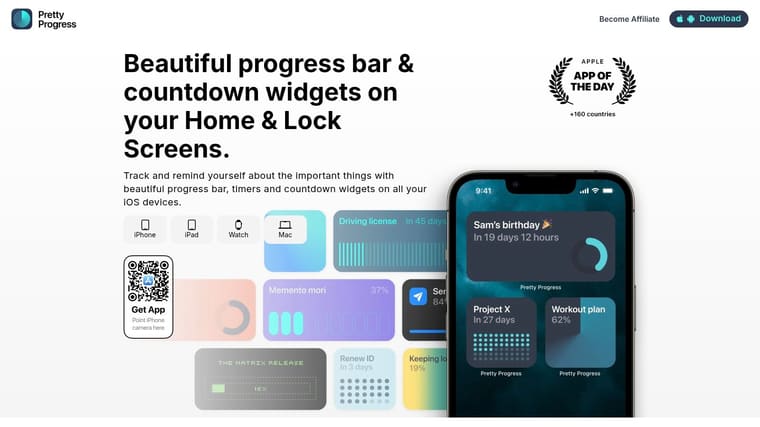
Visibility matters because attention is limited. When progress is glanceable, people reconnect the goal to the work in front of them. When progress is buried, the goal becomes abstract again.
I prefer visibility tools that answer three questions at a glance:
| Question | What the team should see |
|---|---|
| Are we moving | Current status against the chosen metric |
| Where are we stuck | Open blocker or dependency |
| Who acts next | Named owner or next decision-maker |
Teams often underestimate how much motivation comes from simple visual persistence. A progress bar on a dashboard, a widget on a phone, or a shared scorecard on a team screen works because it reduces the effort required to remember what matters. This is the same principle behind a strong progress schedule for longer goals: breaking the journey into visible movement makes follow-through easier.
“If people have to go looking for the goal, they won’t use it to make decisions.”
The best cadence is boring in the right way. It doesn’t depend on enthusiasm. It survives normal weeks, messy weeks, and weeks when the team would rather talk about something else.
Conclusion From Plan to Persistent Practice
Collaborative goal setting works when teams treat it as an operating discipline, not a workshop exercise. The practical sequence is straightforward. Align stakeholders before drafting anything. Co-create goals that are specific enough to guide trade-offs. Assign ownership so progress has a driver. Then build a cadence and visibility system that keeps the goal active.
What usually breaks isn’t the ambition. It’s the gap between agreement and execution. Teams say yes in the room, then return to separate priorities, separate metrics, and separate definitions of success. That’s why rituals matter. Weekly check-ins, clear owners, visible scoreboards, and documented trade-offs do more than keep a project tidy. They preserve shared meaning.
The messy part is normal. People will disagree on priority, wording, sequencing, and scope. Good collaborative goal setting doesn’t avoid those tensions. It gives teams a way to work through them early, then revisit them without drama when reality changes.
Start smaller than you think. Pick one goal that matters, involve the right stakeholders, write it clearly, name the owner, and make progress visible. If that cycle works, repeat it. Teams build trust in the process by seeing it hold up under real delivery pressure.
Goals don’t stay alive because they were written well. They stay alive because people keep seeing them, discussing them, and acting on them together.
If you want an easy way to keep goals and deadlines visible every day, Pretty Progress is a clean option. It lets you turn milestones into customizable progress bars and countdown widgets on iPhone, iPad, Apple Watch, Mac, and Android, so the goals you care about don’t disappear into a notes app or project doc.