July 6, 2026
Your 2026 Wedding Planning Timeline: Stress-Free Prep
Manage every task with our ultimate wedding planning timeline. Get month-by-month checklists, expert tips, & track progress for a stress-free 2026 wedding.
You’re probably in that weird post-engagement window right now. You’re happy, slightly stunned, texting photos to friends, and then the practical question lands fast: what do we do first?
That question gets loud because weddings create instant decision clutter. Venue, date, guest list, budget, outfits, family opinions, vendor research. It all shows up at once, and most couples respond by opening ten tabs, saving fifty screenshots, and feeling behind before they’ve even picked a season.
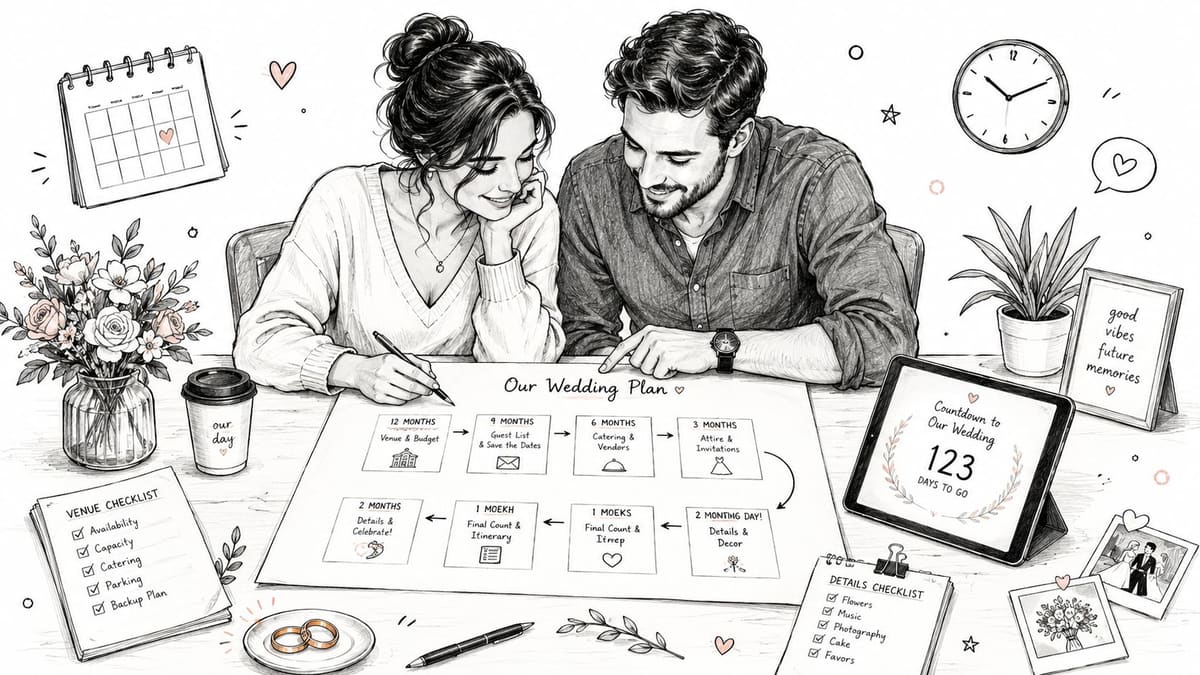
A good wedding planning timeline fixes that. Not by turning your engagement into a project management nightmare, but by giving every decision a place and a deadline. The smartest version of that timeline is visual. You need to see what matters now, what can wait, and what’s already done.
If you want a useful outside reference while you read, this wedding preparation timeline is a solid companion resource. And if you like organizing events with cleaner systems instead of chaotic notes, these event planning best practices are also worth bookmarking.
Table of Contents
- From ‘Yes’ to ‘I Do’ Without the Overwhelm
- Laying Your Planning Foundation in 30 Days
- The Complete 12 to 18 Month Wedding Timeline
- Adapting Your Timeline for Any Horizon
- Mastering the Final 8 Weeks and Your Wedding Day
- How to Track Your Wedding Progress Visually
- Common Timeline Pitfalls and How to Sidestep Them
From ‘Yes’ to ‘I Do’ Without the Overwhelm
Most couples don’t need more inspiration. They need fewer open loops.
The moment you get engaged, people start asking for details you probably haven’t decided yet. When’s the date? Where’s the venue? Are you doing a big wedding or something small? If you answer all of that too early, you’ll make rushed choices. If you avoid it completely, the whole thing starts to feel shapeless and stressful.
The fix is simple. Stop treating wedding planning like one giant list. Treat it like a sequence. One phase leads to the next.
The real job is reducing decision load
You do not need to pick flowers, cake flavors, and table numbers in week one. You need a planning foundation. That means deciding what kind of wedding you’re building, what matters most, and how you’re going to keep track of progress without turning your Notes app into a crime scene.
Practical rule: If a task doesn’t affect your date, venue, budget, or guest count yet, it probably doesn’t belong at the top of your list.
A strong wedding planning timeline does more than assign dates. It protects your attention. It prevents random tasks from hijacking the big decisions.
A visual timeline calms people down fast
This is especially true if traditional checklists make you freeze. Lots of couples don’t need a stricter spreadsheet. They need a cleaner way to see milestones, dependencies, and what’s already finished.
That’s why I recommend thinking visually from the start. Use a timeline you can glance at. Break work into small milestones. Mark complete items aggressively. Progress lowers stress because it replaces vague panic with visible movement.
Your engagement should feel organized, not clinical. Structured, not rigid. If your system makes you feel guilty every time you look at it, it’s the wrong system.
Laying Your Planning Foundation in 30 Days
The first month decides whether the rest of your wedding planning timeline feels smooth or constantly reactive.
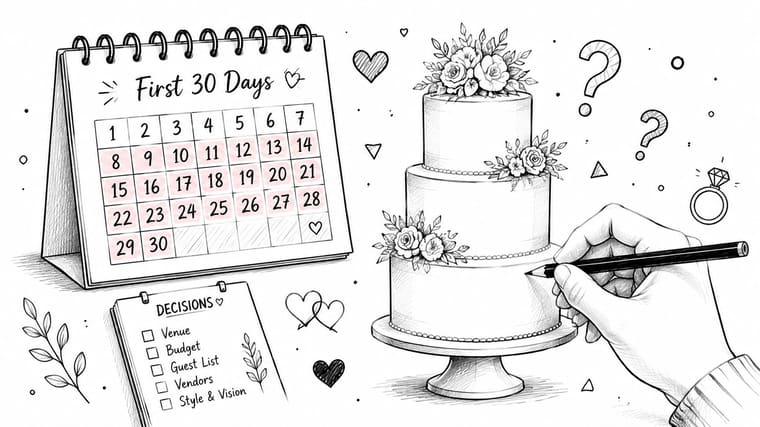
Don’t waste it on tiny decorative choices. Use it to lock the four things that shape everything else: vision, budget, guest count, and planning style.
Start with three decisions only
First, define the kind of day you want. Formal city wedding? Relaxed garden party? Destination weekend? Tiny dinner with your closest people? If you skip this step, every vendor conversation gets harder because you’ll be reacting instead of choosing.
Second, set a real budget. Not a fantasy number. Not a vague range. Decide what you can spend, who’s contributing, and which categories deserve the biggest share. If photography matters more than floral design, say that now.
Third, draft your first guest list. It doesn’t need to be perfect. It does need structure.
Use three buckets:
- Must invite: Immediate family, closest friends, essential people.
- Would love to invite: People you care about if space and budget allow.
- Nice in theory: The people who make the list swell for no good reason.
This one move saves a huge amount of frustration later because venue options, catering style, and invitation planning all depend on headcount.
Build a planning system that fits your brain
Most wedding advice assumes you love linear checklists. A lot of people don’t.
That gap matters because most wedding planning timelines fail to address ADHD-friendly or neurodivergent planning structures, which is urgent as 30-40% of couples report heightened stress that impairs executive function according to this wedding planning discussion on Reddit. The useful takeaway isn’t just the number. It’s the planning method. Couples often need flexible, visual, milestone-based systems, plus bite-sized tasks and countdowns, instead of one long monthly checklist.
If that sounds like you, stop forcing yourself into a system that only works for people who enjoy administrative sequencing.
Try this instead:
- Choose weekly themes: One week for venue research, one for photographer outreach, one for attire.
- Use task sizes on purpose: Make some tasks tiny. “Shortlist three venues” beats “figure out venue.”
- Create visible finish lines: A checklist with no celebration built in is a motivation killer.
- Keep one dashboard only: Don’t split tasks across texts, email flags, screenshots, and paper notes.
Small tasks aren’t a sign you’re doing less. They’re a sign you’re building a system you’ll actually use.
Your first month isn’t about doing everything. It’s about building a wedding planning timeline that your real life can support.
The Complete 12 to 18 Month Wedding Timeline
If you have the runway, use it. A longer engagement gives you better vendor choices, more room for custom details, and fewer panic decisions.
Most couples plan their wedding over an average timeline of 18 months, and that longer window matters because top venues often need to be booked 12 to 18 months ahead, high-priority vendors like photographers and caterers usually need 9 to 12 months, save-the-dates for standard weddings go out 6 to 8 months before, formal invitations are typically mailed 4 to 6 months before, and RSVP deadlines are usually set 3 to 4 weeks before the wedding, according to Zola’s ultimate wedding planning checklist.
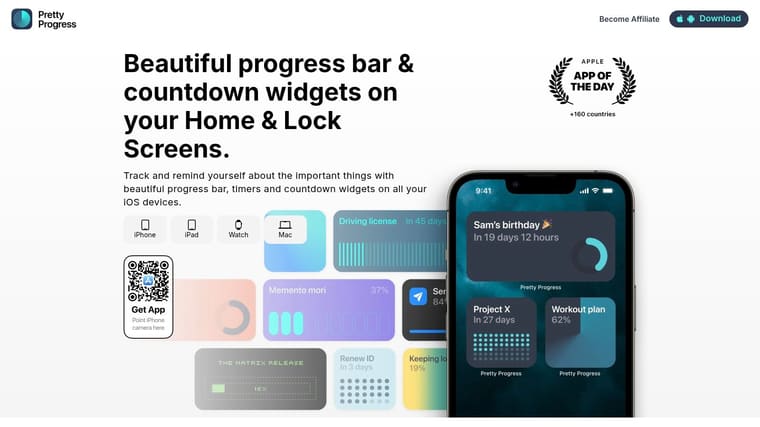
Near the start of this planning stretch, a visual dashboard helps a lot.
12 to 18 months out
This phase is about the architecture of the wedding. Big choices first.
- Set the date range: Pick a season and a few acceptable dates, not one inflexible dream date.
- Book the venue: This is the anchor decision. Once it’s locked, everything else gets easier.
- Set the budget framework: Decide what categories matter most before deposits start flying out.
- Draft the guest count: You don’t need the final number yet. You do need a realistic estimate.
- Choose your key vendors: Photographer, caterer, and entertainment usually deserve early attention.
- Decide the wedding format: Traditional full-day event, destination weekend, private ceremony, or something smaller and more relaxed.
If you’re aiming for a high-demand season, act faster. Peak dates disappear first, and waiting doesn’t make your options better.
9 to 12 months out
This is the booking and confirmation zone. You’re still shaping the event, but now you’re turning ideas into contracts.
Focus on the vendors that affect timeline, guest experience, and availability. That usually means:
- Photography and video
- Catering
- Band or DJ
- Attire shopping
- Rental needs if your venue is a blank slate
- Travel logistics if guests are coming from out of town
This is also a smart point to define your communication setup. Keep one folder for contracts, one for payment dates, and one for guest-facing information. If your systems are sloppy now, the final months will feel much harder than they need to.
Book the vendors that can’t duplicate themselves first. A venue, photographer, or band can only take one wedding date.
6 to 8 months out
Now the wedding starts becoming visible to guests.
This is the standard window to send save-the-dates for most weddings, and it’s also a useful point to build your registry if you’re doing one. If you’re planning a destination wedding or a holiday wedding, guest communication needs to happen earlier because people need time to arrange travel.
Use this phase for:
- Save-the-dates
- Registry setup
- Wedding website details
- Wedding party attire
- Florist and baker booking
- Transportation planning if needed
Many couples often drift into style rabbit holes at this stage. Don’t let stationery fonts eat the time you need for real logistics.
4 to 6 months out
This part of the wedding planning timeline is where guest communication gets more concrete.
Formal invitations usually belong here, along with the practical details people will ask you repeatedly if you don’t write them down somewhere clear. Ceremony timing, dress code, transport notes, accommodation info, registry links, and any special instructions should be easy to find.
Use these months to tighten the plan:
- Mail invitations
- Finalize menu and tasting decisions
- Refine ceremony details
- Confirm music choices
- Schedule attire fittings
- Review vendor contracts for missing details
- Plan signage, printed items, and personal touches
At this point, every task should answer one of two questions: does this improve guest experience, or does it reduce day-of chaos? If the answer is neither, it can wait.
A short visual walkthrough can also help if you want to see how timelines get turned into practical planning flow:
Final month and final weeks
The final stretch is operational. You’re no longer choosing the shape of the wedding. You’re executing it.
Expect these tasks to take more energy than they look like they should:
- Track RSVPs and chase missing replies
- Confirm the final guest count
- Build the seating plan
- Confirm vendor arrival times
- Prepare final payments and tips
- Create a day-of timeline
- Pack personal items, attire, and emergency basics
This is also where couples tend to underestimate how many mini-decisions remain. Song cues, who holds the rings, where gifts go, who has the marriage license, who brings decor, who returns rentals. Tiny gaps become real stress points if no one owns them.
The best approach is boring and effective. Put everything in writing, assign each task to one person, and assume nobody remembers verbal instructions.
Adapting Your Timeline for Any Horizon
Not everyone has a long engagement. That’s fine. A shorter wedding planning timeline doesn’t mean a worse wedding. It means you need sharper priorities and fewer optional complications.
This matters even more now because micro-weddings under 50 guests account for 25% of all weddings in 2024–2025, and those events often need a 3 to 6 month planning horizon with a different vendor order than a large traditional wedding, according to this micro-wedding planning guide.
Wedding Timeline Milestone Comparison
| Milestone | 18-Month Timeline | 12-Month Timeline | 6-Month Timeline |
|---|---|---|---|
| Vision and budget | Start immediately and refine slowly | Start immediately and lock quickly | Decide in the first week |
| Venue | Book early for best choice | Book fast with backup dates ready | Take what fits your priorities and availability |
| Guest list | Build in layers | Draft early and trim sooner | Keep it tight from day one |
| Key vendors | Space bookings across months | Book in focused batches | Contact top choices immediately |
| Save-the-dates | Use the standard schedule if needed | Use only if helpful | Skip if the timeline is too short |
| Invitations | Standard mailing window | Standard mailing window with less slack | Send as soon as the details are stable |
| Decor and extras | Add selectively over time | Keep a shortlist | Cut anything that creates admin without impact |
The 6 month sprint
A six month plan works best when you stop pretending it’s an eighteen month plan.
Keep your priorities tight. Venue, photographer, food, attire, invitations, and the actual ceremony matter most. Favors, custom signage, elaborate guest welcome boxes, and fifteen layers of decor do not.
Use this filter for every decision:
- Must book now: Venue, officiant, photographer, food, music.
- Can simplify: Flowers, cake design, wedding party outfits, printed extras.
- Can skip: Anything that only exists because you saw it online.
A six month timeline rewards decisiveness. You don’t have time for endless comparison shopping.
The 3 month whirlwind
This is not the season for perfectionism. It’s the season for clarity.
If you’re planning in three months, choose a venue that already solves multiple problems. A restaurant with a private room, a boutique hotel, a small event space with in-house food, or a venue with built-in tables and staffing will save you major stress.
Your strategy should be ruthless:
- Cut guest count fast
- Choose one location if possible
- Use digital communication where appropriate
- Rent or buy off-the-rack attire
- Say no to DIY projects unless they’re easy
The shorter the timeline, the more every extra choice costs you.
The micro wedding plan
Micro-weddings need a different logic. A smaller guest count changes what matters.
When fewer people attend, guest experience becomes more intimate and personal. That often means better food, stronger photography, a more meaningful ceremony setup, and less interest in banquet-style production. In other words, book the vendors who shape memory and atmosphere, not the ones that only support scale.
For a micro-wedding, I’d prioritize:
- A beautiful, manageable venue
- A photographer you love
- Excellent food and drink
- Simple floral choices
- A short, clean timeline
I’d deprioritize large rental packages, oversized entertainment setups, and complex room flips unless you specifically want them.
The biggest mistake couples make with smaller weddings is trying to imitate a large wedding in miniature. Don’t. A micro-wedding should feel intentional, not reduced.
Mastering the Final 8 Weeks and Your Wedding Day
The last eight weeks feel different from the rest of planning. The work gets smaller, more specific, and much less forgiving. A missed email now matters more than a delayed mood board ever did.
This is the point where couples start saying, “We’re almost done,” while privately shouldering the most mental load of the whole engagement.
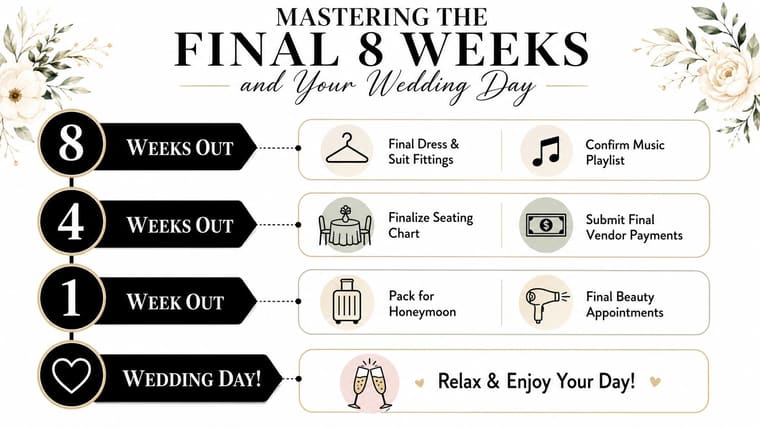
What matters at 8 weeks and 4 weeks
At around eight weeks out, focus on anything that still needs adjustment time. Final fittings. Music decisions. Menu details. Ceremony wording. Small logistics that can still be fixed without drama.
Then the four-week mark hits, and the wedding starts becoming a real operations plan.
Handle these items early:
- Finalize the seating chart: If you want a cleaner way to move guests around and test layouts without rewriting everything by hand, a digital wedding seating chart tool is useful.
- Prepare final payments: Put envelopes, transfer dates, and responsible names in one place.
- Confirm vendor details: Arrival times, load-in instructions, contact person on site, and final deliverables.
- Lock the timeline: Ceremony start, first look if you’re doing one, family photos, travel windows, meal timing, speeches.
The seating chart always takes longer than couples expect because it’s part logistics, part diplomacy. Start before you feel ready.
The last week and the wedding day
The final week should not be packed with creative decisions. If you’re still debating decor concepts or rewriting the schedule, you waited too long.
Pack what needs to move with you. Attire. Accessories. Marriage license. Vows. Overnight bag. Vendor tips. Emergency kit. Honeymoon basics if you’re leaving right after. Give one trusted person a master copy of the plan so you’re not the only brain holding the event together.
One day-of rule is not optional. Build a 25% time buffer into hair and makeup. Wedding planners recommend this because delays during prep create a chain reaction that can cut portraits, first look time, or calm breathing room before the ceremony, as explained in Eventors’ guide to wedding timeline essentials.
If hair and makeup runs late, photography gets squeezed first. That’s how a whole day starts feeling rushed.
Also, feed people. Water, snacks, actual lunch if the schedule is long. Hungry wedding parties become slow wedding parties, and slow wedding parties wreck timelines.
On the wedding day, your job is not to monitor every moving piece. Your job is to show up prepared enough that you can let go.
How to Track Your Wedding Progress Visually
A wedding planning timeline works better when it lives somewhere you’ll see it.
Most couples build systems they have to remember to open. That’s the flaw. If your timeline is buried in a spreadsheet, hidden in a folder, or trapped in an app you only check when stressed, it won’t guide your decisions day to day.
Turn the date into visible momentum
The easiest way to stay steady is to make progress glanceable. Put the wedding date where you’ll see it often, then break the full timeline into smaller visible checkpoints.
That means tracking more than one thing:
- the wedding date
- the next vendor payment
- the next fitting
- invitation mailing
- RSVP deadline
- honeymoon planning if you’re doing it
- any personal goals tied to the event, like finishing DIY projects early instead of at midnight
This is why visual progress tools are so helpful for planning. They reduce friction. You don’t have to mentally reconstruct the timeline every time you check in.
If you want a good companion read on structuring schedules visually, this progress schedule guide is useful.
Use separate trackers for sub goals
Don’t keep one giant “wedding” tracker and hope that’s enough. Split the experience into sub-goals with clear endpoints.
For example:
- Planning tracker: Engagement date to wedding date
- Paperwork tracker: Invitation design to RSVP close
- Attire tracker: Purchase date to final fitting
- Payments tracker: Deposit paid to final balance complete
- Travel tracker: Booking complete to departure date
That setup is cleaner than one overloaded checklist because each tracker tells you something different. One shows overall momentum. Another shows urgency. Another catches slippage before it becomes a problem.
A lot of modern planning advice for events now leans this way because visual systems are easier to maintain than sprawling task documents. If you want a broader perspective on digital planning workflows, this 2026 event planner guide offers practical ideas you can adapt.
The best visual system is the one that lowers anxiety on contact. If looking at your wedding tracker makes you feel more focused in under a minute, you built it right.
Common Timeline Pitfalls and How to Sidestep Them
Even a strong wedding planning timeline can wobble. That doesn’t mean you’re failing. It means you need a reset, not a spiral.
You’re behind on multiple tasks
Symptom: You keep moving tasks to “next week.”
Diagnosis: Your list is too large or too vague.
Prescription: Shrink every stalled task. “Book photographer” becomes “email top three photographers.” “Fix guest list” becomes “cut ten maybes.” Momentum returns when the next step is obvious.
A vendor goes quiet
Symptom: You’ve sent follow-ups and still don’t have what you need.
Diagnosis: You’re relying on goodwill instead of deadlines.
Prescription: Send one concise message with the exact outstanding item and a clear response date. If the silence continues, activate your backup option fast. Don’t waste emotional energy hoping responsiveness will suddenly improve.
Your budget starts creeping
Symptom: Every small upgrade seems reasonable on its own.
Diagnosis: You’re making category decisions without reviewing the whole picture.
Prescription: Freeze optional add-ons for a few days. Re-rank your top priorities with your partner and cut anything that doesn’t support those priorities. A wedding feels cohesive because of good choices, not endless extras.
You and your partner keep hitting decision fatigue
Symptom: Simple choices turn into tired debates.
Diagnosis: Too many decisions are being made in random moments.
Prescription: Batch decisions. Hold one short planning session for music, one for guest logistics, one for decor. Shared focus beats constant low-grade discussion. This kind of structured batching is also what makes an event planning timeline easier to follow in real life.
You do not need a flawless engagement. You need a system that catches problems before they turn into chaos.
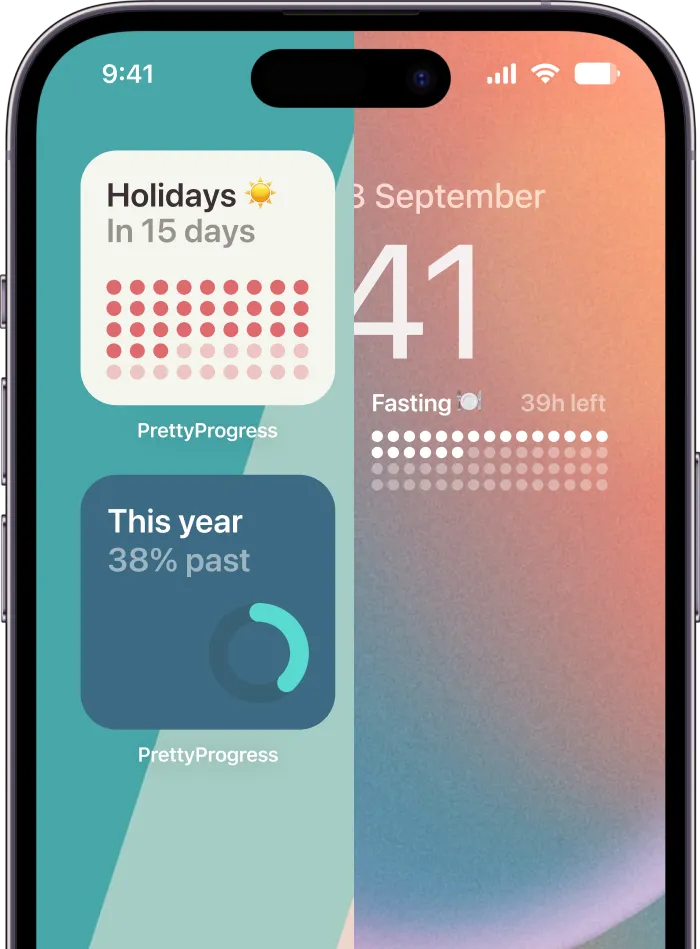
If you want your wedding deadline, vendor dates, RSVP milestones, fittings, and honeymoon prep to stay visible without living in a spreadsheet, try Pretty Progress. It turns big dates and sub-goals into clean visual countdowns and progress bars, so your wedding planning timeline feels manageable every time you glance at your screen.