
August 4, 2026
Growth Mindset Development: A Practical 30-Day Plan
Build a real growth mindset development practice in 30 days. Step-by-step exercises, reframing tools, habit tracking, and what actually works.
You’re staring at a task you keep postponing. Maybe it’s the presentation that makes you feel exposed, the course module that exposes gaps, or the feedback note you’ve been avoiding because part of you assumes it means you’re just not good at this. That’s the spot where growth mindset development matters, not as a slogan, but as a repeatable practice for how you respond when your competence gets tested.
The problem is that most advice stops at attitude. Real change usually starts when you treat mindset like a behavior system, not a mood. That means noticing the thought, rewriting it into something useful, asking for feedback, and recording what you’ll try next time until the new response becomes more natural than the old one.
Table of Contents
- What Growth Mindset Development Actually Means
- A Quick Self-Assessment of Your Starting Point
- The Core Reframe Exercises You Will Practice Daily
- Wiring the Practice Into a Real Daily Routine
- What Progress Looks Like Across the First 30 Days
- When Growth Mindset Helps and When It Does Not
- Tracking and Visualizing Your Mindset Reps
What Growth Mindset Development Actually Means
A lot of people hit a wall and immediately make it personal. They hear criticism and think, “I’m not cut out for this.” They see someone else improve and assume they’ve been left behind. They stall on a project and decide the stall is proof of their limit.
Growth mindset development is the trained habit of responding differently in those moments. It’s not pretending everything feels easy, and it’s not a personality switch you flip once. It’s a set of reps, noticing the fixed story, reframing it, then taking one better action. That’s closer to how an athlete builds skill than how motivational content usually talks about self-belief.
A useful way to think about it is this, if you want better performance, you need drills, feedback, and a way to see progress. That same logic shows up in practical training guides like the Vanta Sports performance guide, where improvement is treated as something built through structured effort rather than inspiration alone. The mindset work follows the same pattern.
Practical rule: If your thoughts improve but your behavior doesn’t change, you’re not really developing a growth mindset yet. You’re just having a nicer thought.
That’s why the next 30 days should feel a little unglamorous. You’ll do small daily moves, often when you don’t feel like it. Over time, those reps make the response faster, cleaner, and less emotional.
For readers who want to connect this with broader resilience work, the internal guide on resilience building techniques is a helpful companion, because resilience and mindset tend to reinforce each other when the environment gives you enough structure to practice.
A Quick Self-Assessment of Your Starting Point
Before you change anything, get honest about where your current patterns show up. Don’t score yourself like a test. Treat this as a snapshot of how you react under pressure, because your weakest spots are where the daily drills will matter most.
Set a timer for 10 minutes and write fast. Use separate notes for work, relationships, and learning if that helps you see the pattern more clearly. The goal is to spot your default story, not to judge it.
Three zones to inspect
Start with criticism. Then move to comparison. Then look at what happens when you hit friction.
- When I get feedback, my first reaction is often… Do I get defensive, shut down, overexplain, or get curious?
- When someone else succeeds, my first internal story is… Do I feel inspired, threatened, embarrassed, or behind?
- When a project stalls, what do I tell myself about why it stalled?
- Do I hide struggles, or do I share them early enough to get help?
- What do I usually do first when I feel stuck, reread, research, avoid, ask, or quit?
- Which area of my life feels most fixed right now, and what makes it feel that way?
Once you’ve written answers, look for the tone. If your language is full of final judgments, that’s the place to work. If your language already leans toward problem-solving in one area but not another, that’s normal too. Mindsets aren’t all-or-nothing, they shift by skill, setting, and relationship.
You’re not trying to prove you already have a growth mindset. You’re trying to locate where the old script gets loudest so you can build a better response there.
That baseline matters because the rest of the plan should be targeted. Someone who spirals after criticism needs a different emphasis from someone who compares themselves constantly or avoids hard tasks until the deadline is unbearable. The more specific your snapshot, the more useful the next 30 days will be.
The Core Reframe Exercises You Will Practice Daily
This is the center of the whole process. These drills are not affirmations, and they’re not about forcing positive language when nothing has changed. They’re about interrupting a fixed pattern and replacing it with a more useful one that leads to action.
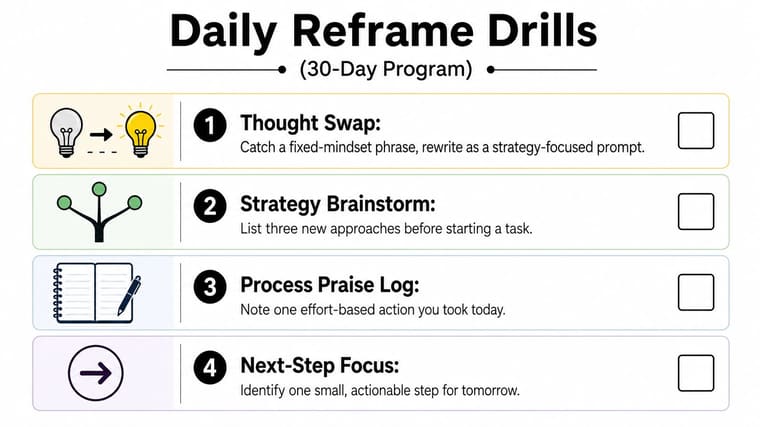
The four daily reps
Thought Swap means catching a fixed-mindset sentence and rewriting it as a strategy sentence.
“I’m bad at this” becomes, “I haven’t found the right approach yet, so tomorrow I’ll try a different method.”
“That feedback means I’m not good enough” becomes, “That feedback shows one place to improve, and I can work on that.”
Feedback Ask means requesting one specific piece of feedback after a meaningful task.
Not “How did I do?” That’s too broad. Ask, “What’s one thing I should keep doing next time?” or “What’s the clearest improvement I can make before my next attempt?” Specific questions pull you out of self-protection and into learning.
Effort Audit means reviewing what worked, what didn’t, and what to change.
Keep it short. One sentence for each. This way, effort stops being a vague virtue and becomes useful information. If you only praise yourself for trying, you miss the chance to improve the next attempt.
Strategy Notebook means recording one tactic adjustment every day.
That can be tiny. “I started with examples instead of definitions.” “I asked for help earlier.” “I practiced in shorter blocks.” The point is to notice that progress usually comes from strategy shifts, not just grit.
A few before-and-after examples make the difference obvious:
-
Before: “I’m terrible at presentations.”
After: “I froze because my opening wasn’t clear, so I’ll script the first 30 seconds and rehearse it twice.” -
Before: “I just need to work harder.”
After: “Effort matters, but this task needs a better plan, so I’ll test a new method before I add more hours.” -
Before: “They’re naturally better than me.”
After: “They may have more reps or better feedback, so I need to study their process and borrow what works.”
These drills work because they keep the mind tied to behavior. A growth mindset shows up when you reframe, seek feedback, revise, and try again with a clearer plan.
Wiring the Practice Into a Real Daily Routine
The fastest way to lose this practice is to leave it floating in your head. It needs cues, a small target, and a place in the day where it’s hard to skip. Habit stacking helps because you attach a new action to something that already happens.
If you want a simple model for building the habit structure, the guide on habit schedule planning is a useful reference point. The key is to make the routine predictable enough that your brain stops negotiating with it.
A sample day you can copy
Use one cue for each drill, and keep the whole thing short.
- After morning coffee: do one Thought Swap.
- After your first meaningful task: write one Feedback Ask question for a coworker, teacher, coach, or peer.
- At the end of the workday or study block: complete a quick Effort Audit.
- Before bed: add one line to the Strategy Notebook.
A micro-goal beats an ambitious plan here. One reframe a day is enough to build consistency. Ten rewrites a day sounds serious, then collapses the moment the week gets busy.
Simple rule: A missed day is data, not proof that you failed.
That matters because all-or-nothing thinking is one of the most common fixed-mindset traps. If you skip Tuesday, don’t turn Wednesday into a guilt spiral. Restart at the next cue and keep the system small enough that returning feels easy.
You can also design the cue with time, place, and trigger in mind. For example, “After I close my laptop at 5:30 p.m., I’ll open my notebook and write one strategy adjustment.” The more exact the cue, the less you rely on willpower. Over time, skipping the drill should feel stranger than doing it.
What Progress Looks Like Across the First 30 Days
The first week often feels mechanical. You catch thoughts you used to ignore, and the new wording can feel a little fake. That doesn’t mean the practice is failing, it means you’re finally seeing the script that used to run automatically.
By week two, one recurring situation usually starts to shift. Maybe it’s how you handle a rough draft, a gym session, or a class assignment. You don’t magically love the struggle, but you stop taking every setback as evidence that you’re done.
The middle stretch is the hardest part
Week three is where many people wobble. Novelty wears off, the checklist feels boring, and the old voice comes back saying none of this matters. That’s normal. Behavior change gets dull before it gets durable.
Week four is where the accumulation becomes visible. You still get frustrated, but your response is less personal and more practical. Instead of collapsing after one bad meeting, you ask what to change, who can help, and what small adjustment comes next.
A useful example is someone training for a fitness goal while also learning a new skill at work. Early on, they keep telling themselves they’re “behind.” Midway through the month, they notice that one warm-up, one feedback request, and one note in the strategy log change how they show up the next day. By the end of the month, the big shift isn’t confidence theater. It’s that they recover faster from a miss and spend less time insulting themselves for having one.
That emotional arc matters because people often quit when the process starts to feel repetitive. Don’t confuse repetition with stagnation. The reps are what make the response more automatic.
When Growth Mindset Helps and When It Does Not
The trade-off is straightforward. Growth mindset development helps most when the setting gives you something real to work with, feedback, instruction, and enough support to practice well. It does not replace those conditions, and it does not fix a weak environment by itself.
Research on context-dependent effects shows that results vary by setting, which is why a mindset shift can feel powerful in one place and flat in another. A large national U.S. study reported stronger effects in some schools and student groups than in others, and the broader question is still whether the same intervention helps every learner in the same way. That is the practical point behind The research summary on context-dependent effects, growth mindset works best as a complement to supportive instruction, not as a substitute for it.
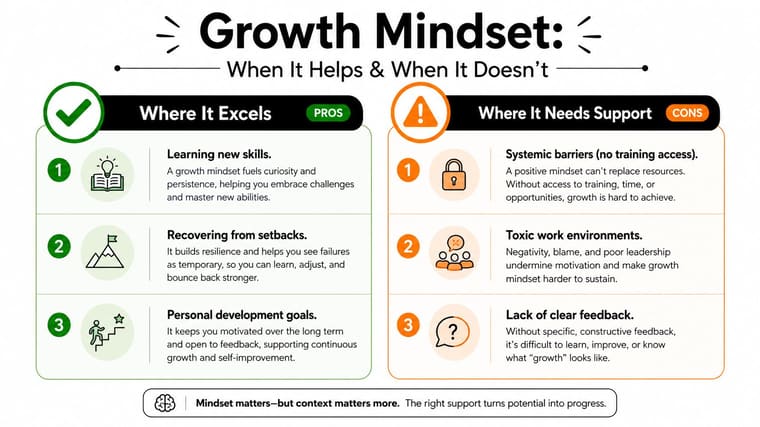
What to rely on, and what not to expect
Use mindset work when you are learning a new skill, recovering from a setback, or trying to stay engaged long enough to improve. It helps most when a coach, teacher, manager, or peer can give specific feedback and normalize the messy part of learning. That combination makes the internal work stick.
Do not expect mindset alone to fix a toxic environment, limited training access, or missing feedback. If the system around you gives no real support, the best inner script in the world will not carry the whole load. In that case, the work is partly internal and partly environmental. Find better feedback, better instruction, or a better container for practice.
A quick audit helps. Ask whether the problem sits mostly in your thinking, your strategy, or your surroundings. If all three are in play, start where the impact is highest and stop blaming yourself for everything at once.
Tracking and Visualizing Your Mindset Reps
Daily drills are easier to keep when the work is visible. A simple log is enough, date, exercise completed, one sentence about what shifted. Review it once a week and look for the patterns that keep pulling you back into the same fixed response.
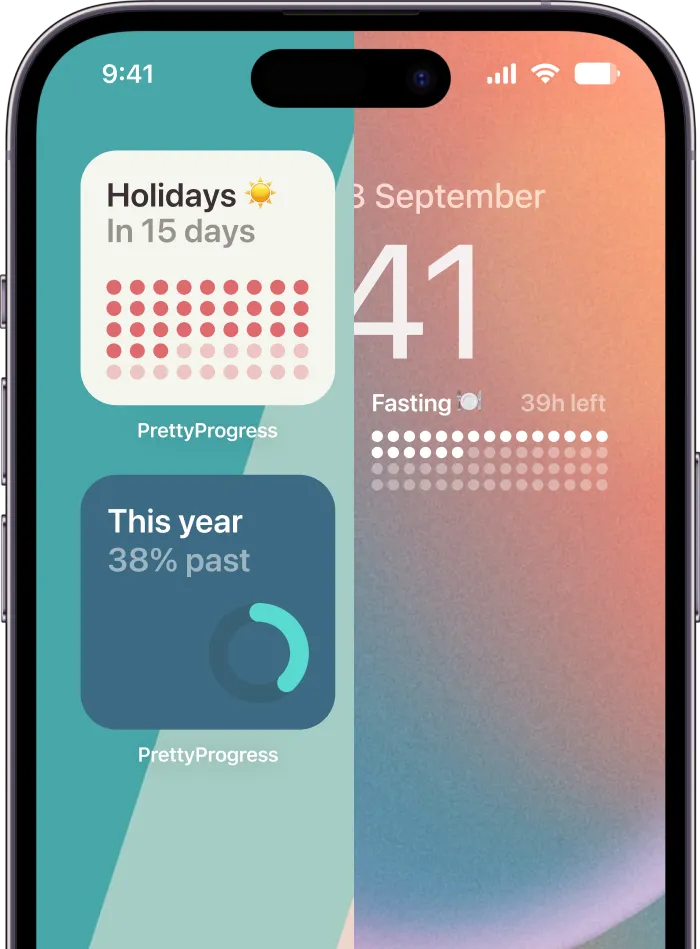
A visual reminder can help even more than a written log. A Lock Screen or Home Screen widget keeps the goal in view without forcing you to remember it every time you pick up your phone. That kind of glanceable cue matters on low-motivation days, because the cue does part of the work for you.
A simple tracking setup
Use three parts:
- Daily log: note the date, the drill you completed, and one line about what changed.
- Weekly review: mark repeated trigger points, like criticism, comparison, or procrastination.
- Visual reminder: show the 30-day program, or a milestone you care about, in a place you see often.
If you want a customizable countdown or progress bar widget, Pretty Progress is one option that can show a 30-day program, a habit streak, or time remaining until a milestone. It works well when you want the goal to stay visible without opening another app. For a closer look at how visual cues support follow-through, the guide on visual habit tracking is worth a read.
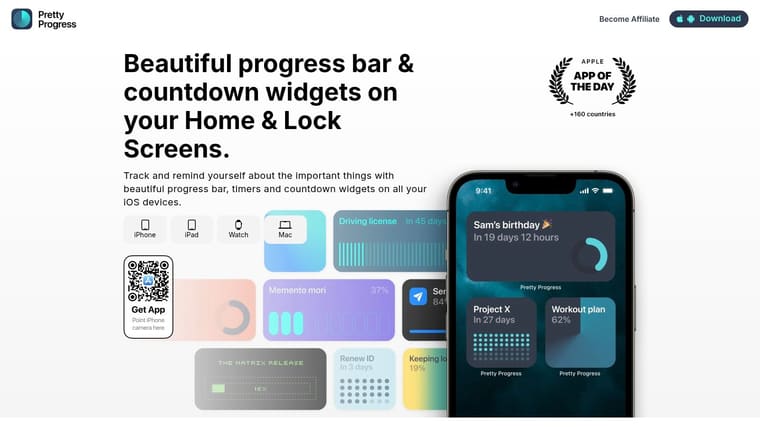
Practical rule: If you can see the rep, you’re more likely to repeat it.
Tracking gives the practice a record. It turns vague effort into visible evidence, and visible evidence is easier to trust on the days when mood tries to rewrite the story.
If you want a clean way to keep your 30-day mindset reps visible, trackable, and hard to ignore, set up a progress bar or countdown that stays on your screen using the tool you configured earlier. Use it to mark each daily drill, keep your focus on the next rep, and make the habit feel concrete instead of theoretical.